I was out in Hampshire earlier today and travelled through Farnborough Station, not known as a hot bed of socialism. One stalwart comrade was handing out leaflets calling for a Labour vote on the back of the renationalisation promise. Last time I saw Labour leafleting places like this was 1997. Is something happening? …
Manifesto bingo, digital liberty and the internet
I have had a look at the manifestos and see what they have to say on the internet and Digital Liberty. I have been very influenced by the EDRi voting exchange and summarise the issues of Digital Liberty as e-citizenship, equality before the law, privacy and copyright reform, to which for this election we must add internet governance and industrial & innovation policy. I have created a table summarising the positions of the Tories, Labour, LibDems and Greens. Possibly I should have analysed the SNP manifesto since much of this is Westmister reserved powers. I was hoping to write something easy and quick to read. I don’t think I have succeeded. My super summary is in the figure immediately below, and here is the table I built to help me write this article. (I lost the excel file, so this will have to do!) My main source was the ORG pages but I have been reading the Labour Manifesto also. I feel that the opposition parties have suffered from the surprise; they probably expected more time to develop their promises. All three opposition parties 2015 manifestos covered these issues in more depth. …
Co-ops
In the 21st century, are joint stock companies the best form of corporate governance. There’s a lot of justice in arguing for either worker or consumer co-ops. The arguments for consumer co-ops being the dominate form of governance in financial services seem overwhelming to me. Thatcher of course created laws where the previous generation of mutual’s de-mutualised; they have since been bought by banks and in several cases caused them fatal damage. …
Compensation
Nationalisation without compensation, remember the eighties. It’s a bit trickier now since Thatcher privatised the pension funds; we don’t know who owns these companies now. …
Labour’s Magic Money Tree
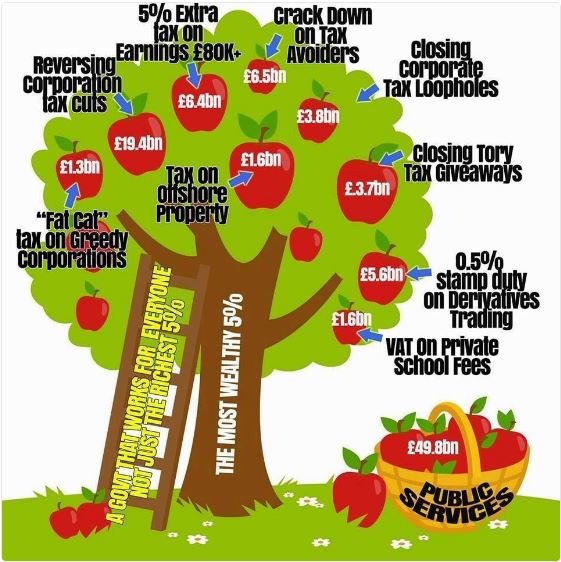
I rather like this …. and it doesn’t talk about the growth in GDP and the consequent increase in tax revenue. …
Borrowing
The Tories have resurrected the phrase the magic money tree which has been commented on by me, and Edward Snowden. But for the thick, Damien Green, that’s you that is, here’s how the financial markets work and how Labour will pay for those nationalisations that require compensation.
They borrow a wodge of money at the current rate about 1% for say 25 years, and buy some companies currently returning 5% (or more) ROI.
When I was doing sums at school, 4% is higher than 1%. Perhaps we should buy some more stuff because it’s such a good deal. …
Student Debt
The Independent and the Canary both report that not only will Labour abolish Higher Education tuition fees, and reintroduce grants but will also consider how to give some form of relief on the current debt already held by students. This is about £76 bn, which is quite a bit, but if you consider it an investment in the nation’s human capital, it’s something that is worth borrowing for and can be paid through the capital borrowing account. …
Money Tree
There is a magic money tree, or at least shrubs ….
 …
…
Guesswork
The Register has published it’s take on the polls and the election. It’s probably a balanced view, quoting Nate Silver as needing to be suspicious of outliers e.g. YouGov. They do take a guess, ranging from a hung parliament, to a 50 vote majority. They also point at Electoral Calculus’s prediction tool, which is not as pretty as the old BBC one but fun. …
Debate
I watched the debate last night. I think Rudd was brave but it was always going to be a tough sell and Craig Murray can’t have helped her by writing his own pen picture of her, detailing her wealth, her attempts to hide it and contempt for the poor, a point exposed by Jeremy Corbyn’s question about if she’d visited a food bank. In my opinion, it did the Tories no good, and Angus Robertson (SNP) & Caroline Lucas (Green) came out of it well. Jeremy held his own. …