I have been researching an as yet unpublished blog article on New Labour’s governments and looked for and found Labour’s 2001 Manifesto, which was published and given a mandate between Blair’s first and second terms. I used diigo to capture my notes, but a single entry cannot be linked to (or I don’t know how to do it). So this, below/overleaf is what I captured. … …
Au Revior/Auf Weidersehen
It’s done.
What a moment - the UK flag has just been taken down at the EU Council building in Brussels pic.twitter.com/EzvGwwzM1Z
— Andrew Connell (@andrewiconnell) January 31, 2020
Dignity and respect at work
I was writing a motion for GMB Congress on Bullying and came across this, from one of the ACAS codes, as part of the definition,
Everyone should be treated with dignity and respect at work
I thought that maybe there’s a human rights dimension so went to check out the European Convention on Human Rights since we are losing the EU’s Charter of Fundamental Rights which does include it. Nope! ECHR doesn’t! Well done! …
1917
I have just seen 1917; I quite liked it, it was made for me by the speech from Benedict Cumberbatch as Colonel MacKenzie. We had been set up to expect an act of monumental stupidity, an expectation reinforced by just having re-watched Generation Kill, but we got something quite different. I was also reminded, a bit, of the Odyessy via “Oh Brother, where art thou?”
 …
…
Leadership candidates and their MP nominators

Who nominated who for the Labour leadership? This can be seen at https://drive.google.com/file/d/1WpGM2EJ3_d6JVk17Jbr2UOKSayHhWx3L/view?usp=sharingthis page on the Labour Party’s web site. I have made a .pdf mirror today, and hope to make one on the 16th, the closing day, the LP’s stuff has a habit of going AWOL or is it just the Tories that do that. …
A question
To Labour’s Leadership/Deputy Leadership candidates: What confidence can you give us that you will put a stop to the toxic culture of bullying & slander that comes from many parts of the factional disputes, often covered up, as shown most dramatically by Bex Bailey, by Labour Party full-timers, who in some cases act with impunity in breach of the law and the rules? …
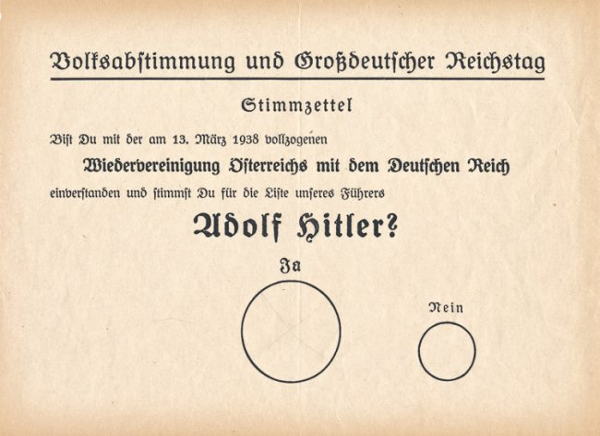
Vote Yes
This is an image of the ballot paper used in the Nazi run Anchluss referendum; can’t think what made me check it out!
 …
…
Seasons Greetings

Here’s a robin! …
Needs updating
One of the small side effects of the General Election is I need to revise the charts in my articles, Too Long , which analysed the longevity of service of the PLP and “PMs & Coronations“, which looked to see if becoming a party leader in opposition and winning an election differed in terms of success to being appointed mid parliament. …
Life continues
The noise about Ubuntu Linux has increased over the last couple of days, much of it critical. I have been aware that the Open Source militants have for a long time had a down on it and Canonical for bundling proprietary software with the distro (coadecs and now graphic card drivers) and they have taken some odd diversions in their path to today ( Amazon Search Bar, I am talking about you), but it has a a commitment to a usable free desktop and server operating system and it’s not owned by a proprietary software company and is not a competitive weapon in the systems market, unlike say Red Hat who “own” Fedora, RHEL and Centos. The industrialisation of Red Hat was funded by IBM as a competitive weapon against Solaris and HP/UX and who now own it and offer it as their O/S of choice for their Intel servers. At a meeting I attended, Richard Stallman expressed his tests as: does it do surveillance, doe it have restrictions (against the four freedoms) and does it have backdoors and documents his then use of GNewSense, a Debian derivative. He also argued, correctly, that one can’t know if the software is free of these defects unless one can read the code. I wonder how many of these Linux distributions meet these tests today?
My review of the meeting might be worth having another look at, unlike some of what I write, it has aged well. …