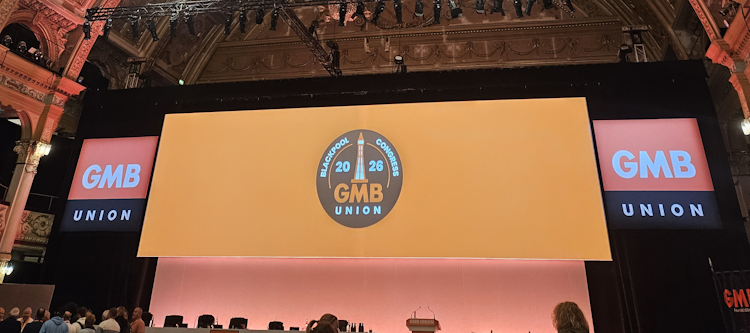
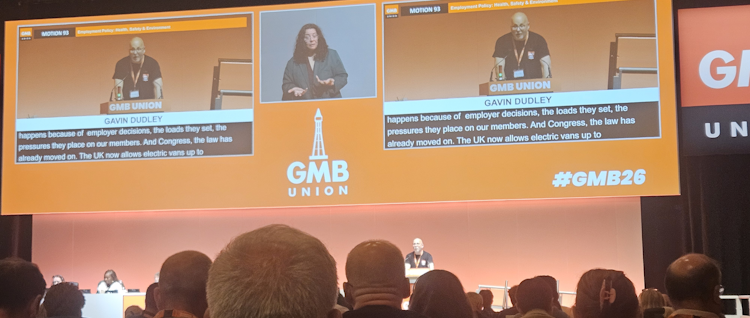
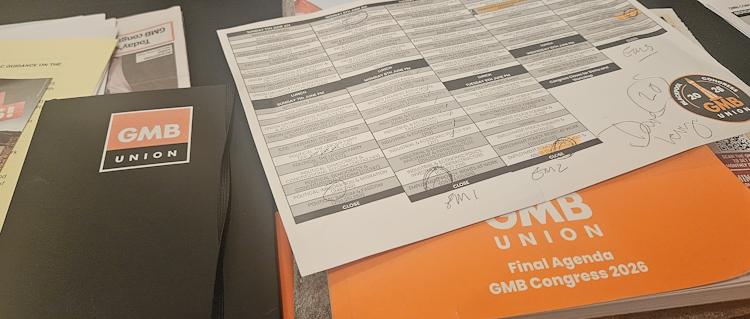
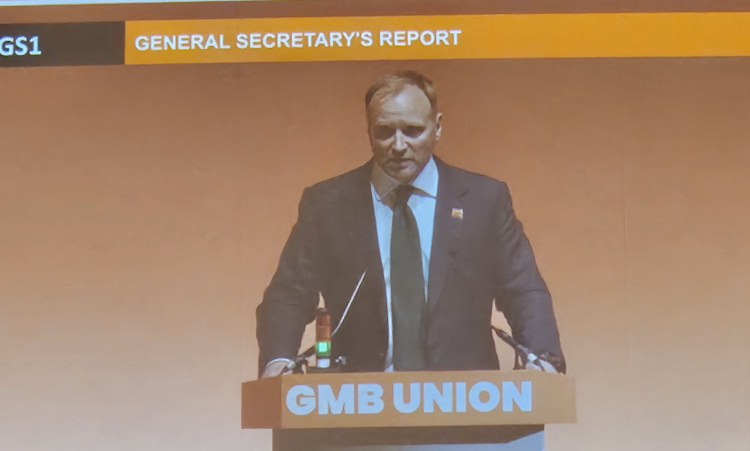
I have just finished my write up of GMB Congress 26, held in Blackpool and you can find the long form report on my blog, tagged GMB26.
Please note that this report has taken far too long to produce, for which I apologise and I have backdated the articles to near the date of occurrence. The first article in the series, points at the GMB’s congress document file folder, which will help follow the report …
And I travelled home. My thoughts about the congress as an ordinary member of the London Region delegation is that it was a strong and and articulate delegation well rooted in strong large branches, for once the count of first time delegates represents something powerful about growth. .Unusually the CEC was overturned several times which is unusual; let’s hope they learn. The London Region’s AI fringe was good, with good speakers; people want to do something and given we have policy that this is an organising problem I hope we develop a meaningful action plan.
It was Sonya Davies’ first conference in the chair.
There were a large number of Emergency Motions tabled. The key rules are that it relates to an event occurring after the closing date for motions which is the end of January.
In this blog post, I identify what I consider the important emergency motions, two because they are important statements of policy and one because it managed o raise an issue nearly 50 years old. This is an important issue to me as I sought to get an Emergency Motion tabled on the basis of an event two months old and was told that it wasn’t an emergency.
EM6 dealt with the scandal of the forced adoptions for single mothers that occurred in between 1949 and the eighties. The issue had become live due to a Parliamentary Education Select Committee where the Government had raised the issue of an apology. The debate is on the feed, and I have posted the motion to this blog.
The new guidance is discriminatory, unworkable and effectively excludes trans, non binary and gender diverse people from swathes of public life including working life the Lords. The law must be changed.
The motion notes that the law not only oppresses trans people but also places a duty on managers and workers that may breach their free speech rights. It also noted that the advice becomes law after a scrutiny period and called for action to oppose its passage in Parliament. The debate is on the video feed.
On the 9th June, riots broke out in Northern Ireland where the victims/targets were immigrants. Further protests occurred in Glasgow, Scotland and Southampton. At Congress, one of the delegates present made a fabulous and well received speech expressing the Union’s intolerance of racial hatred and solidarity with the communities effected. (I am looking for the video feed URL). We also debated an Emergency Motion, the text of which is on this blog. A critical quote is,
We say no to racism, we say no to violence incited by those who do not live in or care a one bit for our communities.
Due to the high number of EM’s neither the agenda document nor the time tables were amended, and at the time of posting there was no single document containing the emergency motions. I hope to take better notes next year if fortunate enough to be elected a delegate. I have obtained a copy of the emergency motions. …
My branch proposed M262, on IMPRISONMENT FOR PUBLIC PROTECTION.
The motion says,
Imprisonment for public protection (IPP) sentences were introduced in 2005 and abolished in 2012. The application of this law was not backdated, so thousands are still behind bars indefinitely. Those released live with the threat of a return to indefinite incarceration for misdemeanour offences or more concerning if a relapse in their mental health proves a perceived risk to the public.
Without adequate access to rehabilitation and in the latter case denial of care provision in the most appropriate place (hospital than prison), The European Court of human rights ruled in 2012 that this practice violated of human rights under Article 5. It is time this practice decried by the United Nations as “inhumane” was ended.
We call upon the Government to:
1. Prioritise the review, and re-sentencing of all prisoners currently under an IPP, noting that around 70% have served 10 years more than the sentencing tariff.
2. Take all reasonable steps to ensure that prisoners under an IPP have access to adequate support and appropriate healthcare provision to reduce their risk to the public allowing safe release.
3. Allow urgent re-sentencing and risk assessment of those for whom the continuation of the IPP sentence has been deemed by a medical professional to be a specific barrier to the delivery of effective health care provision and recovery.
I have always attended the finance department fringes if attending Congress as a delegate but this article reflects on the debate on Congress floor, dealing with rep expenses, subscriptions and the annual accounts.
This year the income and expenditure statement shows a small surplus, but I was pointed to the growth in net assets, in particular cash balances. I need to read the report more thoroughly.
The debate consisted of a series of motions, including two “Emergency Motions”, both of which were on rep. expenses. The ordinary motions were on access to digital tools (M43), the funding of GMB presence at the Tolpuddle festival (M44) and on legal support and roles M45. These are on pp49-50 of the Final Agenda. The motions on expenses, EM10 & EM11 were not available to me at the time of writing, despite being nearly three months after the event. They were both about increasing the rates of subsistence and pay for reps.
On the state of the Union’s finances, the real operating surplus was £401k, which represents a slight drop in value on £74½ m turnover, itself up by £5m.
The cash held figure is up by £4.1m, with total net assets up to £133m by £17m. It is these numbers rather than the operating surplus which allow the leadership to claim such a rude health. This positive report is caused by ending the special pension fund payments of £10m p.a. They also claim that the fund is now very healthy, so I hope for a reduction in employer contributions next year. On the positive side, the Union has been earning through the resolution of legally managed equal pay disputes, but they may also need to reserve against a Unionline fraud which Is being investigated by the police.
The CEC recommend a member’s subscription freeze.
During the debate, one of the speakers called for the restoration of the branch remittance to 10%. Branch expense is up, but down from 2021 when it was £6½m. It would seem that the cut in branch remittance has not saved what they expected.
After the Congress ended, I was pointed at the Union’s AR21, which showed that the GS salary has increased, from £166k to £176k. CEC honouraria expense, excluding the President and Vice President, has fallen, 19 of 55 ordinary executive members of the GMB CEC were paid a sum total of £144k ranging from £1,000 to £16K. I must remember to look at the AR21, if available, before Congress next year. Only the AR21 reports on the leadership costs. …
I seconded a motion on the use of Twitter/X, the motion criticised the seeming scofflaw approach by twitter/x and called for protection for workers who wished to avoid it and called for the GMB to further restrict its use of the platform and to also call for employers to withdraw also. The article, posts the words of the motion, my speech and links to the video. It also noted that it was opposed. For the complete article, use the "Read More" button.
Congress was addressed by John Healey MP, the Secretary oi State for Defence, I looked for the text of the speech on Labour and the gov.uk site, but could not find it. It was however reported in the Morning Star and at the BBC, also Google AI perspectives says,
“John Healey MP used his speech at the GMB Union Congress in June 2026 to announce plans to unashamedly prioritize British companies and jobs in future defence spending.
This speech, like the whole conference was published on the GMB video feed. Possibly the key push within the new plans is that by prioritising British firms, they claim the money works twice, firstly by buying weapons to secure the UK, but secondly by investing in UK industries and workers. There are some who argue that defence investment is a dead investment as there is no, or little, investment multiplier effect, but they can’t argue that there is no multiplier effect from spend on labour costs. Actually the idea that defence industry investment has no civil multiplier effect seems to be extraordinarily weak.
Healey name checked the defence factories that the GMB organises and of course, defended the need for Trident, and rather strangely, declared the desire to see the Union Jack on top of every weapon. (Very Dr. Strangelove). This strange patriotism avoids talking about the UK’s dependence on US arms industry and the current unreliability of the United States as a provider; it also may make co-operation with Europe and the EU member states more difficult as the UK’s failure to join the EU SAFE programme, and the continued conversations about the EU’s industrial accelerator Act, aka the “Made in Europe” proposals shows.
What this hubris also fails to address is that developing some of these weapons is now beyond the UK alone, we need allies and that today involves a choice.
The debate on Employment Rights, started the day, and dealt with Composite 6 and motions 104-6 pp 73-74 in the final agenda document. The debate is published on youtube. I have clipped the whole debate so that you can see/hear the CEC reply to all four motions.
Composite 6 Employment rights bill is on pp163-164 of the final agenda document. It argues that the compromises necessary to secure passage of the ERA were needed and necessary reforms and that further legislation is needed. Below/Overleaf are my speech notes and links to the motion texts. I also comment on two important topics, bullying and 3rd party removals. …
Congress then considered its policy on the Water industry. This took place in two debates.
The first was on a composite motion, C13 p169 in the final agenda document, entitled, “Public interest environmental reporting, GMB seat on new water super regulator, and trade union representation on water company boards. “
To me the purpose of the motion, is well summed up as follows, when decisions are taken behind closed doors, accountability & transparency suffer! This debate was followed by a guest speech by Fergal Sharkey.
…
Later in the day, we debated, M222, p122 in the final agenda document, 222. Proposal to design oil and gas exploration contracts in the UK for the benefit of British citizen .
This argues for nationalisation and/or the adoption of the Norwegian model,
When people criticise motions on trivial grounds, which I am about to do, I often claim we are not writing legislation, that he direction of policy is good enough, which is so for this motion. The motion does not recognise that Norway has a special petroleum industry tax, and that it also acquires value through its state ownership of the industry and its supply chain, but writing and designing fallback positions is very difficult. Zak Kahn’s moving speech is very good. The debate is published on the video stream, and since the CEC supported the motion, I have clipped the moving and seconding speeches.
There followed a debate on investment and infrastructure, which was well informed, arguing to protect farm land, yet reinvest in manufacturing, I fear we’ve missed the boat on renewable energy as a manufacturing competitive advantage, the failure of the giga factory and the windmill company. Google AI perspectives tells me, “The United Kingdom is a global leader in renewable energy generation and deployment—particularly in offshore wind—but lags significantly behind major global competitors in domestic manufacturing of clean tech hardware.” I also fear that we are starving the universities and the NHS of research funding, so it’s unlikely that the next technological breakthrough will occur within the UK. Greater access to Horizon Europe would of course help in the development of ideas on which growth can be built. (The more I examine the question of industrial policy, the more I can see the damage that the Tories did to the UK’s productive capability. Brexit of course is one culprit, but their refusal to engage in an active industrial policy is another, illustrated by permitting the further collapse of British steel and as identified elsewhere within this report the ceramics industry. ) …
Current Congress policy is recorded in the GMB’s policy book and the key differences between GMB policy and the more radical campaigners is that it wants to see the new jobs before the old systems are turned off, their goal is 2050, they support nuclear power and retaining gas as a source of consumer energy. Importantly the GMB wants to see the energy companies renationalised. The union still has policy supporting fracking and to issue more drilling licences in the North Sea.
The motions debated were M293 and 294 available in the final agenda document, also here, and the debate is recorded on the video stream. I congratulate Val Brooks moving M295 for her speech. Both motions call for the development of campaigning coalitions and for member education. They are both steps away from the hard luddism of some elements of the GMB. There may be room for hope because the big problem with the GMB policy is that given a choice between jobs & members and net-zero, GMB’s leaders choose jobs. They show little understanding that “Just Transition” is two words.
For procedural reasons, I only have the CEC comment/qualification on M294, they say,
The CEC is seeking to refer this motion to explore further working with our worker-led Workers Power the Future campaign and Climate Jobs UK, which is a coalition of trade unions representing tens of thousands of energy workers, campaigning for a jobs-first clean energy transition that delivers high-paid, high-skilled work here in the UK.
The CEC does not agree with the motion’s assertion that GMB has “failed to identify and articulate broader long-term interests of workers and how jobs can be sustainable” given our longstanding work with the above two initiatives which has been precisely to empower our members to have their say over the nature and type of work that they do and play a role in determining the future of their industry.
It remains GMB’s belief that our belief that there are paths for all the GMB-organised industries to play their part in meeting the net-zero emissions target. It must be recognised however that some industries will always be difficult to decarbonise, and while every effort should be made to achieve carbon reductions within individual industries, it is the overall balance across the UK that counts. Any decarbonisation plans should also be subject to full and genuine consultation with the workers who are most affected by industrial change.
I have never heard of the two campaigns and agree with the motion that the GMB has failed to identify and articulate broader long-term interests of workers and how jobs can be sustainable. Given the choice between renewables and legacy energy systems, GMB chooses the latter, the phrase, “it is the overall balance across the UK that counts”, is basically code for agreeing to keep dirty energy systems running. The good news is that this is being questioned by members and delegates
It’s a difficult problem for the GMB, I hope it finds a way to do the right thing by the rest of the country. …
This website uses cookies to improve your experience. We'll assume you're ok with this, but you can opt-out if you wish.AcceptRead More
Privacy & Cookies Policy
Privacy Overview
This website uses cookies to improve your experience while you navigate through the website. Out of these, the cookies that are categorized as necessary are stored on your browser as they are essential for the working of basic functionalities of the website. We also use third-party cookies that help us analyze and understand how you use this website. These cookies will be stored in your browser only with your consent. You also have the option to opt-out of these cookies. But opting out of some of these cookies may affect your browsing experience.
Necessary cookies are absolutely essential for the website to function properly. This category only includes cookies that ensures basic functionalities and security features of the website. These cookies do not store any personal information.
Any cookies that may not be particularly necessary for the website to function and is used specifically to collect user personal data via analytics, ads, other embedded contents are termed as non-necessary cookies. It is mandatory to procure user consent prior to running these cookies on your website.