After Makerfield, what next?

Is winning in Makerfield a new dawn for Labour, or just that this time, voters chose Labour as the “Not Farage” candidate. Since they won in Runcorn & Helsby, Reform have failed in Caerphilly, Gorton and Denton, and now Makerfield, losing to Plaid Cymru, the Greens and now to Labour. It was a great victory for Burnham and Labour, but the question has to be asked together with has Labour learnt the lesson that to fight Reform, you need to fight it. (I think not!)
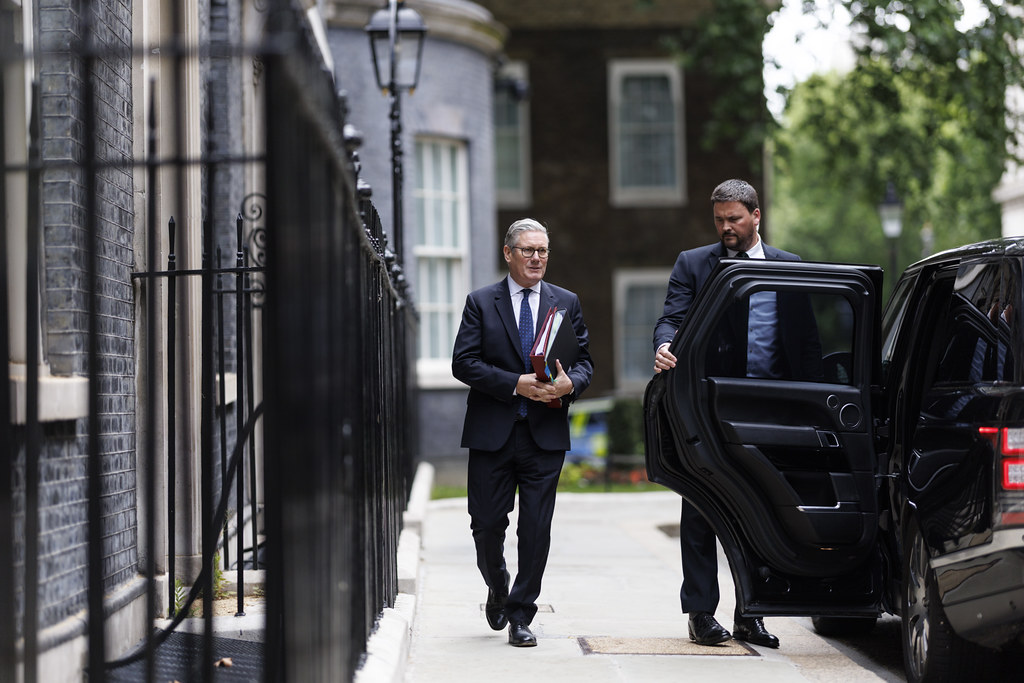
Source: No10@flickr 10th June 2026 CC 2026 BY-ND-NC

Having returned to the House of Commons, Burnham has forced Keir Starmer to resign and a time table for a Party leadership election has been declared.

Much has been written about why he had to go; I have been calling for it since February when the likely defeats in Scotland and Wales became obvious. On the day, Labour also lost three more London Councils.

Starmer’s resignation speech starts in the same way as his election campaign to be leader of the Labour Party, with lies. When Starmer inherited the Labour Party, it was in the strongest financial position it had been for decades and anyone who has closely read the Forde report and the EHRC report knows there is still work to do to eliminate racism from the Labour Party. The focus on macroeconomic statistics repeats the mistakes that Biden made. While I do not subscribe to the meme that “perception is reality”, perhaps it is truer in politics than in engineering. Claiming the credit for growth doesn’t work if income equality remains at the current miserable level and if the growth in the economy goes into the pockets of a few. If people don’t feel better off, then it’s pointless claiming they should. It’s also difficult to understand, how Starmer can claim credit for the abolition of the two child benefit cap when he initially suspended seven MPs for voting for that abolition.

Much has been written about Starmer’s weaknesses as a politician and Prime Minister. For a lot more words you can check out Jonathan Freedland in the Guardian, who focuses on personality and the politics of Downing St., and fails to mention Gaza and the Middle East, and alternatively, Phil Burton Cartledge, who does mention them, together with the dishonesty of his mandate within the Party. Phil also repeats his accusation that Starmer and McSweeney deliberately sought to break up Corbyn’s electoral coalition.

 Although some would seek to claim he’s been good on the world stage; this does need to be contrasted with his speeches and actions on Gaza, which is one of the primary causes for Labour’s loss of political support. Labour started the general election campaign with a poll score of 44%, finished with a vote of 34% which has since  collapsed to a score in the high teens.
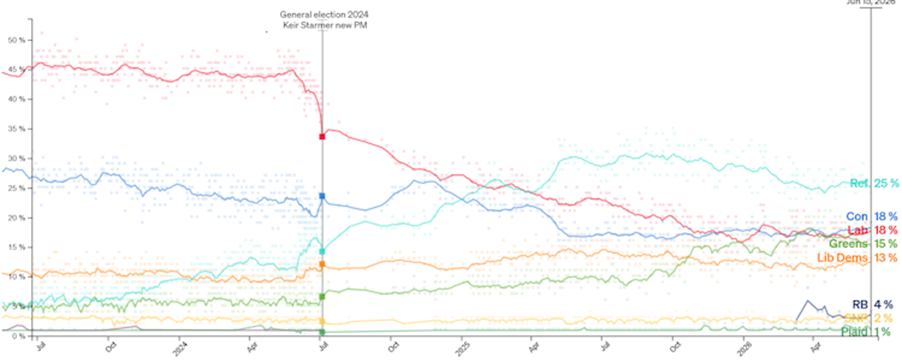
Source: politico.eu – British polls 24 June 2026

It is expected that Burnham will be crowned as Labour’s new leader. If so he will be beholden to the fixers and not the membership and his retreats from his beliefs in order to win Makerfield are worrying because Labour and the country need a change of direction not a change of personnel.

The new leader also needs to turn Labour’s democracy back on. It is clear from the ending of Blair’s New Labour government that this Government and Labour leadership have run out intellectual steam; the Party needs debate and new ideas to sustain its relevance and energy.  We can also see by observing the last two years of the PLP what happens when MPs fear their whip more than their members and voters.

Clive Lewis, in an article entitled, ‘After Burnham’s Win in Makerfield, the Answer Cannot be Managerial Politics with a Different Accent’, speaks for me, when he says,

“Climate breakdown, war, energy insecurity, financial shocks, technological upheaval, and democratic decay are here. They will not wait for Labour to finish its management seminar.”
 …

A question

To Labour’s Leadership/Deputy Leadership candidates: What confidence can you give us that you will put a stop to the toxic culture of bullying & slander that comes from many parts of the factional disputes, often covered up, as shown most dramatically by Bex Bailey, by Labour Party full-timers, who in some cases act with impunity in breach of the law and the rules? …

The Trade Union Gateway

Sadly, Clive Lewis didn’t make it onto the Labour Leadership ballot paper, and we move onto the next stage. The candidates now need support from the affiliates or from 33 CLPs.

The affiliates rule is,

At least 3 affiliates (at least 2 of which shall be trade union affiliates) compromising 5 per cent of affiliated membership

Some of them, LIsa Nandy, Emily Thornbury and Jess Phillips, I am talking about you, will have some difficulty reaching this threshold, there are now only 12 Unions affiliated, six of which are above 5%. …

Democracy for the many

The CLPD has considered for several years the vulnerability to the Left should there be another Leadership election in which the incumbent, Jeremy Corbyn was not able to stand.

The Democracy Review proposed changing the nomination threshold for Leader/Deputy Leader by  reducing the number of PLP/EPLP nominations and introducing effective nominations for affiliates and CLPs. The NEC in its pre-conference meetings rejected the Democracy Review proposal and reduced the PLP threshold to 10% while introducing  additional effective nominations from CLPs and affiliates. Many on the Left think the 10% threshold is too high for a true believer to be on the ballot paper.

Given that the Rule on Leadership nominations, Chapter 4, Clause II.2.B.i.  was changed at Conference 2018, Rule changes to this rule proposed by CLPs and affiliates may not be debated at the next three conferences. R3.III.1.H.

Some people in the CLPD came up with a cunning plan, since the number of motions was to be increased, the Left should use one of its motions to mandate the NEC to bring a rule change to the leadership nomination threshold to Conference 2020. See here.

Max Shanley, partly motivated by the anger felt at Tom Watson has proposed another motion in a similar vein. It is printed in full at the Skwawkbox.

The difference between the two motions are that Shanley’s motion removes the MPs from the nomination process altogether and brings forward the mandate to produce a rule change to this year from the CLPD’s 2020 time-line.

Both these will probably mean that the Unions will vote against it or stitch it up; the work to win the Unions to this has not been done. This was shown last year where the Unions via their reps on the NEC and their votes on Conference floor voted against open selection, against repeal of the three-year rule, and for the current Leadership nomination threshold. i.e. it was the Union votes on the NEC that voted to keep the MPs at 10% of the nomination qualification.

If these two motions are submitted to Conference and if they get through the Union dominated CAC, they may be grouped as a single topic and then subject to a composite meeting. Getting it through the CAC will not be simple as the NEC (or the Office) have been working mightily to keep organisational motions off the Women’s Conference agenda.

I suppose my fear is that the proposal to eliminate MPs from the nomination process will attract the notice and opposition of the Unions who will use their majority on the CAC to bury both.

I would think very carefully before supporting Shanley’s proposal.

Whatever you do on this issue though, you should seek mandates to support the abolition of the 3 year rule which to my knowledge will be on the order paper; you should seek to mandate your Union delegations as well as this will require Union votes to win. …

Power in Momentum I

I have been preparing a little blog article on “Power in Momentum” which has been overtaken by yesterday’s decision by the “Officers” of Momentum to withdraw support from Pete Willsman as a candidate for Labour’s NEC. The article, among other issues, examined the power structures and came to conclusion that with the exception of the powers allocated to OMOV ballots, for which the rules mandated IT still does not exist, every decision and power is granted to the National Co-ordinating Group which meets in secret, doesn’t publish it decisions or its membership and has unlimited delegation powers although it doesn’t publish its instruments of delegation either. (I begin to question if it is genuinely a membership organisation.) One has to wonder why they decided to delegate the decision to the Officers rather than the Chair alone, but it’s a sign of hope that they couldn’t trust the whole NCG even after they purged the remainder of the democratic opposition in the last round of elections.

I have already voted for the #JC9 but do not consider Pete Willsman’s comments to be anti-semitic, and I am not alone, and consider that the Left needs all nine of its slate to be elected. I would urge anyone that has not yet voted that supports the Corbyn leadership to vote for all of the #JC9. …

Electing Labour’s Leader

My submission to the Democracy Review on Electing the Leader.

Required nominations in the case of a vacancy should be set so that the electorate are given a choice. It should be noted that the higher the threshold required within the PLP, the more likely pressure for reselection will be in cases where MPs no longer represent the views of their membership.

On electing our leader, the Leader should be elected by individual ballot, of individual members, affiliate members and registered supporters.

Registered supporters should be asked to renew their commitment annually (and undergo the same checks that are used for people to become members), charged no more than of the order of £5 per year and be able to attend (but not vote during) branch meetings. If Toby Young seeks to become a registered supporter, we should refer it to the Police for fraud.

Freeze dates for all elections for internal office should be decided according to administrative feasibility. i.e. days or weeks, not the 6 months used in the 2016 leadership elections. …

Labour’s coming leadership election

Labour’s coming leadership election

I was hoping to write a piece on a response to the “Leave”vote and a response to the Chakrabarti Inquiry but Ann Black of Labour’s NEC in a circular wrote and asked what her maillist thought of the shenanigans. I had to reply and decided to share it with you all. She stated she planned to vote to include Jeremy on the ballot paper, which I support but asked for opinion on if there should be a freeze date for inclusion on the electoral roll and what to do about registered supporters. I argue to include all members, including those that have just joined in the ballot for Leader. I also argue that the Party should offer its supporters an opportunity to register and join in the ballot. I also commented that the collapse of the National Policy Forum is an opportunity. …