On defence sovereignty

a missile being launched from underwater by AI

James Schneider is in the ‘Statesman writing on Defence. This article is published with a tag line of, “Military insiders are trying to bully the government into dependency on an erratic United States”. I comment on the his arguments, and look at views expressed by other military commentators as to the sense of the UK’s US centric procurement policies and look at Kaldor and Cooper’s paper arguing that social resilience is a defence policy too.

Schneider argues correctly, but not with originality, that expenditure targets are not a strategy. A strategy must consider purpose, weapons and their source. He points out that George Robertson, a recent critic of the financial targets, is connected to and a long time supporter of the US Military Industrial complex. While Defence Secretary, he established the now bi-partisan position that the UK would develop an expeditionary capability designed to work in the context of “allies” i.e. a US led NATO. Robertson then went on to serve as NATO’s General Secretary. His criticisms of the Labour Government’s defence policies and appetite to fund them is repeated in an article in the Spectator written by John Foreman, who was formerly Britain’s defence attaché in Moscow and before that, Britain’s defence attaché in Kyiv.

The problem is that under Trump, the US is clearly an unreliable ally to the UK & Europe.

This opinion is the major assumption in Kaldor & Cooper’s paper, Organised Irresponsibility, where they argue that the Strategic Defence Review, is based on the assumption that NATO is the cornerstone of UK defence policy and that it double down on using the US as its major supplier focusing on expensive weapon systems which have been shown to be extremely vulnerable in Ukraine.

Does the reliance in US weapons systems and infrastructure jeopardise the UK’s defence capability. Schneider questions the availability of both the F35s, used on the aircraft carriers and for European operations and that of the nuclear deterrent. Further evidence is obliquely provided by Perun, an open source intelligence commentator, in a video entitled, “Arming Europe Without US Weapons?“, where he suggests in his imaginary European military, by their omission, that the UK’s exquisite weapons are all too US dependent.

Kaldor and Cooper make two additional arguments. The first that the SDR’s arguments and the government adoption of buying more US weapons limits European Co-operation, and they sub-title their conclusion, “Welfare is Resilience”.

I was reminded at a seminar yesterday, that some defence thinkers are trying to prepare the UK for the view that modern wars are between societies and that everyone needs to contribute. The SDR recognises, and observing Ukraine’s resistance, shows that, yet again, modern wars are likely to be conducted by the whole of society. Additionally, the new cold war is conducted in the grey zone, to which the best defence is a well informed and committed society.

A country at the end of fourteen years of austerity, with a corrupt media, and a public social wage commitment the lowest in Europe is not going to support enhanced defence expenditure at the expense of increased wages and diminishing social security.  The second part of Robertson’s statement is that the welfare bill is too high and that It needs to be cut in order to fund defence; this was days before we discover that the HMG undershot its borrowing projections by £700m.

The UK can’t have an impoverished people and a well funded military, even if the current weapons procurement proposals made sense. A defence policy/strategy needs to be about purpose, then weapons and their cost. The country also needs that its population thinks its worth defending.

Social justice & equality are defence projects too. …

Starmer’s choice

I wrote something on JD Vance’s speech to the Munich security conference. This was part of the series of policy repositioning for the trump administration. My article was published on labour hub, in it I reference Vance’s speech to the Munich Security conference, i note the oligarch’s hypocritical and fascistic agenda, the foreshadowing of the crippling of NATO, and talk of the UK’s alternatives pointing out that we seem to be re-joining the EU one agency at a time.

The plum pudding in danger via wikipedia
The return of great power politics via wikipedia

I reference reports of J D Vance’s speech to the Munich security conference, where he criticised the EU and member state governments for suppressing free speech, failing to halt illegal migration and running in fear from voters’ true beliefs. He refused to meet the German Chancellor and yet met, during an election, with the leader of the far right AfD (Alternative for Germany).

I note his arguments on free speech are partisan; US oligarchs want American rich people’s voices to be heard and amplified by privately-owned social media companies and fear Europe’s regulation of them being based on a demand for truth. We also note the hypocrisy of the US free speech advocates’ attacks on ideas, books and teachers in schools, universities and libraries in the US. His comments on not relying on foreign technology providers by which he meant China, may come to haunt him as Europe examines its defence supply chains.  

Trump’s call for European NATO to increase their defence budgets to 5% of GDP is a naked attempt to build budgets for the US arms industry, just as the UK’s requests to have a side treaty on defence and security with the EU is also at least partially based on the economic interests of BAe.

Trump’s arguments about what does his money, that is, the arms shipments to Ukraine, buy, has a moral vacancy but it is clear that the view that ‘the business of America is business’ has returned to the White House. The crudity with which Trump pursues his views of US fiscal and commercial interests is echoed by the UK Labour Government in positioning its ‘EU reset’, arguing for changes in agreements which only benefit Britian from their limited, primarily electoral, point of view. 

In the Labour Hub article I suggest, the choices facing the Starmer administration are bleak while Starmer seems to be seeking to avoid Trump’s tariff increases, on defence the choice is stark. The UK can either continue to act as a vassal state of the United States or develop more effective partnerships with the European Union. It should be noted that Vance has questioned the need for NATO joint command. Labour’s foundational commitment to NATO, is looking weaker than it once was.

Starmer’s ambition on EU cooperation is limited, I have argued that the UK should use the withdrawal agreement review clauses to re-enter the customs union and the single market. The suspicion is that for the Starmer Administration, the single market is a step too far because of its requirements for a free movement of labour and Labour’s fear of the Tories and Reform UK.

Today’s military questions and the need for ‘security of supply’ strongly imply that the UK should join the European Space Agency and possibly the European defence agency.

The proposed military and security side treaty is looking less and less attractive to both sides because in order to protect our democracy against the attacks from US social media companies and US owned AI search engines, the UK needs the umbrella of the EU’s competition & digital regulators, this needs membership of the single market. We have already rejoined Horizon (the R&D programme) and the Euro HPC joint undertaking, and Northern Ireland is still part of the single market. At what point do we say, we need our MEPs, Judges, Commissioners and Council seats back or will we just be rejoining the EU an agency at a time. …

Munich 2025, peace in our time

Munich 2025, peace in our time

The last week has signified the death knell of NATO. The ninety minute phone call between Trump and Putin signifies the road to a 21st century Hitler Stalin pact. The Trump administration's proposals that the USA and Russia make peace in Ukraine without Ukraine being present at the table and mandating European NATO to provide peacekeeping forces are a return great power politics unrestrained by the rule of law. For more press the button ....

Labour & NATO

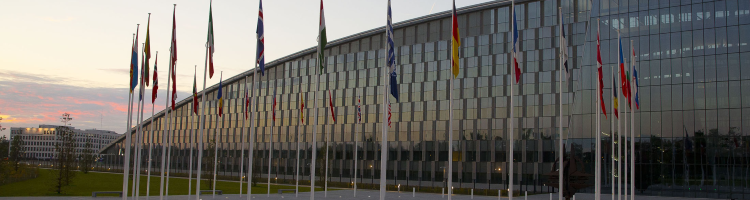
nato flag and badges

The Times ratchets up the argument in the Labour Party about NATO by repeating threats against those, including MPs, who take a more critical view of its history. A friend writes to me.

… it’s an interesting debate as to the role of NATO. The destruction of Libya and role in the Balkans doesn’t do wonders for its reputation. Yet I see Kier is concentrating on those MP’s who possibly question NATO’s role in conflict.

Haven’t we got more pressing priorities with this government both at home and abroad?

In my humble view the rhetoric of this government is very dangerous and upping the ante with Russia. Our leader needs to be urged to urge rapidly [that] Truss and Johnson to tone down their words of incitement.

We are an outlier in Europe after Brexit they are making us an outlier with our NATO partners.

This is not about opposing arming Ukraine or opposing NATO but opposing childish bellicose language from our Government to mask its other areas of scrutiny

Anonymous

It is a serious problem that Labour’s front bench seems more concerned with fighting it’s left wing, and not opposing the stupid, uber-military virtue signalling by this Government, led by a lazy man-child who if he has any sense of military strategy has learnt it from playing Risk. I think that the Tories’ boasting and grandstanding is unhelpful to the people of Ukraine and designed for home consumption but is in fact dangerous; it’s the Tories’ equivalent of ‘come on if you think you’re hard enough’. For the record, I believe that NATO is necessary, Russia’s invasion of Ukraine shows that. Finland & Sweden’s reaction is obvious and if they decide to join should be supported.  …

Does NATO have a useful future?

Does NATO have a useful future?

This was posted by Stephen Bush, in his morning mail; it’s part of a longer article and referred to the Nato Summit.

The big, unspoken agenda item is: what happens to Nato when the commitment of the United States to Article Five – that an attack on one Nato member is an attack against all – is up for grabs? Donald Trump’s betrayal of the Kurds shows you just how much consideration he will show to his allies, no matter how many times they might roll out their head of state for tea and cake.

Once the US commitment to Western Europe’s security was unquestioned, some might argue the price was high but France & Germany have resisted acting as proxies for the US; one can see clearly that while Macron is not necessarily acting in good faith, the EU as the sole organsation capable of speaking for Europe needs to consider its defence policies, expenditure and alliances. While there is no plans for an EU Army, it is planing to co-ordinate some design and expenditure programmes. …