 I moved into a new flat which had been empty earlier this year and am now being chased by ONS for a Census return. I was not living in, nor renting the flat on the Census date, their web site does not permit one to notify them of the fact the premises was vacant, and I have been visited by an agent of the ONS and informed them that the flat was vacant. NB I had already filled in Census forms about two other address It can’t be that these circumstances are rare, why is it so hard to tell them that the address was vacant, and more importantly, that this is nothing to do with me! …
Sour Grapes
It seems that #yes2av is #downthetoilet, but I was watching Twitter tonight and two tweets passed me by the first says,
“congratulations cameron, congratulations murdoch, your lies have denied the country a democracy. #yes2av #vote2011 #libdems #tories #labour”
and the second, which I can no longer find says something like
“Nick Clegg , you #fail HAHAHA etc….”
You get the idea. There is a very short term view here. I hope some of my Labour friends understand what they’ve done. It’s a huge mistake. First past the post is not democratic, it’s also not helpful to our cause. …
Fair Votes, honest and dishonest arguments
In summary, I believe
- MPs representing communities should have the support of the majority of their voters,
- AV may nationally exaggerate the size of popular majorities, but it is likely to constrain the power of unpopular minorities and this is a good thing,
- the choice of government should not be taken by a small number of swing voters in middle English constituencies, and I mean English,
- AV is harder to ‘game’, people will be able to vote for their first choice, it gives more people a reason to vote and we’ll all see the real attraction and support of each of the parties,
- AV means that more people’s vote will count,
- many MPs will need to appeal to more than their tribal support,
- the British system asks people to vote for an MP, not a government, the voting system should support this,
- ‘First Past the Post” is dying, we use other systems for the European parliament, executive mayors, the Greater London Authority and in Northern Ireland, it’s time to move on.
I shall be voting for AV today, it’s not my first choice, but its better than what we have, why don’t you join me?
 On issues of tribalism I was unhappy to receive a No2AV leaflet, with a picture similar to the one on the left. I have tried to scan the original to share with you, but my scanner isn’t good enough. Interesting that they have Cameron’s back to us. Are they hoping that Labour and other left wingers will forget that the coalition is Tory led by the simple ruse of having him turn his back on us?. (It won’t be the last time!) The leaflet is decorated with text in UKIP’s Purple and Yellow. (Did they have some ink left over from the General Election?). The text suggests that we should oppose AV because of broken promises and back room deals, and that we, the voter, should punish the dishonest. It’s merely another attempt to keep the interests of the Tory party out of the debate. How stupid do they think we are? Why should we punish only Clegg and the Lib Dems for a deal they did with the Tories! Anyway, outside London we can punish them both in the local & national elections by voting against them.
The biggest lie is that the current system is in democracy’s interest. If you vote on the merits of fair voting, you’ll support change, otherwise you have a party agenda, and the Tory Party agenda at that. …
Reasons Labour should support AV
 Martin Kettle, in an article at Comment is Free, on the Guardian’s web site, called “Vote yes to AV if you want to see Tories feel the fear again” among other arguments says something I have been struggling to say. I don’t know if he is Labour Party member of supporter, but I am and so I have quoted it here, and hope that fellow Labour supporters consider it before voting next week. I also suggest you read the article in full. I am unsure if his focus on Labour and anti-coalition activists helps make the argument that AV is fairer than FPTP, but for those who won’t, or don’t want to consider the issues on their merits, but only in the context of the current Government’s longevity and programme he has some interesting things to say which you should read in full. He concludes the article saying,
“Labour still thinks short-term and tactically, not long-term and strategically. It is obsessed with the wrong target, with battering the Lib Dems, with punishing Clegg for the coalition and the cuts, and using those votes to propel itself back into an overall majority. The first part of that may well happen, starting with the local and devolved elections. The second part, though, is much less certain. It depends on breaking the coalition quickly and winning an early election. But that isn’t going to happen, even if AV goes down.
If everyone in Labour thought straight they would see there is a powerful argument for saying that the coalition will be more weakened by a yes vote than a no. If you want to weaken the coalition you want the Lib Dems to be bolder in standing up for themselves against the Conservatives on a range of policy issues. That is more likely with the security of AV, which favours the Lib Dems because it is fairer, under their belt.
You also, however, want to weaken Cameron’s standing in his own party and strengthen the influence of the more rightwing Tories to create mayhem. A yes vote would be a lightning rod for these angry Tories. That’s why, if you want to harm the coalition, vote yes to AV. If you want to make the British establishment fear Labour again, vote yes.”
I understand how, in particular many Londoners, who will not have a chance to use their vote may wish to vote in the referendum to punish the coalition partners but this isn’t a vote of confidence in the Government. Voting No won’t save the NHS or stop further privatisation, or reverse the cuts.
Use your vote in the referendum to change our politics, vote “Yes”, that’s what I shall be doing. …
What if we’d had a fairer voting system last May?
The New Statesman has a series called “Data Hound”, which appeals to me. Last/this week they ran an article on Voting Systems, which is not yet on the web. I thought it was quite good fun, so I have re-produced the graph here. They make the point that Alternate Vote, is not proportional, but that while “First Past the Post”, our current system, may exaggerate the victory of unpopular parties, “Alternate Vote” may exaggerate the victories of popular parties.
I argued earlier this week that there were principled reasons for supporting AV and I hope that most people will vote on the basis of principle and not on the basis of party advantage. So while examining the potential results of last May is fun, I am not sure it should be a major factor in making one’s mind up.
What the idea above does for my argument that we need to restrain the ‘elective dictatorships’, I am not sure, but below, is what the House of Commons would have looked like under “First Past the Post” FPTP, Alternative Vote AV or Single Transferable Vote STV, a more proportional system similar to that used in the European Parliament elections.
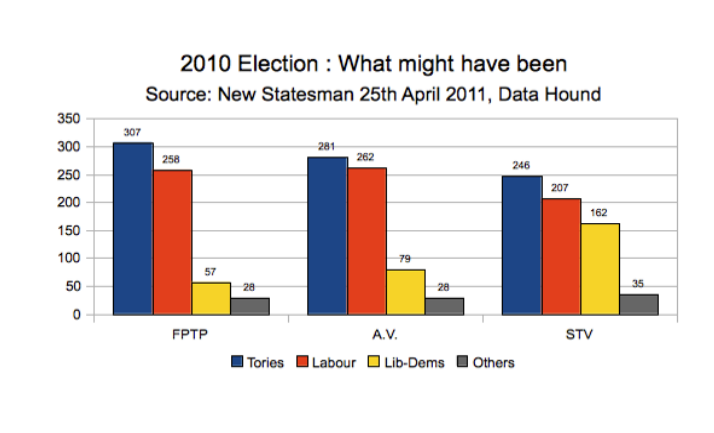
If the Liberals had had a choice, what would they have done?
In any event, I shall be voting Yes for fairer votes. …
Say Yes to AV
 I shall be saying Yes2AV next week, if I can get to a polling station, as I shall be working. It’s not much of an excuse, but its the last day of the working week and I shall be commuting back to Hampshire, particularly if I want to vote in the local authority elections.
I have finally made my mind up and believe that
- AV will allow people to state their first preferences, we’ll get true idea of the locus of political debate in the UK and its constituent countries and regions.
- its wrong that elections are decided by swing voters in about 50 seats,
- MPs should have the, at least, tacit support of the majority of their constituents, FPTP disenfranchises people who live in areas dominated by their opponents; they either have to vote for their 2nd preferences, not bother or just hope their vote counts in the total national scores. AV will give more people a reason to vote.
- I care more about stopping the ‘elective dictatorship’ of a single party government than I do about having a ‘firm’ government with a secure majority. Thatcher’s government didn’t listen to, well, anyone really and Blair’s majority isolated him from taking advice from his real friends and supporters, leading to tragic mistakes.
Finally it may have a liberating effect on political organisation and debate in this country; the tensions within the Parties may require them to ask their voters to help them resolve their debates creating new re-alignments.
It may be a ‘miserable little compromise’, but FPTP has been dying for years, its rarely used in civic society and we’ve been using more proportional systems in public elections more and more frequently, notably in the European Parliament, and in Northern Ireland. It’s not perfect, more proportional systems would be best but it’s better in my mind than the current system. …
Judicial Review of the Digital Economy Act
BT & Talk Talk, the two largest UK internet Service Providers (ISP) went to court towards the end of 2010 and the beginning of 2011 to obtain a judicial review of the Digital Economy Act, a law passed in the dying days of the last Labour Government. This law is designed to place duties on internet service providers to act on the instruction and on behalf of copyright holders and to authorise Web site blocking. On the 20th April, Mr. Justice Parker delivered his judgement.
This article is a personal summary of that ruling. The judgement is awfully hard to read and understand. I have an economics degree and nine years of Civil Service training! Actual quotes should be obvious, other representations are in my words, not those of the judgement. In some places I have got lost in the text of the judgement and while my summary is much shorter than the original, it remains pretty long. The impatient or easily satisfied can skip straight to the summary. …
A retrospective on the DE Act 2010
After campaigning against the Digital Economy Act, which had been passed in the parliamentary wash up, I wrote and presented on the subject to Brockley Labour; I recently found the slides and needed to move them from one storage location to another. The presentation is available, here, and called, The Digital Economy Bill.
The slides cover the parliamentary road to the Biil/ Act, big music & Hollywood’s strategies, what is the IP Law, & music industry economics, It’s actually quite long and was designed to be both educative and polemic. (Hollywood were less engaged in those days as the networks weren’t fat enough to carry movies).
This was recovered from a disk, posted in July 2020 and backdated to a time about when i wrote and made the presentation …
How not to extradite…
 So earlier today, UK Human Rights blog reported that the UK courts stated that Sweden’s application for the extradition of Julian Assange was valid and that he should be returned in custody to Sweden. I thought and hoped the case would hinge upon the fact that the Swedish prosecutors had not charged Assange and as such the UK would reject the extradition. The European Arrest Warrant should not be allowed, and I understood wasn’t permitted unless there is a case to answer in court. It seemed to me that it had been issued by the Prosecutor’s office in order to “help them with their inquiries”.
The UK’s ancient “Habeas Corpus” rights today ensure that people can only be held for a very short period of time before being charged, unless the courts permit longer due to terrorism concerns, the result of a shameful piece of legislation by the last Government.
I am not sure we should extradite anyone to permit questioning, i.e. we shouldn’t allow foreign police to go trawling for evidence in a way that we deny our own police.
So advice to Mark Stephens, “Stop fannying around about fitness for office, look at the case; are they ready to prosecute or not?”
I am afraid if they are, games up! …
Labour’s new front bench
Earlier today, Ed Miliband and Alan Johnson announced the latter’s resignation as Shadow Chancellor. Ed Balls has been moved from his Home Office position to replace him. The commentariat seem divided in their opinion with Labour’s friends welcoming an expert who’ll give Osbourne, the Tories and the Liberal Democrats an exceedingly hard time, and their enemies who are trying to re-start the feuds that emanated throughout the lifetime of the last Labour government.
I am excited that Labour’s finest economist is on the front bench and in a position to nail the tory lies
- the current crisis is a crisis of debt and not of unemployment
- the last crisis was a crisis of public finance, not banking solvency
- the Tory cuts are designed balance the books not to shrink the state
- we are all in this together
Those who hope that Balls will restart past feuds are wrong, he will not destroy the current state of unity of the Labour Party; and while he may have ambitions to run for Leader again, the big and obvious difference is that he has just lost a Leadership election. Things would need to change a lot for him to win one and he should know it.
Also the Labour Party, finally having been asked last summer, and having had a better general election than the leadership, has a renewed confidence to hold the leadership to account.
I am going to enjoy watching Balls take Osbourne apart. I hope he wipes that smug smile off his face. Watch the video below if you need to be reminded.
…