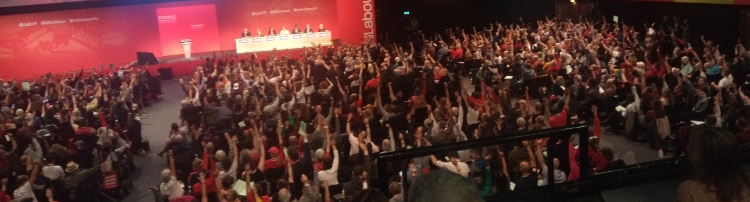
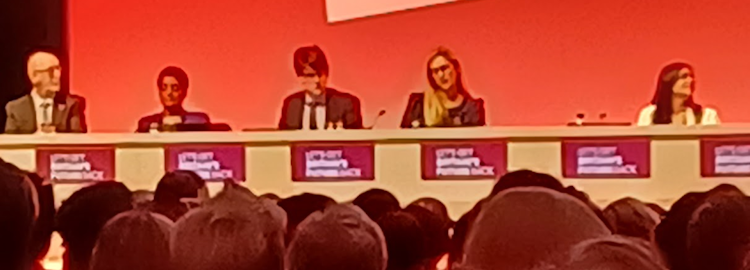
At the General Committee of Lewisham North last night we agreed to send a motion calling for the abolition of the two child benefit cap, and also proposed a reference back of the NPF report. I intiallly proposed the words in a blog article posted last week. This article repeats some of the text of the reference back and my notes for my moving speech, and right of reply, as it was opposed by both those who think that being outside the EU is a good thing, and those who fear Farage and think the time is wrong. For those details, read overleaf ...
This article looks at the development of Labour's Policy as its annual Conference approaches. It looks at the rules commitment to "voting in parts", and reproduces an NPF report reference back motion on the subject of the relationship with the EU that I shall take to my local party. My motion calls to rejoin the single market immediately and to promise to rejoin the EU in the next manifesto. To read the whole article, use the "Read More" button ...
This article is a summary, I say, over the last week, at GMB Congress, three reasons to rejoin the EU or at least the single market have, in my opinion, been exposed. These are the highlighting of the GDPR as defence against AI, the second is the new EU Pay transparency directive, together with the EU's AI Act. The full article is overleaf ...
It is my view that Starmer wants a Swiss style deal with the European Union. The reason I consider the summit to be a draw, albeit a score draw, is that neither of the end goals of rejoining nor staying out with a Swiss style agreement are closed off. But also, neither is the end result of the EU saying we’re too busy to spend this time “dot & comma-ing” with you.
There is no inexorability in rejoining from that agreement as I believe is implied by John Palmer’s Chartist piece. Perhaps, John believes that Trump will drive even Starmer away from NATO but I believe they will try very hard not to make the choice. In fact, I believe the proposal for a defence/security agreement is deliberately made to allow trade-offs against the single market acquis and to try to exclude security which includes border control co-operation from the Charter of Fundamental Rights and the EU Court of Justice’s jurisdiction.
I also believe much of Labour’s defence positioning is designed for internal party combat and learnt from simplistic board games.
Last week, the UK and the EU met at the most senior levels in what the labour government has described as a reset of EU relations. As usual, the conclusions are best documented on the EU website where they published a joint communique. Certainly the results of the negotiations have changed few minds. While I consider that the best result would be if both sides walked out thinking they’d won, my feeling is that this was a draw, although no major breakthroughs occurred and a huge opportunity wasted, primarily due to the lack of vision and ambition on the part of the Labour government. The rest of the article can be read over leaf ...
The article says nothing new and repeats the isolationist nonsense fantasies of Labour’s triangulators that Brexit can be fixed. It includes the phrase “honour the referendum” despite the fact that it was nearly nine years ago, and we’ve had three general elections since then.
Quotes and comments
We are equally confident in what the UK can offer in return. It is a politically stable country, and the government has a huge mandate, with more than four years left to deliver our policies. This stability has already inspired the confidence of businesses across the world, unlocking tens of billions of pounds of long-term investment.
The statistics aren’t in yet to substantiate investment numbers,
Labour is rising to meet the challenges in this new era of global instability.
This is not about ideology or returning to the divisions of the past, but about ruthless pragmatism and what works in the national interest.
When it comes to security, Nato is the cornerstone of our defence.
Really? A fantasy of the Labour Right, NATO’s gone, for at least four years, but Trump’s isolationism has not come out of the blue.
All of this will be framed by the very clear red lines we set out at the election. We won’t return to the arguments of the past: there will be no return to the single market, the customs union or freedom of movement.
Well, it won’t work then. There isn’t a deal in which the UK wins at the expense of the EU. If only because, the queue of member states asking for their own opt-outs would be 25 long.
We will only agree an EU deal that meets the needs of the British people and respects the 2016 referendum result.
You can’t do both if you believe honouring the referendum means staying out of the EU but the referendum mandate was dishonestly won and is now nearly nine years old; I estimate that about 4½ million voters have died since then. …
I subscribe to Best for Britain’s news letter and they sent me the following. I can’t find it on their web site and so I have posted it here. Their front page has a comprehensive response to Trump’s trade war and is worth a look. Unlike me they are not focusing on the need for the single market to access the protection of the EU’s Digital Services Act and in fact are fundamentally in the “Fix Brexit” campaign, but what they say is interesting.
As you’ll no doubt have seen, the UK joins Brazil, Australia, and the uninhabited Heard Island – along with almost every other country in the world – in being slapped with a 10% tariff on all imports to the US. The EU has fared even worse, as they stare down the prospect of a 20% tariff. Unaddressed, this unprovoked and punitive move by Trump could wipe out all efforts to grow our economies, both here in the UK and in the EU.
We knew this was coming. Which is why we asked Frontier Economics to model how a better UK-EU trade deal could minimise the impact of Trump tariffs. The results should spur a simultaneous sigh of relief across Whitehall.
Not only would a common sense deal between the EU and UK cancel out the economic hit to the UK from Trump’s tariffs, it could also grow our economy by up to 1.5%. And those areas hit hardest by tariffs – manufacturing hubs like the Midlands and North East England – would see the greatest benefit. A deal that includes deep alignment between the UK and EU on goods and services would also shield the EU, reducing the impact of tariffs on the bloc by around a third.
Those sighs of relief should ripple around the Cabinet table too when you add in the results of our latest polling. Three times as many people think we should increase trade with the EU in response to Trump’s tariffs, compared to just 14% who say we should be sucking up to Trump in the hope of an exemption.
If there was any doubt, Trump is no friend of the UK. His unprovoked trade war will be felt by ordinary people across the country, in our pockets and in cuts to public spending. Anyone seeking to spin this slap in the face as a ‘Brexit win’ should remember the thousands now at risk of losing their jobs, and that Brexit itself has caused far more economic damage than Trump’s tariffs ever could.
But if we tear down barriers to UK-EU trade, we can gain significantly more from our largest trading partner than we stand to lose as a result of back-of-the-envelope calculations made in Washington.
In these choppy geopolitical waters, we’ll keep pushing the government to make the right decision and seek stability for us, and for our EU neighbours. Thank you for your support in helping us do it. …
I wrote something on JD Vance’s speech to the Munich security conference. This was part of the series of policy repositioning for the trump administration. My article was published on labour hub, in it I reference Vance’s speech to the Munich Security conference, i note the oligarch’s hypocritical and fascistic agenda, the foreshadowing of the crippling of NATO, and talk of the UK’s alternatives pointing out that we seem to be re-joining the EU one agency at a time.
I note his arguments on free speech are partisan; US oligarchs want American rich people’s voices to be heard and amplified by privately-owned social media companies and fear Europe’s regulation of them being based on a demand for truth. We also note the hypocrisy of the US free speech advocates’ attacks on ideas, books and teachers in schools, universities and libraries in the US. His comments on not relying on foreign technology providers by which he meant China, may come to haunt him as Europe examines its defence supply chains.
Trump’s call for European NATO to increase their defence budgets to 5% of GDP is a naked attempt to build budgets for the US arms industry, just as the UK’s requests to have a side treaty on defence and security with the EU is also at least partially based on the economic interests of BAe.
Trump’s arguments about what does his money, that is, the arms shipments to Ukraine, buy, has a moral vacancy but it is clear that the view that ‘the business of America is business’ has returned to the White House. The crudity with which Trump pursues his views of US fiscal and commercial interests is echoed by the UK Labour Government in positioning its ‘EU reset’, arguing for changes in agreements which only benefit Britian from their limited, primarily electoral, point of view.
In the Labour Hub article I suggest, the choices facing the Starmer administration are bleak while Starmer seems to be seeking to avoid Trump’s tariff increases, on defence the choice is stark. The UK can either continue to act as a vassal state of the United States or develop more effective partnerships with the European Union. It should be noted that Vance has questioned the need for NATO joint command. Labour’s foundational commitment to NATO, is looking weaker than it once was.
Starmer’s ambition on EU cooperation is limited, I have argued that the UK should use the withdrawal agreement review clauses to re-enter the customs union and the single market. The suspicion is that for the Starmer Administration, the single market is a step too far because of its requirements for a free movement of labour and Labour’s fear of the Tories and Reform UK.
Today’s military questions and the need for ‘security of supply’ strongly imply that the UK should join the European Space Agency and possibly the European defence agency.
The proposed military and security side treaty is looking less and less attractive to both sides because in order to protect our democracy against the attacks from US social media companies and US owned AI search engines, the UK needs the umbrella of the EU’s competition & digital regulators, this needs membership of the single market. We have already rejoined Horizon (the R&D programme) and the Euro HPC joint undertaking, and Northern Ireland is still part of the single market. At what point do we say, we need our MEPs, Judges, Commissioners and Council seats back or will we just be rejoining the EU an agency at a time. …
This blog article comments on the reactions to Marco Sefcovic's suggestion that the UK as part of the negotiations to improve relations between the UK and the EU should consider joining the pan European Mediterranean convention (PEM); . Sefcovic is the commissioner responsible for trade. The rest of the article looks at HMG's lukewarm response and looks to explain what the PEM is. For more, press the button ...
This website uses cookies to improve your experience. We'll assume you're ok with this, but you can opt-out if you wish.AcceptRead More
Privacy & Cookies Policy
Privacy Overview
This website uses cookies to improve your experience while you navigate through the website. Out of these, the cookies that are categorized as necessary are stored on your browser as they are essential for the working of basic functionalities of the website. We also use third-party cookies that help us analyze and understand how you use this website. These cookies will be stored in your browser only with your consent. You also have the option to opt-out of these cookies. But opting out of some of these cookies may affect your browsing experience.
Necessary cookies are absolutely essential for the website to function properly. This category only includes cookies that ensures basic functionalities and security features of the website. These cookies do not store any personal information.
Any cookies that may not be particularly necessary for the website to function and is used specifically to collect user personal data via analytics, ads, other embedded contents are termed as non-necessary cookies. It is mandatory to procure user consent prior to running these cookies on your website.