Education and Immigration

Education and Immigration

The Govt renewed its list of universities which act as gateways to the High Potential Individual Visa route; graduates from approved top universities can apply to enter the UK. The list is published on the Govt web site; there’s been much comment this time round that there are no African Universities on the list but then there are no Latin American Universities nor Asian Universities apart from the pacific rim.  The Govt claim to have used two other lists to construct their list; I have examined the QS index, partly because it’s easy to find and partly because I have looked at it before albeit nearly 13 years ago.

What’s startling is the number of PacRim countries now in the top 50, in 2007, there were very few, in 2021, there are many more. This should not be a surprise as the purpose of the QS index was to allow the Chinese state to plan its university programmes to support their investment led growth plans. We should also note that the QS index is/was biased towards English speaking universities.
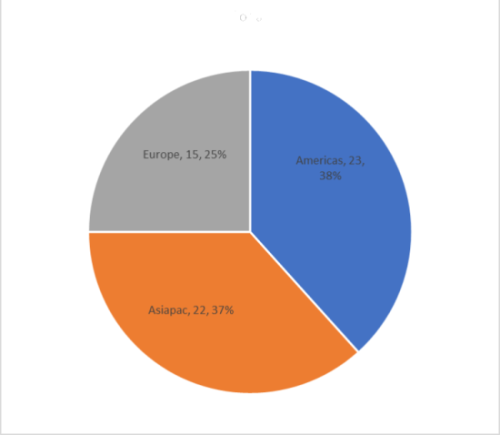
Top 60 Universities by Region according to QS

There are no Latin American Universities in the Top 50, nor any African. The only Asian universities in this list are on the Pacific Rim, so none from the Indian subcontinent. The top Indian university is the Bombay Institute of Technology (177) and the top African university is the University of Capetown (226). The European figures (15) include 8 from the UK, and two from France, Switzerland and the Netherlands and one from Germany; the last figure surprises me, I would have thought they’d have more, but it could be as a result of the index methodology, although Switzerland has two institutes in the top 50. China has more in the top 60, than the UK and the EU. The HMG list includes the Karolinska Institute of Sweden, which I cannot find on the QS Index, but it claims 7th. The HMG List includes two US universities not in the top 60, but they claim to have sourced their list from multiple sources.

I would need to think harder about the impact of this route to entry to the country; the focus on the top 60 is clearly discriminatory as is most of the UK’s immigration law. This has even been confirmed by a leaked Home Office report. I predict someone is going to get into a lot of trouble for letting those words stay in the report!

The big and most important conclusion from examining these lists is that China is catching up, it has nine universities in the top 57, of which four are in Hong Kong. We can also note that the EU’s footprint in the top 50 is far lower than it once was as it was overly reliant on the UK’s universities.

Here’s my spreadsheet which contains my versions of the two tables, and several pivot tables and charts. …

Labour Party rules, women and youth administration autonomy.

Labour Party rules, women and youth administration autonomy.

Another Rule change for Labour Conference; this moves the right of access to the membership list from Appendix 2, to Chapter 2. It clarifies that Women's branch secretaries and secretaries of young labour branches/sections are to be given access to their appropriate membership lists. The guidelines as written state these branch officials should have access to the membership list. These words make it clear that this should be so.

Written for a friend; and the rule text is now below/overleaf ...

More on Corbyn, Starmer and Brexit

More on Corbyn, Starmer and Brexit

In my post, Is there a Starmerproject I criticised both Oliver Eagleton, its author, and Richard Seymour, its reviewer, for their takes on the role of Starmer’s Brexit positioning as part of his planned route to the leadership. I quoted Andrew Fisher on his clarification that Labour’s 2017 manifesto was to support the referendum result, only if the terms were right.

Andrew Fisher, in an article on Labour Hub, lambasts Eagleton for trying to accuse John McDonnel & Dianne Abbot of betraying a 40 year friendship and suggesting that Corbyn was too weak to get the policy he wanted. Fisher shows that Corbyn supported Labour Conference policy; it just wasn’t what Lexiters thought it was, or wanted. It’s an important contribution from someone that was there, reminding some on the Left that the CLPs, the Unions, and the majority of Labour Voters wanted to remain and wanted a second referendum. It was those who put their sterile dogma and personal careers first and voted down the meaningful votes that really killed Corbyn’s leadership. Their alternative reality doesn’t exist where a harsher Brexit line would have won the 2019 election. Corbynism was broken by then.

Fisher in his article, “I was at the heart of Corbynism. Here’s why we lost”, looks at Corbynism,  Brexit, the issue that broke it, and opportunities for progress. Fisher is clear that internal opposition and sabotage were also part of the story. He concluded that most importantly the Left needs to develop a practiced of respect for others on left; if it doesn’t it will fail. But at some time this horrendous factionalism will end as enough of Lebour’s leadership realise that “a bird needs two wings to fly”. …

Gas Prices

The Economist reports  that spot gas prices have fallen but that UK energy prices cannot because the energy companies have already agreed a price; this is known as a forward rate agreement.

Someone is making a shit load of money here because there is a secondary market consisting of options and CFDs. So either the Gas providers or the derivative market makers are making a lot of money beyond the excessive profits of the energy companies. The use of FRAs is, it would seem, is a poor decision. Maybe if OFGEM didn’t nod through the price increases requested by, the so-called energy companies, most are commercial billing entities, they would be more careful.

I recommend you look at the article as it has a chart, and references a further articles on the UK Energy Market and the broken gas market.  …

CLPD & #lab22

CLPD & #lab22

Labour Hub have publicised the Left Slates for Labour’s internal elections, together with their recommended rule changes, available as word or .pdf. They include mine, the complete list is as follows, although some of the titles need to be changed as I think there is a 10 word limit. The deadline for CLPs to submit a rule change to Annual Labour Conference is 12 noon Friday 17th June.

  1. The Labour Party should be able to decide which Labour MPs can seek re-selection – not the PLP
  2. Calls for card votes from Annual Conference; delegates should not ignored
  3. Members need a Party Ombudsperson
  4. Ban lobbyists and property developers from being selected as local government or Parliamentary candidates
  5. Selection of Westminster parliamentary candidates – longlisting should to return to CLPs
  6. CLPs and affiliates should be allowed to submit a motion and a constitutional amendment to Party Conference
  7. CLPs and affiliates should be allowed to submit motions on organisational issues to Party Conference
  8. Popular rule change proposals should not have to wait three years to be discussed at Conference
  9. Full involvement by party branches and branches of affiliated organisations in the selection of Westminster candidates
  10. The NEC must decide on the powers to be granted to the General Secretary, and Conference take the final decision
  11. Member’s Rights and the European Convention on Human Rights
  12. Labour members should be required to be members of a trade union
  13. Member’s rights to free speech should be restored
  14. The NEC should stop publishing its proposed rule changes at the last minute – members need time to consider such proposals
  15. NEC final decisions and good faith
 …

Honesty, good faith and genuineness

A friend asked me to look again at Evangelou vs McNicol, which I did, by looking at Evangelou vs Mcnicol Appeal Judgment 20160812

The clause that interests us all is,

24. In the present case, there is no challenge to the rationality of the eligibility criteria and the freeze date, and they are only said to be unauthorised on the true construction of the contract. It is, however, relevant to note that a discretion conferred on a party under a contract is subject to control which limits the discretion as a matter of necessary implication by concepts of honesty, good faith and genuineness, and need for absence of arbitrariness, capriciousness, perversity and irrationality: see Sochimer International Bank Ltd v Standard Bank London Ltd [2008] EWCA Civ 116, [2008] Bus LR 134 at [66] and Braganza v BP Shipping [2015] UKSC 17, [2015] 1 WLR 1661, and the cases on mutual undertakings and bodies exercising self-regulatory powers mentioned at [47] below.

I have written about this previously on the ruling, and about irrationality, however I have previously focused on the absence of of arbitrariness, capriciousness, perversity and irrationality, but looking at the current so-called evidence definition for proscription hearings, I come to the conclusion that  equally important are honesty, good faith and genuineness. I should always have started there! …

Labour in London, not so good

Labour in London, not so good

Even now, on Saturday morning, it’s probably too early to say what the local elections mean politically. I feel I made a mistake commenting too early last year.

Over the last two days, the story has been that Labour did well in London; there are two punctures in that balloon, Harrow and Tower Hamlets. I believe these losses are caused by a sickness in both the Labour Party and possibly in society itself. In the Labour Party left-right factionalism allied to ultra-communalism/ethno-nationalism has broken both the Party and its connection with its electorate. When one stirs in two spoons of careerism this becomes deadly to the Party and to democratic politics.

I thought Harrow was vulnerable from looking at the Mayor & GLA results last year, as the early declaration of the Harrow & Brent seat results in the GLA elections (last year) had given us all a squeaky bum moment. Given that both councils were Labour, it was expected that there would be a strong vote for Sadiq; there wasn’t. Closer examination of the results suggested that Labour would  Harrow council; I thought that the polling predicted swing to Labour across London would be enough to save it. I was wrong.

The Tower Hamlets result is the culmination of 11 years of bad politics in both the Labour Party and Tower Hamlets; the community is now split on ethnic grounds. Some say it was the poor policies of Mayor Biggs, particularly on liveable streets/low traffic networks which was seen by many as serving the interests of a middle class party against the interests of brown (& white) working class who needed the mobility. In addition, the cuts, in public nurseries, and the notorious ‘fire and re-hire’ programme of the Mayor were unpopular with the Party and the community. This loss is made worse, for Labour, by last year’s referendum in TH to retain the Mayoral system in which Bigg’s Labour campaigned to retain it. My feelings on Mayors is well publicised but it’s possible that Aspire would not have been able to do so well if there wasn’t a ‘whole boro’ mandate being sought.

In Harrow, Labour lost to the Tories, and TH to Aspire. Harrow is over 52% ethnic minority and over 26% Indian, Tower Hamlets has over 55% ethnic minority and over 32% Bangladeshi.

While it is easy to name names in those two borough Labour Parties the true sickness is in Labour’s governance. London Labour has colluded with the leaderships of these two borough parties, specifically the MPs, and in the case of Tower Hamlets for over a decade. This is reinforced by McNicol’s attempts to use senior regional staff as weapon in the factional war, and then Evans’ redundancy programme. I believe that there are only two field/campaign staff left employed by London Labour.

Big governance decisions are not being taken with a view to building a democratic campaigning party or even a democratic parliamentary party. Wrong things have happened and are still happening.

There are plenty of people arguing that by prioritising a ‘blue labour’ policy vector, that Starmer’s Labour is telling the new members of Labour’s coalition that it has nothing to offer them and in doing so jeopardises the support of the young, workers, renters and ethnic minority voters. The relatively good results for the Lib Dems and Greens (& Aspire) shows that people do have somewhere else to go, and some have found out.  …

Labour & NATO

nato flag and badges

The Times ratchets up the argument in the Labour Party about NATO by repeating threats against those, including MPs, who take a more critical view of its history. A friend writes to me.

… it’s an interesting debate as to the role of NATO. The destruction of Libya and role in the Balkans doesn’t do wonders for its reputation. Yet I see Kier is concentrating on those MP’s who possibly question NATO’s role in conflict.

Haven’t we got more pressing priorities with this government both at home and abroad?

In my humble view the rhetoric of this government is very dangerous and upping the ante with Russia. Our leader needs to be urged to urge rapidly [that] Truss and Johnson to tone down their words of incitement.

We are an outlier in Europe after Brexit they are making us an outlier with our NATO partners.

This is not about opposing arming Ukraine or opposing NATO but opposing childish bellicose language from our Government to mask its other areas of scrutiny

Anonymous

It is a serious problem that Labour’s front bench seems more concerned with fighting it’s left wing, and not opposing the stupid, uber-military virtue signalling by this Government, led by a lazy man-child who if he has any sense of military strategy has learnt it from playing Risk. I think that the Tories’ boasting and grandstanding is unhelpful to the people of Ukraine and designed for home consumption but is in fact dangerous; it’s the Tories’ equivalent of ‘come on if you think you’re hard enough’. For the record, I believe that NATO is necessary, Russia’s invasion of Ukraine shows that. Finland & Sweden’s reaction is obvious and if they decide to join should be supported.  …