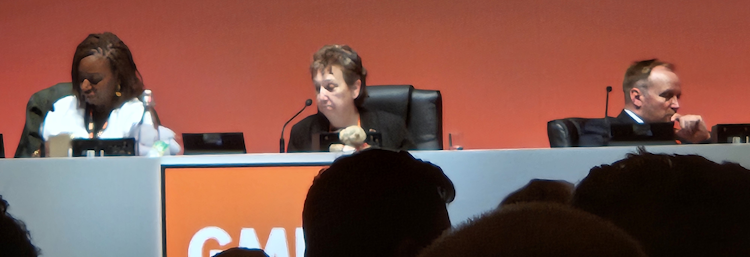
For some reason, a motion on the cost of living crisis (M242, pp 131) was debated in this section, I note it because of the coherence and power of the moving speech by Margaret Lewis which gets to the bottom of the failure of the Starmer government and in my mind should have been the centre piece of Gary’s speech. See the youtube clip. The CEC asked for referral as the motion focussed on machinery of government and not on policy outcomes. …
Congress moved onto a debate called “Politics and the UK Constitution”. My branch had submitted a motion on proportional representation for Westminster, but failed to get support from our Region, so I withdrew it in the knowledge another Region has passed a similar motion. When we got to Blackpool, we discovered that that motion had also been withdrawn. One of two important lessons I learnt or re-learnt in this case, delegates need to be committed to the policies of their branch and their motions.
We debated a motion on rectifying the injustice to voters of MPs crossing the floor. It seems simple, but one of the speakers started from the assumption that a vote was a positive affirmation of support, which is violated when an MP or Councillor crosses the floor. Under 1st past the post this is not necessarily true, people often vote against people rather than for them, and now we can see that the electorate need to be protected against the malicious use of disciplinary and membership rules by parliamentary and council caucuses. The CEC asked for, and Conference agreed to refer the motion to the CEC. …
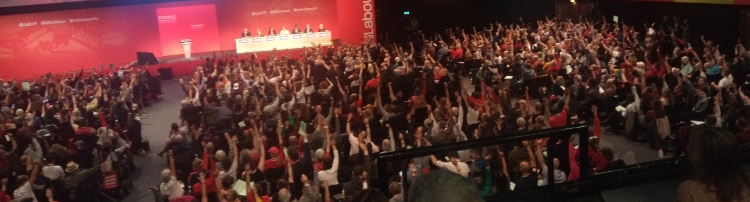
On Sunday afternoon, on day one, the CEC presented a special report on “Politics and the Labour Party”. For special reports, each region is asked to make a speech, and no other speeches are permitted. It is unusual but not unheard of that Regions oppose the CEC and on this debate Southern Region opposed the paper. A Southern Region branch also moved a motion (231), calling for a consultation on political strategy, and a special rules revision conference to discuss the consultation.
The CEC Paper is to my mind too complacent about the achievements of the Starmer government; the paper concludes that political organisation is about power and influence and that Unions must organise politically just as employers and wealthy interests do. Remaining affiliated to Labour gives GMB the best opportunity to secure better jobs, stronger rights and a fairer outcomes for workers, together with the ability to pursue other policies of interest to the union’s membership. They also argued, correctly in my mind, that pursuing additional political affiliations would likely weaken, rather than strengthen, the union’s influence as should the Union spend money on a Party that opposes Labour, Labour would expel it as they did the RMT in 2004.
Motion 231 argued for the building of a new workers party, standing and supporting workers candidates, and calling for a conference across unions to build a political alternative for workers based on a pro-worker, socialist programme. The choice in the motion was quite clear.
The debate is on the video, and there are some good speeches and some not so good.
The basic weakness of the arguments in maintaining the status quo policy is shown by the shopping list of demands that the Labour Government has failed to deliver, often at the behest of its own internal factional interests, these include, the remediating the poverty of the WASPI women, a failure to meet GMB & TUC aspirations on the minimum wage, together with the social security cuts proposed and then back tracked. Apart from Sharon Yates speech, who spoke of the ceramics industry, no-one addressed Labour’s industrial policy, although Les Timberly and Fazuma Umma presented lists of disappointments, inc. Labour’s policies and positions on Palestine and Gaza. It’s true that being at the table gives the Union power; I just wish we had more confidence that the whole of our policy portfolio was pursued as vigorously as our positions on Gas, Oil, Ukraine & Nukes.
The speakers opposing the CEC were calling for a consultation and the great weakness is that, while people only agree when it suits them, that Congress has no need to consult; it is the sovereign policy body of the Union. While their criticisms of Labour representing the working class, maybe based on fact, some of the language around this issue could have been delivered by Reform politicians. I also doubt as claimed, that more GMB members voted Reform rather than Labour, but I suspect that very few in the room have read the level of opting into the political fund which is at a historic low.
The CEC paper was carried, and the alternative motions fell.
I feel that over the period of Starmer’s opposition, the GMB and TULO have in my opinion sold us short, in terms of what we expected and with the exception of the New Deal for Workers has allowed Labour Together to write the manifesto and the government programme. If the GMB had pursued and won the full spectrum policy initiatives then the first two years of the Labour Government might not have been so disappointing. The Union leaderships, and not for the first time, sold us short.
I am pleased that we remain affiliated, but I wish that the GMB leadership showed more sympathy and pursued all the policy aspirations of the GMB. …
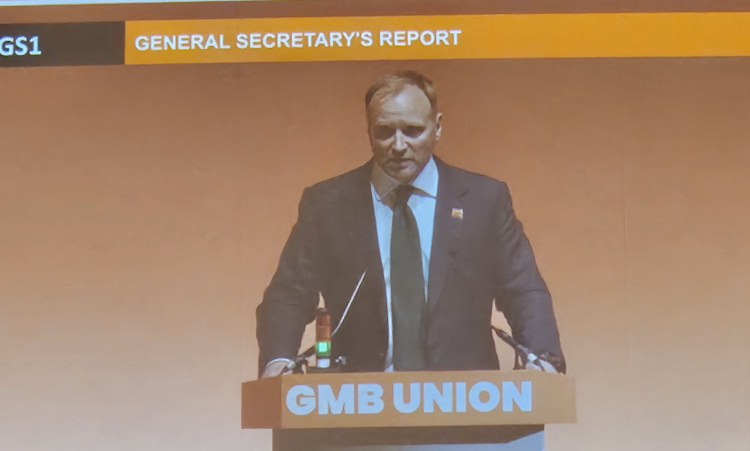
After lunch, Gary Smith presented the Annual Report. In previous years, I have entittled the article, “His Master’s voice”. I should note that he has been re-elected unopposed for a second term as GS.
In his speech, also on video, he toured around the regions highlighting what he saw as important campaigns, one of which is the Midland Region “Save our Ceramics” campaign. [I am curious if they understand its role in future computing architectures, I asked google, “how important is ceramics to future computing” and while the AI perspective was quite interesting, I was not impressed with the sources.] Gary mentions in passing the government response documented at government steps in to back long term resilience of UK’s chemicals and ceramics industries as an indicator of success of the ceramics campaign.
On politics, he almost expresses disappointment in the Labour Government but says that he doesn’t believe in washing the dirty linen in public, but that he has made it clear that they have been “too slow, too timid, and to open to business lobbying”.
He looks at the Greens and criticises them for jeopardising jobs in defence and energy, concluding this part of the speech with the statement, “Hands of our Jobs”.
I feel, that the Union’s soporific support for Starmer is a blind alley that makes it difficult to campaign politically and the backward position on energy and defence is also difficult. We should be looking at organising in the renewables sector, arguing for an industrial policy that invests in renewable manufacturing although its possibly too late to build batteries and windmills in the UK; we used to but the Tories supported by us presumably, let them go and I suspect that Brexit did not help. On defence, I support Ukraine, but no one is talking about effective capability and Gary has taken us to a position where we support Trident before an effective army.
Unlike with his criticisms of the Greens, Gary starts the attack on reform with the phrase that he hears the pain, but argues that Reform are not and will not be the answer. His most powerful rejection of the politics of Reform is in his summary, where he repeats that the central value of the GMB is solidarity irrespective of race or religion, or I should add birthplace.
Before that summary, he looked at some macro-economic issues. He’s right that energy prices are too high but pessimistic that decarbonisation won’t bring good jobs, however I agree that the “Stop the War” claim of welfare not warfare, echoed in reverse by the defence establishment is a false choice. See On-defence-sovereignty on my blog for a longer statement of my comments on defence. …
This was particularly anodyne with even the rule amendments being surprisingly non-provoking.
The change of consequence in my view is that they regularised the CEC’s right to vet General Secretary candidates. This may seem odd, but the GMB is a very large organisation with an extensive compliance burden. In principle, I believe, any member in good financial standing should be able to stand and seek the necessary supporting nominations but the Union disagrees . (In order to be on the ballot paper, a candidate needs the support of 30 branches from at least two regions, and earlier this year, the CEC voted to prohibit four candidates from going forward, leaving only one candidate on the ballot paper.) …
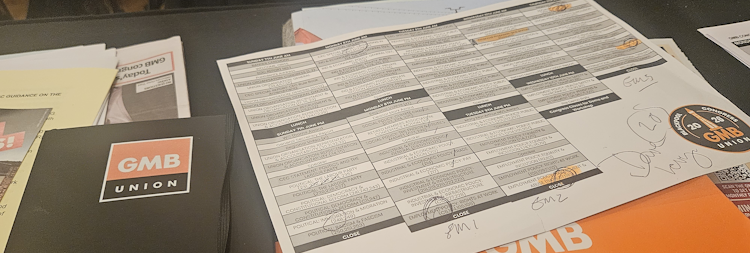
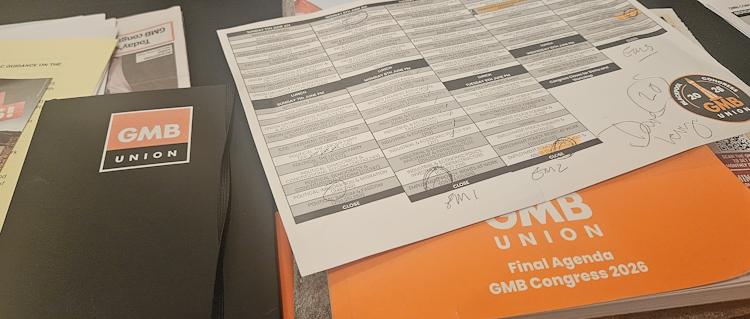
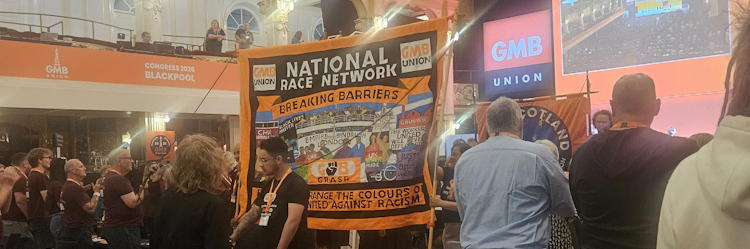
The following articles tagged GMB26, are my report of GMB Congress 26, which was held in Blackpool. These are best read in junction with, GMB Congress 2026 | GMB Union for the Congress documents and this Youtube playlist for the video record. Most important is the Agenda which is here on the GMB’s Congress page. This i.e. my report has taken far too long to produce, for which I apologise although I have backdated it to near the date of occurrence..
In this year’s report, the GMB have changed the way in which they make the thumbnails and so for artistic reasons, I have posted the video clips behind text hyperlinks. …
A short note on how Labour’s Leadership election rules work.
Rule Ch1.Vii establishes the roles, and delegates the election process to Ch4.II.
This from C1.VII, is quite amusing given the history of the last few years, underling is mine.
The Leader shall, as a member of the NEC, uphold and enforce the constitution, rules and standing orders of the Party and ensure the maintenance and development of an effective political Labour Party in parliament and in the country.
Chapter 4.II defines the nomination and election process. The first clause is the now sadly common rule that claims to establish a principle but actually allows the NEC to vary the process and either bend or break the rules. Any such variation would need to be conformant with Wedensbury reasonableness rules, but this is unlikely to be ever tested in a court.
The rules specify process to be followed in the case of a vacancy, or where no vacancy exists.
To be a valid nominee, a candidate requires nomination from the PLP, CLPs and affiliates. In the case of a vacancy, the rules are silent as to the order these are to be sought.
In the case of a challenge, someone would have needed to have collected the 20% of the PLP supporters, and then others would need to be given the opportunity to do so too. The timing of the making of supporting nominations by CLPs and affiliates is also silent.
The rules state that nominations shall be made by all three classes of nominators.
The election consists of a one member one vote and is designed to include union political levy payers, who are not members of a political party. This I thought interesting,
4.II.C.vii The precise eligibility criteria shall be defined by the NEC and set out in procedural guidelines and in each annual report to conference.
as yet again neither members nor candidates know the rules until after the election has been called and nominations made. See also the Rule Book 2026 and/or My Repo, which holds mirrors …
As Labour turns a corner and begins to address if it should seek to lead the country into a closer relationship with the European Union, I found a thread on bluesky which questions if the UK is sufficiently democratic, and ready to adopt the complete acquis. I thought I’d reply, and this is what I say!
On Democracy
Is the UK sufficiently democratic to join the EU. The two key organisations that measure ‘democraciness’ both argue that the UK is a democracy. Its score in the EIU Index in 2024, is 8.34/10.00, its 11th out of 20 in Western Europe, and above France, Italy, Spain and three other countries. France and Italy it considers “Flawed democracies”.
I have some difficulty with the EIU methodology, as while its open and accessible, I find it hard to replicate and comng from the Economist scores defences of liberal economics highly vs the pursuit of social rights. I looked at this in 2018, where I categorised the Economist’s weaknesses in the UK’s democracy. Amnesty International says that the UK’s treatment of refugees and asylum seekers is inadequate and that it fails to comply with its international obligations, including to ensure the rights to food, housing and adequate social security.
One issue raised in the thread is that the UK does not honour its devolution agreements. This will not impact the Copenhagen criteria; the EU treaties are an agreement between member states, and subsidiarity is an agreement between the EU and the member states. Subsidiarity ensures that “decisions should be made at the closest possible level to the citizen”. It would benefit all the citizens of the EU, and the UK, if the treaties required member states to have internal subsidiarity contracts with their people and that the Committee of Regions was accountable to the citizens of the regions and not appointed by member state governments.
On the Acquis
All the opt-outs are gone. The Brexiteers gave them away.
If the UK were to seek to rejoin the EU, it would need to agree to the EU’s freedom of movement laws. In fact all the opt-outs have gone and so while politically difficult for UK campaigners, freedom of movement is a benefit for which campaigners should argue and it is becoming more popular amongst young people.
The UK will also need to recognise that its Justice Pillar opt-outs have also gone, as everyone decent should want as they were designed, by a Labour Government, to allow the UK to have more illiberal immigration and trade union laws.
On the Euro, the UK should come to an agreement to adopt the Euro, i.e. supporters of rejoining need to be more explicit that both freedom of movement and the Euro are benefits and we should want them.
With respect to the Euro, I am still concerned about the Stability and Growth Pact as I don’t think macro-economic planning should be frozen in a treaty. I also think the quantitive money theory baked into the treaties are wrong and cause misery and poverty,. …
People are interested in what they’re interested in and it seems that I can’t put copyright down. I was at in conference on artificial intelligence over the weekend, organised by global justice now (GJN).
by NASA via unsplash
The question I want to ask though is, that if AI, is meant to be so clever, how does it acquire all the science, social science and humanities white papers currently held behind copyright enforced paywalls or on DNS blocked repos.
It seems they don’t, unless they have “Partnership agreements” with the copyright holders for which they pay.
I’m concerned about this hole in human knowledge that is unavailable to the LLMs. Are we really betting all this money on only part of what we know?
I reviewed “Pressing Reset” , the recent Fabian pamphlet on the state of play within the mainstream of the Parliamentary Labour Party on relations with the EU. This was published on the Chartist Magazine’s website. I conclude that the Parliamentary Labour Party is still not ready to abandon cherry-picking, and abandon Starmer’s red lines.
In my review, I highlight Stella Creasy’s contribution where she makes a cogent argument for a Swiss style deal, made easier by the EU having recently updated the Swiss agreement. She recognises that to make progress, the UK is going to have to give something on freedom of movement. Liam Byrne makes an argument for an Economic Security Union, which he claims is definitely not just the single market renamed. It is in fact more comprehensive than the single market . In the review, I say, “Byrne argues that a broader agenda will make agreement easier and that the UK must stop asking for favours and offer a true partnership.”. This is a contribution from a heavy weight to be welcomed.
The final two chapters look at what’s happening in the EU. Jannike Wachowiak of UKICE writes about what the EU wants. He starts by saying that, “Brits spend an inordinate amount of time discussing what they want from the EU. They spend far less, however, pondering what the EU and its member states might want from them.” In the review, I say, “Wachowiak argues that the consensus within the EU is that the TCA works well for them. He also argues that the EU still maintains an opposition to cherry-picking, and while there is some evidence that this is not as strong as it once was, it is clear that the EU will not agree to a better deal for an ex-member than that offered to other members and members of the EEA. Again, he argues the UK needs to put more on the table, and it needs to be what the EU and its member states want.”
As part of my conclusion, I say,
From reading the pamphlet, I have heard that some argue that we can’t rejoin, because the EU has changed. This is true, but it seems we haven’t. We are still acting like a nation of shopkeepers, and unless we raise our ambitions, the EU is planning in further changes which will make it even harder to participate as a partner 3rd country or even as members unless we decide that membership of these programmes is more beneficial than a Scrooge-like analysis of the costs and benefits of each programme.
Also,
… the biggest disappointment in the pamphlet. If Labour doesn’t lead [opinion] and drop its red lines, the cost of Brexit will increase, and the relationship will stagnate as the EU concentrates on other things.
Jannike Wachowiak and Jude Kirton Darling’s articles make it clear that we need to put more on the table and see the EU as a coalition of values and culture rather than exclusively a trade club or a defence market.
However, without pressure, this government may make verbal compromises with its red lines but express no desire to genuinely commit to the European Union and thus the EU may just move on, addressing the issues that are more important to them. …
This website uses cookies to improve your experience. We'll assume you're ok with this, but you can opt-out if you wish.AcceptRead More
Privacy & Cookies Policy
Privacy Overview
This website uses cookies to improve your experience while you navigate through the website. Out of these, the cookies that are categorized as necessary are stored on your browser as they are essential for the working of basic functionalities of the website. We also use third-party cookies that help us analyze and understand how you use this website. These cookies will be stored in your browser only with your consent. You also have the option to opt-out of these cookies. But opting out of some of these cookies may affect your browsing experience.
Necessary cookies are absolutely essential for the website to function properly. This category only includes cookies that ensures basic functionalities and security features of the website. These cookies do not store any personal information.
Any cookies that may not be particularly necessary for the website to function and is used specifically to collect user personal data via analytics, ads, other embedded contents are termed as non-necessary cookies. It is mandatory to procure user consent prior to running these cookies on your website.