Yet even more on Prime Ministers and their Mandates

Yet even more on Prime Ministers and their Mandates

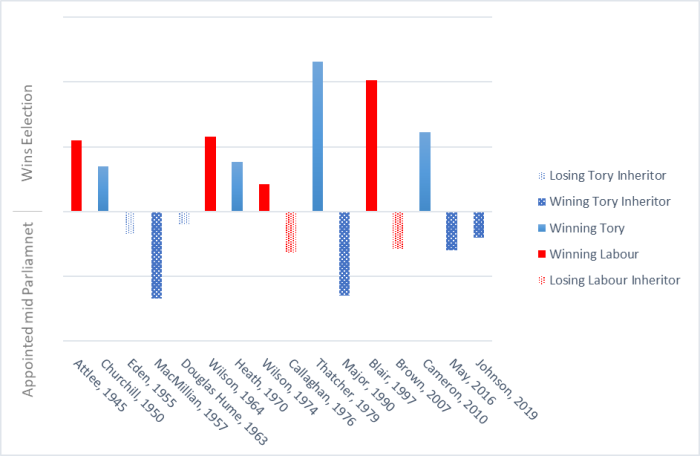
I have again revised the diagram I use to illustrate the nature of Prime Ministerial mandates which I last revised a day or two ago. I started thinking about the reasons, other than electoral defeat that leads to prime ministerial departure; it comes down to ill-health or coup, and in parliament, it’s the support of your own party that is critical. I have amended the chart, to show the two reasons for departure and posted it on my wiki.

Three points, as prime ministers get younger they are less likely to resign for reasons of health although the job is much tougher today and all recent ex-prime ministers looked terrible as they resigned, except John Major who was obviously getting a lot of exercise.

My initial diagram was inaccurate in that it showed Eden as a losing inheritor, this isn’t true, he called an election which increased his majority, perhaps Gordon Brown should have studied this episode in history more carefully, but it is unlikely that it would have overcome his risk aversion or cowardice; you choose the word.
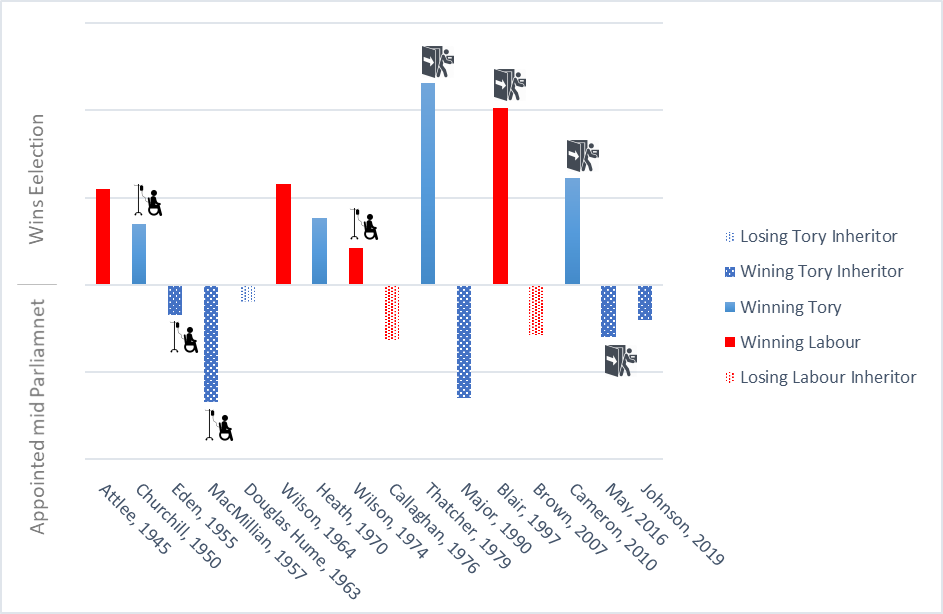
Prime Ministers: Insurgents and Inheritors & reasons for departure

Macmillan & Cameron are interesting. Cameron didn’t succumb to ill health, unless not being arsed has become a medical condition, so I count this as a coup. There are friends that dispute this, but he hd clearly lost the confidence of the nation and should have resigned. Macmillan had lost the confidence of his parliamentary party, what with all the shagging and lying, (how times change) but he had enough control to deny those who were plotting the succession because the Tories didn’t do anything as vulgar as have elections in those days.

So my theorem is that Prime Ministers that test their popularity on accession are more successful, with the examples of Douglas-Home, Callaghan (maybe), Brown and May being illustrations of failures who failed to compete within their Party or go to the country.

A second suggestion from the evidence is that either Heath’s 1970-4 administration was a fluke interruption of a 15 year Wilson government or that by selecting Douglas-Home, the Tories gifted Wilson the 64 election which he won by only four seats. Obviously, it can’t be both.  If the latter, this shows the shocking success of the Tory Party in selecting its premiers as election winners. If Maudling or Butler has succeeded McMillan, and then beaten Wilson, our governments would have looked like Italy or Japan, or West Germany. Douglas-Home is the only Tory Prime Minister not to have won re-election.

ooOOOoo

 I originally published a model in an article called “Mandates” and revised it in an article, ‘PMs and “coronations”’, in which I looked at Theresa May’s record; I made some notes in a wiki article, “Confidence of the House“. …
At long last we have a Brexit deal – and it’s as bad as you thought

At long last we have a Brexit deal – and it’s as bad as you thought

The UK Government and the Commission have agreed a Free Trade Agreement, it is reviewed by Tom Kibasi in a piece in the Guardian and the Commission have produced a simple info graphic. I highlight some quotes from the Kibasi article, which touch on Starmer’s disgraceful and stupid plan to whip the PLP behind this deal. Once again we are doing what those who do not vote for us want, not what those that do.

Here are some quotes from Kibasi’s article …

We already know its contours: a barely-there treaty that will make trade harder and destroy jobs. Labour should oppose it …

It was Labour’s abject failure to arrive at any coherent political position on Brexit in the last parliament that was one of the many reasons for its dire showing at the polls in December 2019. …

But the plan to vote for the deal shares the same political thinking as Labour’s disastrous embrace of austerity under Ed Miliband – where the same Westminster logic led it to follow polling rather than to show leadership. Do not expect the electorate to thank Labour for abandoning its principles and voting in favour of a deal that will damage Britain. They won’t. …

Convictions in politics matter. Had the 2016 referendum gone the other way, does anyone seriously imagine that Tory Brexiters would say they had to accept the result and march through the lobbies in favour of the latest EU treaty? Voting in favour of a shoddy deal will surely dampen the enthusiasm of many of Labour’s supporters, the vast majority of whom have always been rightly hostile to the hard-right Brexit project.Failing to oppose the Tory Brexit deal will leave Labour mute for years to come as the damage unfolds, unable to prosecute its central argument to sack the Tories. …

A thumping majority for the Brexit deal would hand Johnson precisely the “reset” moment that his rocky premiership so desperately needs. It would see the prime minister end a torrid year with endorsement not only of his deal but also the disgraceful tactics he employed to secure it.

Tom Kibasi – The Guradian 24 DEC 2020

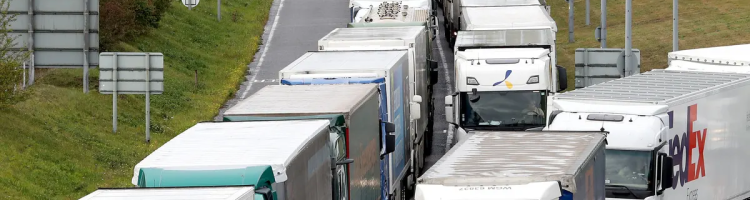
Minds may have been concentrated by Macron closing the UK border, the chaos of turning Kent into both a toilet and lorry park to the chorus of headlines such as, “Brexiters left stunned after several EU countries demonstrate easy control of their own borders“, from News Arse.

More seriously and on a personal note, Erasmus has gone (except for Northern Ireland), recognition of professional qualifications has gone, as have pet passports and stays of over 90 days require a visa. We’ll have to see what happens with flights although it seems they’ve kicked it into the grass, although it seems intra-eu flights will be stopped (for airlines, I assume). They are fudging the reciprocal health care arrangements which might stay in place. We are out of all the police co-operation programmes because we won’t accept the Court of Justice of the EU. The New European in an article entitled, “The long and winding road (back to the EU)” enumerates the gaps from the current status quo.

I am looking to see what disputes resolution and monitoring arrangements are being put in place. I know there are some and the deal would seem to give the EU an exit point if the UK leaves the ECHR,

I am in two minds how I feel about being trapped in Great Britain, but I offer my solidarity to those EU citizens whose rights in the UK have and will be diminished.

What are Lewisham Labour with its sanctuary borough programme doing?  …

More about PM’s mandates

More about PM’s mandates

I have from time to time reviewed the politics and history of how Britiain’s post-war prime ministers came to power. Earlier today I was reminded of my surprise at school on learning of how Von Papen replaced Brüning ,wondering how someone from the same side could succeed someone who had lost a vote of no-confidence. At the time in the UK, party government was secure and sectarian, although this was about to change.  I published a model in an article called “Mandates” and revised it in an article, ‘PMs and “coronations”’, in which I looked at Theresa May’s record, which caused my model problems of definition. I was inclined to believe that now both the major parties have “primary” leadership elections, party coronations are not successful. May is a case in point while Johnson had to fight a member’s ballot. Anyway, as this Tory administration reaches, what if there were any justice, its denouement, here’s what the chart looks like today.

It only shows those leaders who became prime minister; politics may have changed to the point where we need to include those leaders who lost elections as well.

I first explored this in 2010 when the press were claiming that Gordon Brown was squatting in No. 10 after they had monstered him for not seeking a mandate in 2008. Good politics might suggest that he should have done so. …

On macroeconomics, in memory of David Graeber

On macroeconomics, in memory of David Graeber

David Graeber died a couple of months ago on 2nd Sept. I never met him but was introduced to his work by my son who pointed me at "On Flying Cars and declining rate of profit", and he was introduced to me as one of the world’s leading anarchist thinkers; he was teaching at Goldsmiths which is close to where I live. I didn't feel it appropriate to write anything at the time, however I was clearing up my desktop and came across "Against Economics", which is a review of Robert Skidelsky's book, "Money & Government: the past and future of economics". It is through these two articles, and his tweet stream, that I came to know him; there is much wisdom in these articles. In this blog post, I comment on three things which I think especially important. Firstly, the nature of capitalism has changed. Capitalism is no longer progressive, and its defenders are moving towards arguing there is no alternative. The problems that the economic system needs to solve are no longer growth and the resource allocation required to deliver it, but, in his words, "how to deal with increasing technological productivity, decreasing real demand for labor, and the effective management of care work, without also destroying the Earth". This would also require an equitable distribution of wealth and income, the lack which is one of the chief criticisms of capitalism. Secondly that amongst the fatal flaws in economics as a science is the truth that systems that promise a benevolent equilibrium cannot rely on expectations of exogenous rewards to act as stabilisers. Thirdly, I look at his critique of the quantitative theory of money, and his positioning of credit and debt as an exclusively social construct. For more, see below/overleaf ...

Labour’s vote: where does the next tranche of voters come from?

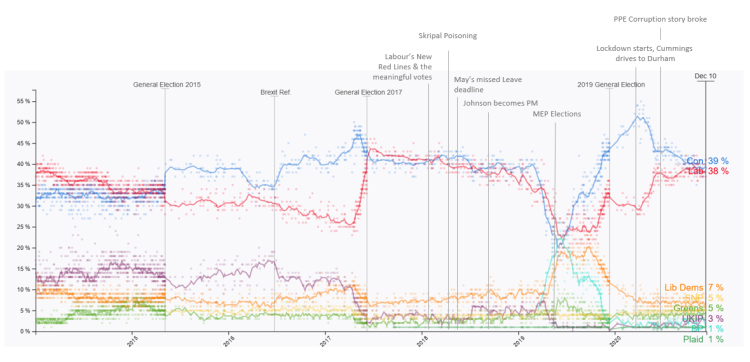
I wrote a pissy little piece on the polls the other week but in doing so looked back as far as this one at politico goes. They mark certain key events on the chart, but miss some which I think are important, such as the 2019 Euro-elections, and key counter pandemic events, including Cummings and his drive to Durham and the breaking of the growing corruption story. They also miss the Skripal poisoning, the failure to leave on May’s first deadline, Corbyn’s new red lines and Labour’s NEC’s shit Brexit position for the Euro-election. I’d argue that Labour’s opposition to May in early 2019 won it voter share, but it’s behaviour after that didn’t. Labour’s voter share began to rise after it’s fixed ’19 Conference. The rise and fall of UKIP/LibDems would seem to be the story of the summer and autumn of 2019 suggesting that the electorate was polarising over the issue of Brexit, but that Farage gave up when he realised that his fucking about was jeopardising the Tory vote and there’s no explaining the ludicrous implosion of the LibDems.

The big problem here is that throughout the six year period, with the exception of the 9 months, from June 17 to April 18, Labour’s vote share is under 40%, to reach the FPTP tipping point voter share needs to be above that. It’s a fact that Labour needs to win votes from the Tories but there is some evidence that so-called radical economic policy might win some of the working-class Tory or Brexit Party vote back, if in fact this vote was ever Labour’s. It might be of benefit if the Liberal Democrats recovered some of their vote, especially since they are clearly positioned in the model of European Liberal Parties of ‘dry’ economics, with a dash of social liberalism, add several dollops of constitutional reform and a dash of political sectarianism. If they are kicking lumps out of the Tories who cares? One problem they face is they are not asking themselves these questions either, of where their voters will come from politically or geographically?

How does Labour increase its voter share to over 40%? Where will they get them from politically and geographically? Purges and abstentionism is unlikely to do it unless “Team Starmer” are relying on the idea that Govts lose elections, oppositions don’t win them. If that’s the case, Labour could be waiting a long time. …

Valuing people

Valuing people

I was nudged to look at Psychometric systems, both Myers Briggs which I see as offering one insight into yourself and Belbin which more orientated to managing teams. Perhaps one reason they’re important is based on the insights one of my ex-managers shared with his team,

“You’ll be good at what you enjoy! What’s not going to happen, is that I sit you down in front of your manager who’ll tell you what you’re bad at and then we attempt to remedy your weaknesses through training; that’s how you build mediocrity”

One of my Old Managers

Shame he was shagged by his global management who introduced a system of stack ranking which means no-one will admit their weaknesses and managers recruit for the permitted talent spectrum.

Myers Briggs helps you understand your strengths and weaknesses and this know what help you need, If you build teams where people do what they’re good at and are encouraged to rely on the complementary strengths of others, you teams will perform well and even those perceived as adding the least value may be critical for success. No man left behind! As Belbin’s theory says, we can’t all be Plants, i.e. too many of some skills/personality types diminishes team effectiveness.  …

The danger of a false nostalgia

The danger of a false nostalgia

In the FT, “Britain will do a Brexit deal on Europe’s terms“, looks at the asymmetry of negotiating power and the role of khaki tinted nostalgia in shaping the Brexiteer’s negotiating position. I particularity like the line, “More broadly, Britain’s Leavers were guilty of swallowing their own propaganda.” and the article finishes with a skewering truth, that Britain “won” the second world war only with and solely because of the help of the USA and in this dispute, they will be on the side of the EU; whether all of this will make Johnson’s government agree a deal on Europe’s terms is another question. They might be too stupid and too proud and too frightened of the Tory party’s cleansed backbenches. …

What are the polls telling us?

What are the polls telling us?

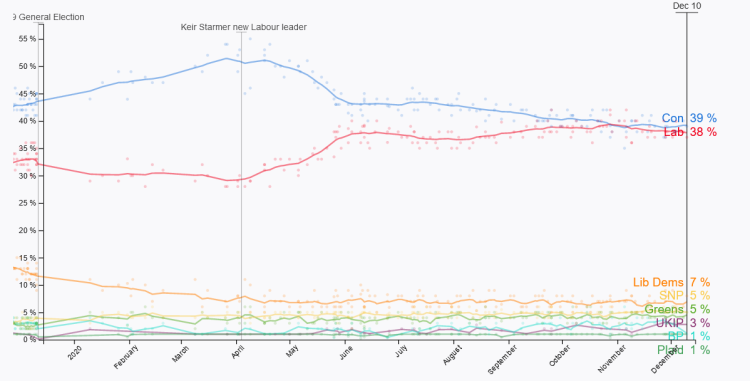
Are the polls telling us anything? Here’s a chart from politico.eu , since June, Labour have between 37% and 39%. This is better than earlier in the year but we should remember that polls claim a 3% error margin, which is why multi source publications like this are more accurate than a single company’s results. We should note this Govt. is killing people and guilty of the worst corruption and cronyism, but it is rare for Labour to poll much higher and we need to ask where the next batch of votes are coming from?

politico.eu – UK National parliament voting intention

Labour supporters should note that the SNP vote share is rock solid at 5%, although there is evidence that the ex-pit and steel towns are returning to Labour, so not only do we need to ask where are the votes coming from, but we need to know where are the seats coming from? …