An amazing coincidence

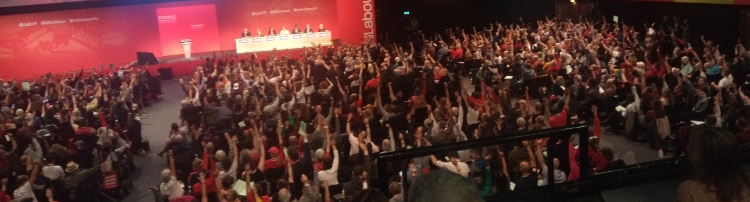
Labour Conference 2019 from the balcony

I sat down to watch Conference, this morning and in practising my friendship skills spoke to the woman in the seat beside me and when we exchanged names, I discovered that she was Emmanuelle Avril, whose paper, “The (Unintended) Consequences of New Labour: Party Leadership vs Party Management in the British Labour Party” had caught my eye several years ago. (See below/overleaf for cross references to the paper and to my previous articles.)

So we had a coffee and talked about the coincidence that in a room of 3,500 people that we should sit together as she observed, the number of people who will have read the paper is very limited, which is a shame.

We talked about the answer as to why the stupidity of the previous afternoon had occurred. … …

Not yet decided!

Labour Conference 2019 from the balcony

Labour Conference failed yesterday to take the opportunity to declare itself a remain party. I am of course deeply disappointed. I am told of resignations already. The debate was conducted in the best traditions of the Labour Party which means lots of games were played. The quality of the debate was not good but one or two speeches shone out. This article documents the games played in the NEC, the composite meeting and on the floor and platform of the Conference hall itself. Read More ...

More on Points of Order

More on Points of Order

I missed most of Saturday but bumped into a friend and we discussed the culture around points of order, it seems there had been a few. I wrote about this last year and in that article I observed that “Point of Order: You haven’t called me, or people like me” isn’t a point of order. While talking to my friend, I remembered my transition from CPSA to SCPS; in the former, there were points of order all the time, and in the latter not, in fact, I still remember the strange faces I got when I moved my first point of order at SCPS. In some places it’s done, in others not.

I sort of wonder if the proximity of the average member to the student movement is a factor and the very high number of first time & young delegates. At GMB Congress, this year, there was only one point of order over 5 days, and they gave notice to the President and were called to the rostrum as an emergency agenda item. Also, I was asked if we i.e. London Region should move one on the CEC position on Venezuela. I demurred as the disruption makes one unpopular.

It’s sort of clear that conferences have a high or low point of order rate. It would seem in Parliament, the rate has gone up, much of them nonsense and in Parliament, they have a culture of allowing interruptions, so you don’t need a point of order to make your point. In fact, and it’s very rude to everyone else in the room, it is at times, or even mostly, used to jump the queue to make a point rather than wait to be called to speak.

I should also say, that, “Point of Order: the last speaker is talking bollocks” is unlikely to get you anywhere, as this little clip shows!


In fact, the Labour Party’s rules, at Conference, now make it clear that a point of order must start with a citation as to the rule that has been broken; eventually, they required people that want to make one, to quote their rule to the speaker desk before the point of order would be accepted. Good! People should consider, that all that can happen is that the Chair agrees with you, unlikely, or says that you are wrong and tells you to sit down, at whch point you can challenge the chair’s ruling for which you need a ⅔ majority. 🤔 Wonder if that would force a card vote!

I finish this little note with the observation that the acronym for Point of Order is POO!

Image Credit: Lenin: Right outside the Finland station (Finlyandsky vokzal), sits this statue of Lenin, looking out over the river. He might be raising his hand to catch the Chair’s eye to make a point of order. From flickr CC 2008 Stephen D Strowes BY-SA …

Unions & Brexit

Unions exist to fight for the rights of their members. Brexit is a calculated move, cooked up by the Tory right, to undermine workers rights and attack migrants and free movement. The whole trade union movement should be united in opposing it. By standing with Labour members, we have an opportunity to unite the party and move on with a clear policy.

NB I am a life long Trade Unionist, currently a member of the GMB. …

Reform of Labours Candidate Selection

Labour Conference 2019 from the balcony

On Saturday, Labour Conference changed the rules as it pertained to the Local Campaign Forums now named Local Govt. Committees, the Rule changes were published in CAC 1 and I have made a copy that exclusively refers to Chapter 12, LCF Rule Proposal extract from CAC1

The key reforms are,

  1. Voting power on the LGC will be ⅓ for the Council Group, ⅓ for the CLP Reps, and ⅓ for delegates from Trade Unions. This is voting power it is not dependent on the number of delegates.
  2. Councillors may only sit in the Council Group class of delegates
  3. The Leader/Deputy Leader are to sit on the LGC Executive.
  4. There are strong, or maybe weak, but at least some rules to constrain Councillors from impacting seats they are interested in, but obviously not swapping favours.
  5. CLP’s delegate numbers will be representative of the number of wards represented in the LA area.
  6. The authority for the manifesto remains unclear.

This does not increase the accountability of the Labour Group.

Have a look and make a comment if I have missed anything. …

Democracies don’t have Executive Presidents

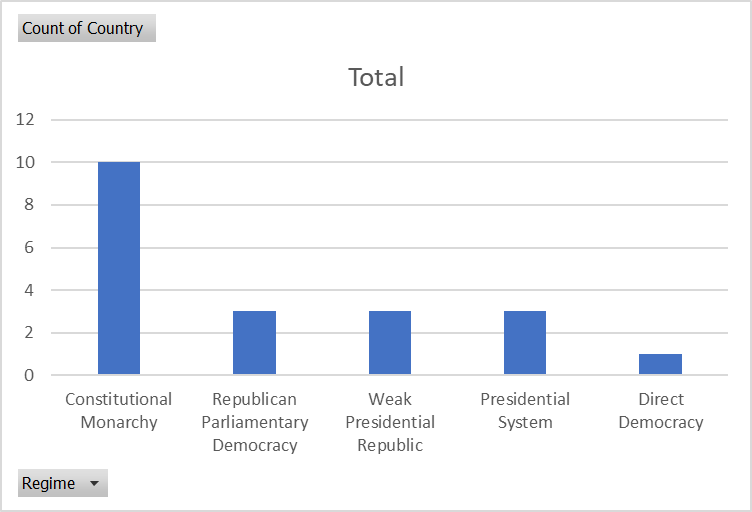
The Economist Democracy Index classifies only 20 countries as “Full Democracies”. (This includes the UK, which I question if it’s a full democracy.) Of these the majority are Parliamentary systems with constitutional monarchs. Here’s a chart showing the frequency of regime type by class; I have made the classes myself. I tried to have three, Parliamentary, Presidential Republic and Republican Parliamentary Democracy. The latter being republics with Presidents indirectly elected and mainly concerned with Govt. formation.

In the Constitutional Monarchies and the Republican Parliamentary Democracy systems, the Assembly (or lower house) appoint and hold the Govt. to account.

In the Presidential Systems, the President’s appoint the Cabinet and act as Head of Govt. & Head of State. These consist of Costa Rica and Uruguay. (I currently class Austria as a Presidential System as the President can dismiss the Govt., however the Pres. is Head of State, not Head of Govt. and the latter would seem to require the consent of the Assembly).

The weak presidential systems the President is directly elected but there is a Prime Minister accountable to the Assembly.

The Parliamentary Democracies are as far as I can tell, indirectly elected presidents with Prime Ministerial Govt. accountable to their Assemblies, this includes Germany.

Direct Democracy is Switzerland, which of course is different! They have no President, no King, a collective head of state & a government elected by the Assembly.

The democracies of the world don’t use Presidential systems. …

Proof

There are two ways to construct a theory, one is to observe the facts and draw conclusions, the second is to conceive a theorem and then prove its truth. The reality is that no matter how one builds one’s theory, it needs to be tested against reality. …

but democracy!

but democracy!

As we approach Brexit Ground Zero, Labour’s leavers, at least those too embarrassed to talk about immigration are pinning their hopes on the “but Democracy” argument.

In March 1975 Margaret Thatcher described referendums as “a device of dictators and demagogues” but she got a lot wrong and I ask myself if this is true.

Britain is run as a Parliamentary Democracy but there is no basic law and Parliament can do as it pleases. Many if not most of the checks on the Executive or on Ministers are based on convention not statute. We have an unelected upper chamber in which both hereditary peers and Church of England bishops have votes and we have a hereditary Head of State. I thought and wrote about the UK’s Democracy last year and found it wanting.

A democracy must exist under a rule of law; Britain does not because Parliament, which means the House of Commons can do as it pleases. Our only Human Rights guarantee is two Acts of Parliament, which can both be repealed. We should note that Government impunity is increased as the Coalition Government took away legal aid for judicial review and while this was designed to stop benefit claimants suing the Government when it broke the law, it also makes it much more difficult to defend more political rights.

Political systems must be designed to resolve priorities either by building a consensus or by articulating a majority view when the issues are such that there is a polarisation in society. We have furthermore the need to define and defend basic Human Rights which the world has developed a consensus around the UN Declaration of Human Rights, although in Western Europe we tend to ignore economic rights, such as freedom from poverty.

The problem of a dual mandate is not uncommon. Presidential systems based on the US model have this built in, as does the French system and on a smaller scale our system of Executive Mayors.  It should be necessary for a President to build a wide-ranging coalition to win, which should be a protection against the degeneration of Democracy, but history would suggest this is not the case. Where a society is split on critical social & economic issues, or religious[1] or national identity issues, the “winner takes all” nature of Presidential systems and Plebiscites is a centripetal force on the unity of the polity. (This is powerfully identified in Juan Linz’s paper, Democracy: Presidential or Parliamentary, Does it make a difference?) I say,

Only a Parliament can represent the breadth of interests[2] in a complex society, only a Parliament can negotiate popular compromises based on 2nd choices and changing priorities.

Presidents and plebiscites pose a tyrannical threat to the nuances of the people’s will, only a Parliament has a mandate and capability to resolve & negotiate these complexities and we should note its mandate is comprehensive and current. The issue of developing a compromise may be critical, particularly in the terms of the Brexit debate where a number of advocates of Leave have changed their minds from seeking a deal to opposing one. I was of the view that the advocates of Leave should negotiate the terms of exit and then as Unions do, ask if the deal was acceptable. This allows people to change their mind, and consider their opinion when the detail of the proposal is concrete.

The history of the degeneration of democracies, most recently and obviously in Turkey, is one where a Parliamentary system is transformed by plebiscite into a Presidential one, and then bit-by-bit the checks and balances are removed, starting usually with an attack on the independence[3] of the judiciary.

We are sleep walking along a similar path.

While I cannot find an inexorable proof that plebiscites[4] are the tools of dictator’s and demagogues, their history would strongly suggest that this is the case.

ooOOOoo

[1] For a short period, Bosnia & Herzgovina had a multi-ethnic/faith presidium and the Lebanon had an ethnic/faith power sharing convention sharing the President/Prime Minister/Speaker roles.

[2] This needs small-ish constituencies and fair voting systems, and in the UK the abolition of the House of Lords

[3] Although the only independence that the UK judges has is indefinite tenure; another area we could do better.

[4] I am of the view that Presidential systems based on the US model are also less capable of representing the breadth and nuamce of the politics of the nation and are fundamentally less stable. …