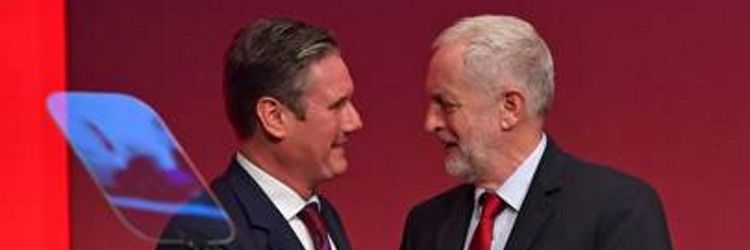
May to Corbyn: ping pong

I got my blog on Corbyn’s letter to May out just in time, she replied yesterday as I was writing it. Opinion be divided as to what she says, the Guardian commented and published a copy of the letter which I have mirrored on this site and below/overleaf.

The Guardian documents her refusal to countenance a customs union and everything else falls from there on in. She is seen by the BBC as encouraging further talks on the backstop i.e. let’s go back to my plan which parliament has already rejected and waste some more time.

The open letters and the lack of agreement makes it seem like two seals fighting, by which I mean the amount of noise.

I am however surprised at her warm words around the Common European Arrest Warrant, she must know that its corollory is the CJEU & the Charter of Fundamental Rights. … …

Another Red Line

I wrote this as an after thought to my article on Corbyn’s letter to May on Labour’s new Red Lines because it fascinates me; the European Arrest warrant is only available to full members of the EU, and in order to join or use it, it is necessary to comply with the CJEU and the Charter of Fundamental Rights to have access to it. Frankly the Good Friday Agreement needs that too. This would seem to be a trojan horse to put the Court and Charter of Rights back on the table. I wonder if they realise? … …

Cod Wars 4.0

Cod Wars 4.0

While writing Labour’s new Red Lines, I looked at Common Market 2.0 which promises to exit the Common Fisheries Policy. How can we do that? The British quotas were sold and bought by other EU member entities. Who’s going to compensate the current quota holders? Are we to return to the Cod Wars because the EU is not Iceland and the French by themselves now have more surface warships than the Royal Navy. …

Labour’s new Red Lines

Labour’s new Red Lines

Here’s Labour’s new Brexit Red Lines on Brexit, which includes the text, and here is Paul Mason, Stephen Bush and Paul Cotterill.

Mason and Cotterill think it’s a move towards remain or a final say, and this is especially true if the Tories reject the offer. Mason feels that it puts the Tories in a difficult position but if they reject the offer, it puts Labour’s parliamentary Brexiters in very difficult position. Cotterill feels it’s the on ramp to a 2nd referendum and is especially excited by the requirement that the commitments to be made in the political declaration are to be backed by legislation. Bush considers it to be move towards soft brexit which maybe very attractive to the Labour sponsors of Common Market 2.0. He also says, that with the exception of free movement, it is specific and achievable and so, is on the Brexit off-ramp in a way that the six tests were not. He also notes that the new Red Lines are silent on free movement, which he argues is a better position than that previously held.

Is this good or bad?

I think I am with those who think it’s clever and resets the question in Parliament, which needed to be done. It interrupts May’s attempts to run down the clock and offer the Parliament or even the people a choice between her deal and no deal. It increases the odds of a final say between, May’s deal and Remain. In terms of an outcome, it’s nearly acceptable, although it now moves into the pointless end of the spectrum.

My one true fear is that it means Labour accepts the withdrawal agreement which will throws those Brit’s living in the EU under the bus, and the will permit the Tory government to implement another Windrush by placing EU citizens in the UK, having lived here for months or years under the same hostile environment applied to other alien immigrants and subject to uncertainty about their rights to remain. For me this might be a price too high!

There’s more below/overleaf …  …

Venezuela: what does Amnesty say?

For those that think the UK Government has the right to tell Venezuela how it should run itself, here are Amnesty International’s reports on Venezuela and the UK.

They make an interesting read, criticising Venezuela on the grounds of freedom of expression, freedom of assembly, excessive use of force, arbitrary arrest & detention, human rights defenders, independent justice system, prisoners of conscience, international scrutiny, enforced disappearances, impunity, detention, right to food and health, women’s rights and refugees.

The UK report picks out Legal, Constitutional & Institutional affairs, the Justice System, Counter-terror & security, Torture and other ill-treatment, Surveillance, Northern Ireland – legacy issues, Sexual and reproductive rights, Discrimination, Right to life, Refugees’ and migrants’ rights, violence against women and girls and the arms trade.

Neither list is pretty but the freedom of speech and international scrutiny/legal, constitutional & institutional affairs are surprisingly equivalent and the Amnesty report on the UK raises several vulnerabilities of the UK people as a result of austerity, so its questionable that the Tories questioning the legitimacy of Maduro on the grounds that he’s oppressing his people.

The Venezuela presidential election is conducted, it would seem by one of the best e-voting systems in the world, with what IT security experts require, paper receipts and control audits. The opposition conceded.

It is quite bizarre that the leader of the opposition declares himself the acting president and that this is recognised by other states, not to mention foolhardy, there’s a

Maduro may be a shit, but he is not the only Head of State to be so, and the poverty of its people has as much to do with the illegal sanctions employed by the USA as it does to the any kleptocratic, corrupt instincts in the Venezuelan ruling party and he was elected in free and fair elections.

ooOOOoo

The Amnesty report on the UK does not mention Philip Alston’s, the UN’s rapporteur on extreme poverty and human rights report on the UK, covered by me on this blog here… .

I posted this with a spelling mistake in the title, bother! Here is the wp SURL https://wp.me/p9J8FV-1Jz and here is a bit.ly SURL http://bit.ly/2WYtBN8 …

Sovereignty

While I suspect that Labour’s Democracy Review team changed the sovereignty relationship between CLP ECs and GC/AMMs for good reasons, the number of stories of ECs suppressing the membership’s ability to make policy and run their parties being legion and in some places it seems not to have stopped but making it work will be difficult as the amount of time required to hold the new officers and committee to account is significant. My last EC spent hours discussing the Facebook usage policy 🤔, and since everything is factional, stuff gets discussed at detail twice.

I almost wonder if it was deliberate; the GC/AMMs will spend so long discussing administration that they won’t have time to discuss policy or hold the leadership and the PLP to account. …

Fiscal credibility, ptui!

Yesterday, I went to a meeting on Brexit, Free-movement and immigration; conversation in the bar afterwards segued from, “why did a Corbyn led PLP argue to abstain on the Tories Immigration Act?” via a  post match analysis of Lewisham Deptford’s Brexit/Anti-Brexit meeting to consider the radicalism of Labour’s 2017 Manifesto and the development of macro economic policy since then; it doesn’t do so well when compared with the Corbynomics of 2015. One of the key developments since then has been the development of Labour’s Fiscal Credibility Rule, which promises to only borrow to invest.

To those who think this is smart, I ask why so-called current account spending on education is not seen as “investing” in Human Capital, but this is not it’s main problem. …

Member’s Rights (in the Labour Party)

Fabulous, I found this in the new Rules, the new C2.II Individual Membership Rights

7.   Members have the right to dignity and respect, and to be treated fairly by the Labour Party. Party officers at every level shall exercise their powers in good faith and use their best endeavours to ensure procedural fairness for members.

I shall be seeking to amend this to include a mandate to abide by the Nolan Principals. …