Happy Fish

Happy Fish

Who’d have thought it? After threatening a no-deal Brexit to protect Britiain’s fishing industry, we discover that the goal would seem to have been to make Britain’s fish happy! FFS! The inconvenient truth is that most of the fish caught in British waters are sold in the EU and given the need for more paperwork at the border, the industry is having such severe difficulty in getting their fish to market that they are keeping the boats in port to save the quota until a time when they can sell what they catch. It seems, however, we still have time and resources to chase the Irish away from Rockall. It may not just be fishing, the LSE predicts that UK Exports to the EU will fall by ⅓, total trade by 13% and GNI by 6%.

There is a murmur of evidence that, what economists call, increased friction at the border is causing supply chain disruption for the super-markets and there are coming shortages in the shops, it could of course just be as people enter the new lockdown they stock up to minimise their visits to the shops but if it’s a customs check thing, then we should note that the UK imports half it’s food. In the words of Corporal Jones from Dad’s Army, “Don’t panic!”.

I am shocked at how fast it seems to be falling apart but can’t deny myself a bit of schadenfreude about the fish but any lost job is shame and will impact the workers and their families and I remember that offshore fishing is the most dangerous job in the country. I wonder when Richard Corbett and Seb Dance will be calling for us to rejoin and whether real industry will join them.

But Labour’s front bench have hitched their fortunes to making the Brexit deal work. Too late to do any good electorally, and too early to avoid the coming shit storm. We are telling our remaining core vote to once again, concede political and moral space to people who don’t support us; given a choice between blue labour and red clydeside, Starmer’s Labour has made its choice and we’ll have to see if it’s the right one. …

Nationalism and the class struggle

Nationalism and the class struggle

So many friends are considering leaving the Labour Party, for some it’s the lack of vision expressed by Starmer, for others it’s the rejection of Corbyn’s social democratic manifesto and for others it’s the collusion with the bullying bureaucracy. Others have a powerful political critique of how change happens in society and believe that the events of the last five years show that the Labour Party is not part of a better future. This has been said before by among others Ralph Miliband and so I was looking at his Wikipedia page to see which of his books was the critique of the “parliamentary road”.

There is a quote from his diary, in 1940, which today helps explain the forces behind Brexit,

The Englishman is a rabid nationalist. They are perhaps the most nationalist people in the world … When you hear the English talk of this war you sometimes almost want them to lose it to show them how things are. They have the greatest contempt for the continent in general and for the French in particular. They didn’t like the French before the defeat … Since the defeat, they have the greatest contempt for the French Army … England first. This slogan is taken for granted by the English people as a whole. To lose their empire would be the worst possible humiliation.

Ralph Miliband – from his diary via Wikipedia

Not much has changed it would seem. …

Yet even more on Prime Ministers and their Mandates

Yet even more on Prime Ministers and their Mandates

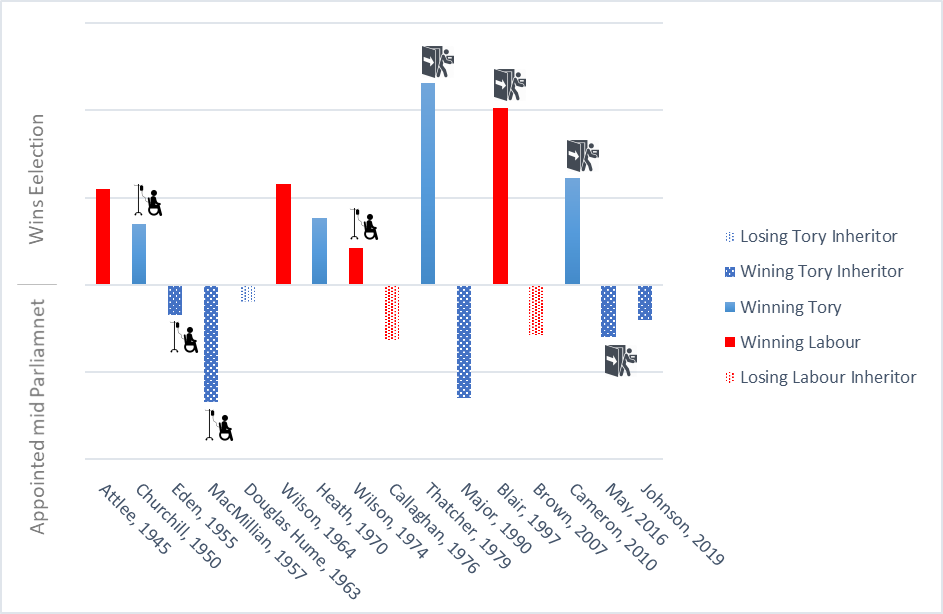
I have again revised the diagram I use to illustrate the nature of Prime Ministerial mandates which I last revised a day or two ago. I started thinking about the reasons, other than electoral defeat that leads to prime ministerial departure; it comes down to ill-health or coup, and in parliament, it’s the support of your own party that is critical. I have amended the chart, to show the two reasons for departure and posted it on my wiki.

Three points, as prime ministers get younger they are less likely to resign for reasons of health although the job is much tougher today and all recent ex-prime ministers looked terrible as they resigned, except John Major who was obviously getting a lot of exercise.

My initial diagram was inaccurate in that it showed Eden as a losing inheritor, this isn’t true, he called an election which increased his majority, perhaps Gordon Brown should have studied this episode in history more carefully, but it is unlikely that it would have overcome his risk aversion or cowardice; you choose the word.

Prime Ministers: Insurgents and Inheritors & reasons for departure

Macmillan & Cameron are interesting. Cameron didn’t succumb to ill health, unless not being arsed has become a medical condition, so I count this as a coup. There are friends that dispute this, but he hd clearly lost the confidence of the nation and should have resigned. Macmillan had lost the confidence of his parliamentary party, what with all the shagging and lying, (how times change) but he had enough control to deny those who were plotting the succession because the Tories didn’t do anything as vulgar as have elections in those days.

So my theorem is that Prime Ministers that test their popularity on accession are more successful, with the examples of Douglas-Home, Callaghan (maybe), Brown and May being illustrations of failures who failed to compete within their Party or go to the country.

A second suggestion from the evidence is that either Heath’s 1970-4 administration was a fluke interruption of a 15 year Wilson government or that by selecting Douglas-Home, the Tories gifted Wilson the 64 election which he won by only four seats. Obviously, it can’t be both.  If the latter, this shows the shocking success of the Tory Party in selecting its premiers as election winners. If Maudling or Butler has succeeded McMillan, and then beaten Wilson, our governments would have looked like Italy or Japan, or West Germany. Douglas-Home is the only Tory Prime Minister not to have won re-election.

ooOOOoo

 I originally published a model in an article called “Mandates” and revised it in an article, ‘PMs and “coronations”’, in which I looked at Theresa May’s record; I made some notes in a wiki article, “Confidence of the House“. …

More about PM’s mandates

More about PM’s mandates

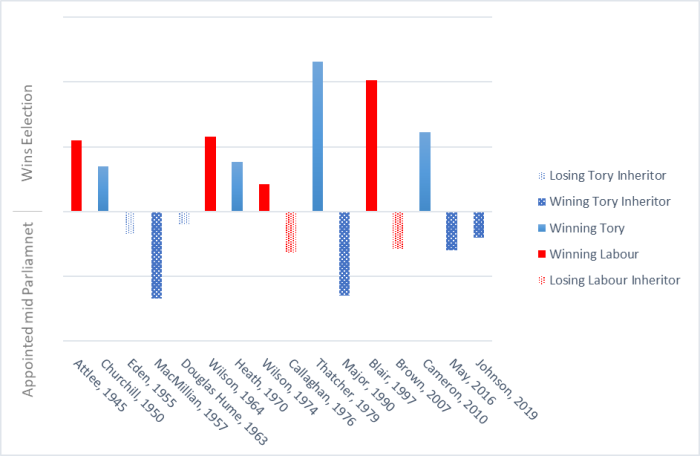
I have from time to time reviewed the politics and history of how Britiain’s post-war prime ministers came to power. Earlier today I was reminded of my surprise at school on learning of how Von Papen replaced Brüning ,wondering how someone from the same side could succeed someone who had lost a vote of no-confidence. At the time in the UK, party government was secure and sectarian, although this was about to change.  I published a model in an article called “Mandates” and revised it in an article, ‘PMs and “coronations”’, in which I looked at Theresa May’s record, which caused my model problems of definition. I was inclined to believe that now both the major parties have “primary” leadership elections, party coronations are not successful. May is a case in point while Johnson had to fight a member’s ballot. Anyway, as this Tory administration reaches, what if there were any justice, its denouement, here’s what the chart looks like today.

It only shows those leaders who became prime minister; politics may have changed to the point where we need to include those leaders who lost elections as well.

I first explored this in 2010 when the press were claiming that Gordon Brown was squatting in No. 10 after they had monstered him for not seeking a mandate in 2008. Good politics might suggest that he should have done so. …

Labour’s vote: where does the next tranche of voters come from?

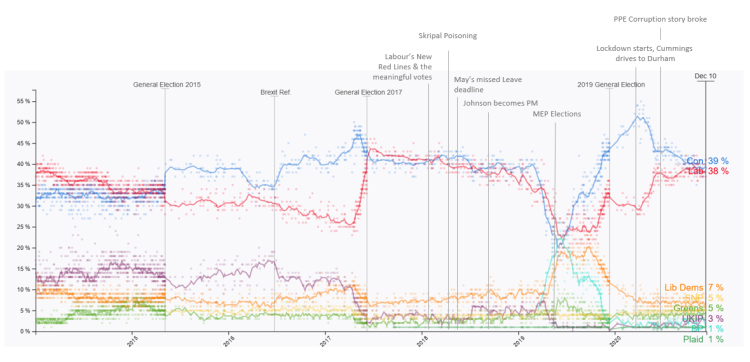
I wrote a pissy little piece on the polls the other week but in doing so looked back as far as this one at politico goes. They mark certain key events on the chart, but miss some which I think are important, such as the 2019 Euro-elections, and key counter pandemic events, including Cummings and his drive to Durham and the breaking of the growing corruption story. They also miss the Skripal poisoning, the failure to leave on May’s first deadline, Corbyn’s new red lines and Labour’s NEC’s shit Brexit position for the Euro-election. I’d argue that Labour’s opposition to May in early 2019 won it voter share, but it’s behaviour after that didn’t. Labour’s voter share began to rise after it’s fixed ’19 Conference. The rise and fall of UKIP/LibDems would seem to be the story of the summer and autumn of 2019 suggesting that the electorate was polarising over the issue of Brexit, but that Farage gave up when he realised that his fucking about was jeopardising the Tory vote and there’s no explaining the ludicrous implosion of the LibDems.

The big problem here is that throughout the six year period, with the exception of the 9 months, from June 17 to April 18, Labour’s vote share is under 40%, to reach the FPTP tipping point voter share needs to be above that. It’s a fact that Labour needs to win votes from the Tories but there is some evidence that so-called radical economic policy might win some of the working-class Tory or Brexit Party vote back, if in fact this vote was ever Labour’s. It might be of benefit if the Liberal Democrats recovered some of their vote, especially since they are clearly positioned in the model of European Liberal Parties of ‘dry’ economics, with a dash of social liberalism, add several dollops of constitutional reform and a dash of political sectarianism. If they are kicking lumps out of the Tories who cares? One problem they face is they are not asking themselves these questions either, of where their voters will come from politically or geographically?

How does Labour increase its voter share to over 40%? Where will they get them from politically and geographically? Purges and abstentionism is unlikely to do it unless “Team Starmer” are relying on the idea that Govts lose elections, oppositions don’t win them. If that’s the case, Labour could be waiting a long time. …

The danger of a false nostalgia

The danger of a false nostalgia

In the FT, “Britain will do a Brexit deal on Europe’s terms“, looks at the asymmetry of negotiating power and the role of khaki tinted nostalgia in shaping the Brexiteer’s negotiating position. I particularity like the line, “More broadly, Britain’s Leavers were guilty of swallowing their own propaganda.” and the article finishes with a skewering truth, that Britain “won” the second world war only with and solely because of the help of the USA and in this dispute, they will be on the side of the EU; whether all of this will make Johnson’s government agree a deal on Europe’s terms is another question. They might be too stupid and too proud and too frightened of the Tory party’s cleansed backbenches. …