Labour and antisemitism, some thoughts

Labour and antisemitism, some thoughts

I have now read the EHRC Report, Investigation into antisemitism in the Labour Party, and this is what I think needs to be done. I have published some thoughts already and I believe that it is necessary that the Labour rectify its rules and culture to make it a place where discrimination is both absent and shunned, where perpetrators have the opportunity for contrition and that suspensions and expulsions are a last resort applied only after a fair trial. I am particularly incensed to find there has been no policy nor procedures to guide the investigation nor the determination of discrimination complaints because it’s so basic. However, before I look at the specific recommendations, I want to look at some context. The first is Human Rights law, and the second is that the failings are so basic that anyone of good faith will insist that any remedy is applied to all complaints and disciplinary processes and affairs because the failings are systemic, not specific to handling antisemitism complaints. The article then looks at what a fair and independent process might look like and asks that it take account of the ECHR’s Article 6 and 11, the right to a fair trial and freedom of association. It calls for the retention of the NCC and the provision of legal advice to ensure its independence from the Leader and the NEC. It recognises that the Party must be considered institutionally racist and that attempts to fix the problems have been dogged by factionalism. It calls for the adoption of the Nolan Principles. It recognises that things were worse under McNicol until Formby was appointed. It reaffirms that Labour’s policy and rules are made by Conference and not announcements by the Leadership. These issues are explored in greater detail overleaf …

Things improved under Formby

judges gavel

It is clear from reading the EHRC report, Investigation into antisemitism in the Labour Party that things improved when Jenny Formby became General Secretary in 2018, but the EHRC’s sample data looked back to 2011. The EHRC report states several times that the failure to act on the Royall & Chakrabarti Inquiries is a failing and evidence of Labour’s complicity in the inadequacy of its processes. Much of the failure needs to be placed at the door of the then incumbent General Secretary, Iain McNicol, Formby’s predecessor, and the NEC members that allowed him to act with impunity. Additionally it should be noted, to give an idea of the scale of McNicol and Harman’s ambitions, that over 10,000 complaints were lodged over the summer of 2015, leading to over 5,000 suspension and nearly 4000 investigations, all of them with no policy to guide the investigators and the NEC members making judgement. To expedite the process the NEC set up a wonderfully named Procedures Committee to supervise this purge/examination of eligibility, it consisted of Harriet Harman MP, Margaret Beckett MP, the then general secretary Iain McNicol, Jon Ashworth MP, Keith Birch (Unison), Paddy Lillis (USDAW), Jim Kennedy (Unite), Diana Holland (Unite) and Ann Black (CLP). It’s interesting how some of the names are still around and even more powerful today; the Guardian story exposes how the committee rejected legal advice on using the canvassing records as reasons for exclusion. Canvassing records should only be used for the purpose for which Labour holds them, electoral campaigning, anything else is a likely breach of the electoral secrecy laws. I was advised that I must not use the canvassing records as a source of information when recommending people to be rejected as members or registered supporters during this period.

timeline rules leaders and general secretaries

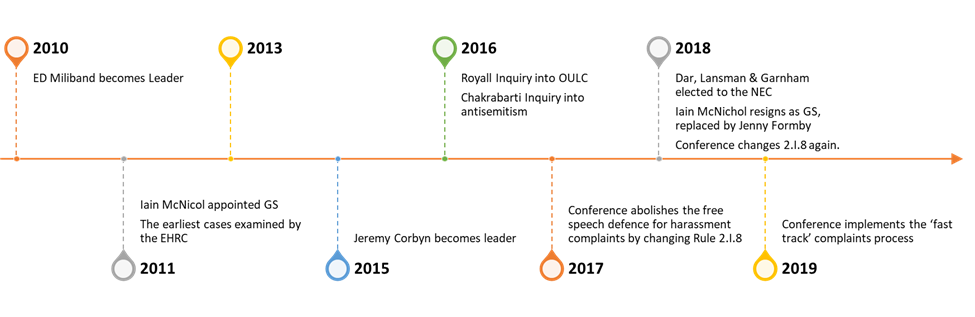
The Labour Party in an attempt to improve the antisemitism complaints handling process has  changed its rules three times (Conference 2017, 2018 & 2019), the 2017 amendment removed/weakened the free speech defence, the 2018 amendment made breach of codes of conduct disciplinary offences and gave the General Secretary powers to delegate their authority to people other than staff, and 2019 introduced ‘fast track’ process where the NEC and not the NCC heard cases related to discrimination without hearings. These developments show that the Labour Party took the problem seriously but focused on end stages of the process and in doing so, ignored the investigation stage and decision to prosecute which the EHRC has excoriated. The Party also in making these changes created a special class of complaint, that of discriminatory behaviour, which is treated differently to bullying, slander, thuggery and breaches of the rules for factional advantage.

In the LRB review of Jones’ “This Land” and Pogrund & McGuire’s “Left Out”, the James Butler, says, that

His [Jones’s] account is an improvement on the defensive response that the public’s perception of the problem with antisemitism in Labour was distorted, or that positive changes were made to disciplinary procedures after they were taken out of the hands of anti-Corbyn party staff.

James Butler – LRB

This article is not an attempt to say that Labour solved its disciplinary problems under Formby, it clearly didn’t but she inherited a system far distant from what was needed. Its crap etherealness and its then and current inability to address corruption within the bureaucracy are further reasons why the EHRC recommendations should be pursued.  …

On Corbyn’s whip

On Corbyn’s whip

On Jeremy Corbyn’s whip, which Starmer has withdrawn, somehow, certainly in breach of the standing orders of the Parliamentary Labour Party. Momentum have drafted a letter to Starmer, Angela Rayner and the CLP Reps calling for the whip to be restored which you can send too. I have sent it although I amended the letter to make it clear that I believe it, and the original suspension to be in breach of the party’s rules, in breach of the EHRC recommendations and in breach human rights law, and the whip withdrawl is an act of double jeopardy. I also pointed out that in my experience, some of his supporters are now leaving as they consider the act unfair and unreasonable.

I consider it to be at least one of capricious, perverse, irrational and/or arbitrary.  …

Political Interference

I have now finished reading the EHRC Report into Anti-semitism in the Labour Party, and while doing this, Corbyn has been suspended, reinstated and then had the whip withdrawn, by it seems a small coterie of staff, in the Leader’s Office and General Secretary’s office, specifically the Leader and GS themselves. In looking at my blog article to remind me what I said, and what remains unsaid, I came across this quote, which is a recommendation; some work to do, I think.

Acknowledge, through its leadership, the effect that political interference has had on the handling of antisemitism complaints, and implement clear rules and guidance that prohibit and sanction political interference in the complaints process.

EHRC – Antisemitism in the Labour Party (P13)
 …

Priti Patel and bullying

Priti Patel and bullying

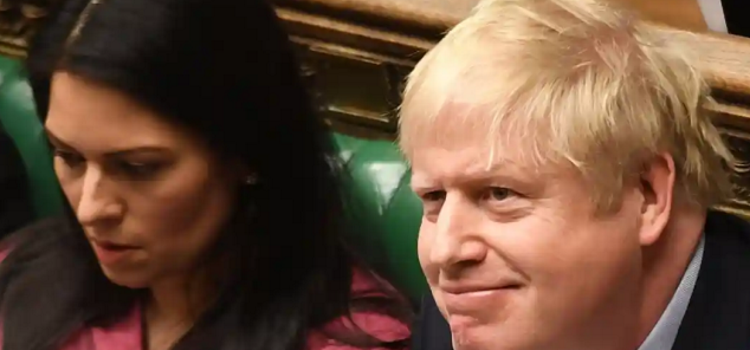
The report by Prime Minister’s independent advisor on ministerial standards says she is and has been ever since she became a minister, Boris, after having tried to nobble the report, decides that intent is a relevant factor; it isn’t! The impact on its victims is the sole definitional fact that counts. Anyway, her ex-Permanent Secretary, Sir Philip Ruttnam, denies the mitigating factors and so will continue on his route to court. The investigating officer, the Prime Minister’s ex-independent advisor on ministerial standards, Sir Alex Allan has resigned.

It transpires that despite asking, Sir Alex was denied the opportunity to interview Sir Phillip, on legal grounds 🙄

This is not just about politics; bullying is endemic in London and was the single most common grievance I pursued as a Union rep until the post furlough redundancies. I hope the Civil Service unions take this up. …

How to fix the Labour Party

Labour Conference 2019 from the balcony

I am considering getting involved in a so-called debate about Lavery, Tricket and Smith’s recent revision of their No Holding Back report, which has been seized with alacrity by the usual suspects, possibly unfairly; it seems more nuanced than its authors and fans suggest but I may not be reading it sufficiently well. I am reminded of the Data Praxis report, Tory Landslide, Progressives Split, which shows how it might have been worse and blames our FPTP electoral system. I precis them by saying,

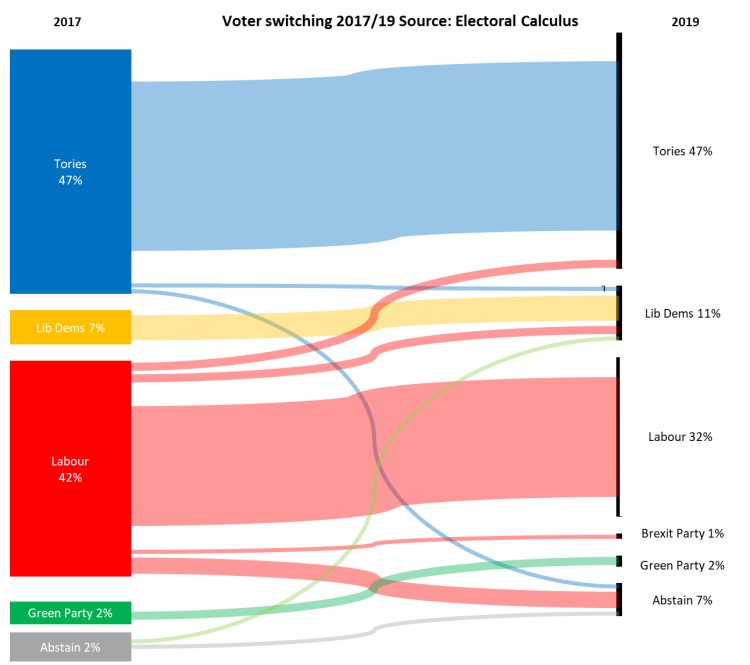
“Labour lost because, Leavers in Labour seats, switched to the Tories, but more Labour Remainers from 2017 switched; Corbyn (& the manifesto) were now unpopular and thus too many Tory Remainers stayed with the Tories.

Dave Levy

We should also note that Lavery, Tricket and Smith do not mention Scotland; it’s not their expertise but there’s no answer without the Scots.

While looking at what to say, and for help in understanding the problem, I was concerned to be truthful at the state of the red wall parties’ health, but it seems hard to get the local contact rates, which will all be poor nor to get the member/voter ratio. I looked at Labour Together’s report, again to see if they said anything useful about local Party organisation/structure and campaigning. This is difficult to be honest about because of the back office chicanery in Labour HQ on 2017 & 2019 and the myths and maybe truths about how Momentum’s volunteer organisation saved us in 2017 get in the way. They i.e. Labour Together don’t say anything useful or concrete about CLP organisation. We should also note that the Democracy Review did nothing to improve local campaigning effectiveness either. Perhaps we should be listening to Crispin Flintoff on his campaign to fund CLPs properly.

About the Labour Together report, I found this, at Immigration News, which pulls no punches. I say, using their words,

[the] New Labour Together Report investigates Labour’s 2019 Election Defeat with crushing honesty – but glosses over senior saboteurs behind the Labour Leaks dossier. A 150-page report published this week by research group Labour Together serves up some stone-cold truths and analysis in what may have led to Labour’s downfall in the 2019 General Election. “

Olivia Bridge – Immigration news JUne 2020

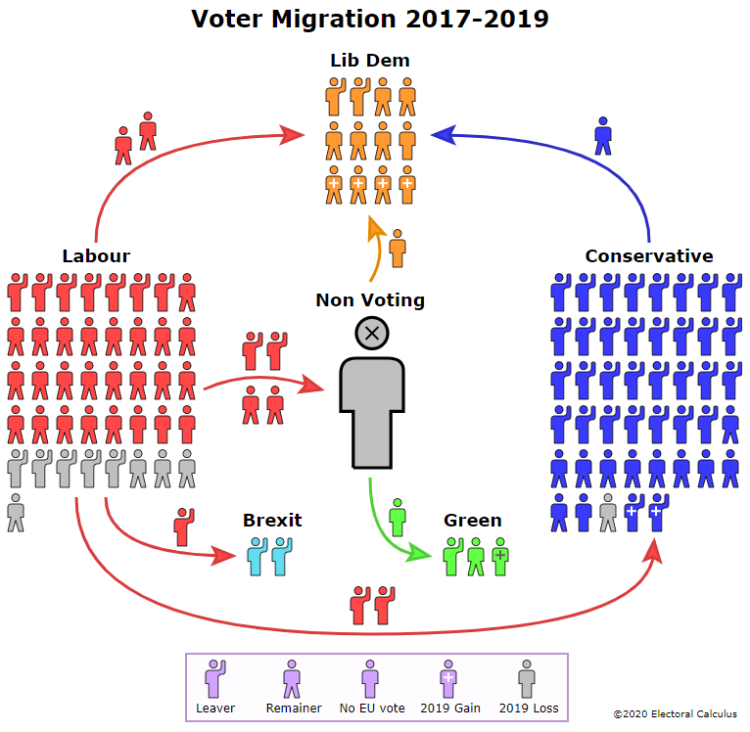
I have written about “What happened?”, and created a reading list tagged “ge2019” on my diigo feed, and to remind me and others of what wise people said, I also reproduce the Electoral Calculus chart on where votes came and went.

I have made a sankey chart from this, it would seem that this chart is for England & Wales only, but for other source notes, you’ll need to check out the original article.

The Labour Together report is strong on the need to get the strategy right; I think we may need to end the factionalism first and recognise the members must have the first and last word but we also need to resolve the fault lines in our coalition, because much of the pro-Brexit positions came from Labour politicians on the right of the party whose heritage is the “Control Immigration” mug and future road is that of Blue Labour, “work, family, community”. Adopting this sort of rubbish and its racist sub-text will jeopardise Labour’s city heartlands, apart from just being wrong. …

Citizen voting power in the US

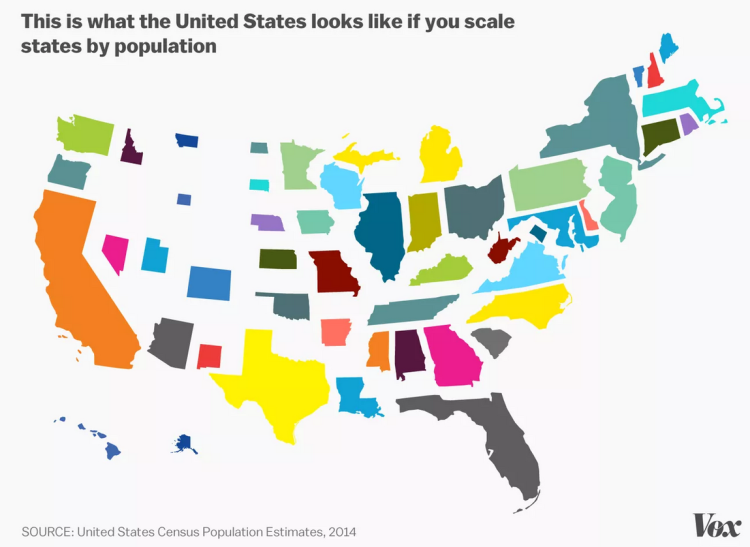
The last article got me thinking about the US electoral college and so I decided to describe the relative power of its citizens using a ratio. Here’s the chart, and it’s coloured in so you can get an idea of who it benefits, if anyone. I was surprised that Texas is the most disenfranchised …

The EC votes are equal to the number of Congress representatives + two to represent the Senators. Each state must have one Congress representative. The apportionment of the Congress representatives was done nearly 10 years ago and things have changed. Wikipedia has a page on this and I used their table to build my chart, although if I had looked harder, they have one similar.

There are three causes of this inequality

  1. Each state gets a vote for each Senator irrespective of the number of voters in the state
  2. There is a floor of three votes/state which explains the difference in influence between the states with three EC votes
  3. Some states have grown in population, and others shrunk; the allocations are 10 years old.
 …

Not just the mandate

…, it’s the powers and the term guarantee

The US Presidential Election, how exciting! Others will discuss the politics and political fallout, but I want to look at something else. Many will look at the failings of the electoral college and thus the glaringly obvious anti-democratic inertia of the Senate but like our consideration of Labour movement General Secretaries the problem is the powers not the mandate although in the USA, the mandate i.e. the electoral college, where each state gets one vote per congress representative, and one vote per senator thus preferring the views of people who live in states with a lower population, is problem.

The US Presidential elections have been settled via the electoral college usually on the basis of matching the popular vote, but the popular vote has rarely been decisive. This twitter thread looks at the last few and they rarely better our Brexit margin of 52-48 per-cent. The size of disenfranchised minorities is too large, the power of the winning coalition too broad and the nature of the decisions is such that expressing a change of mind becomes impossible. This is not right nor is it democratic.

In my article, “but democracy!”, I wrote,

Presidential systems based on the US model have [dual mandates] built in, as does the French system and on a smaller scale our system of Executive Mayors.  It should be necessary for a President to build a wide-ranging coalition to win, which should be a protection against the degeneration of Democracy, but history would suggest this is not the case. Where a society is split on critical social & economic issues, or religious or national identity issues, the “winner takes all” nature of Presidential systems and Plebiscites is a centripetal force on the unity of the polity. (This is powerfully identified in Juan Linz’s paper, Democracy: Presidential or Parliamentary, Does it make a difference?) I say,

Only a Parliament can represent the breadth of interests in a complex society, only a Parliament can negotiate popular compromises based on 2nd choices and changing priorities.

Dave Levy – but democracy!

But in both the UK & USA fundamental reform albeit of differing nature is required.

In the USA, the problem is the powers of the Presidency not the mandate, it’s the powers and strangely the term limit, but also the disproportionate power of the US Senate is becoming inappropriate as the growing majority now live in cities. …