The Govt. and public health

The Govt. and public health

To deal with the coronavirus crisis, the Govt. wants more powers and it wants them for a long time. I wonder why because they don’t seem to be making any decisions and they pretty much have the powers they need. They have a page on Gov.UK describing what they think they need, and Big Brother Watch have published their take on it, as have Inclusion London. The proposed laws reduce the standards for staff in the NHS, make changes to i.e. reduce duties under the Mental Health Acts and Social Care laws, they make it easier to dispose of the dead, postpone the May elections, take powers to close events and venues, and give the police & immigration officers powers to detain people. It also abolished the three day waiting period for SSP. We should consider their failure to offer security to those in work who may lose their jobs, fall sick or have to stop work to look after children or elderly relatives. This will also highlight the appallingly low levels of statutory sick pay and redundancy payments, not to mention the 2 year employment longevity requirement for redundancy payments. No-one is talking about those living on savings who will be hurt by the reduction in the BoE interest rate to 0.1%, by the collapse in the stock market (the FTSE 250 is down by over 40% in the month), and even their business support programme is based on loans and not grants. (This blog is based on one written yesterday and has been published before I have read today’s announcement offering an income for those not working.) …

Solidarity with the UCU

Solidarity with the UCU

The UCU have just gone back to work after a strike campaign in which they would seem to be in dispute with their management over most things but there is a particular dispute about pensions. However the Twitter commentary offered me the thoughts of an account known as University Wankings, which I felt I had to follow and they pointed me at the @THEworldunirank from the Times Higher Education supplement. I had a look at the ranking systems 10 years ago while I was helping my kids decide which universities to go to and I had been pointed at the best known ranking system of the time by my work on NESSI.

While I consider the measured quality of the UK’s Universities to be based on the fact that they all have English as a first language, the quality of research, innovation and teaching are an important, if not critical part of building an economic future worth living in, that and worker’s control.

Solidarity with the UCU! ✊ …

Ideas, alliances and promises

Ideas, alliances and promises

I was pointed at, “If hopes were dupes, fears may be liars” by Rory McQueen who compares the state of the UK’s Left today with that in 1983, arguably the last time Labour was in this situation; he conducts a balance sheet on the balance of class forces, and then explores the issues of alliances and programme. He takes “The future of the Left”, an anthology written after the 1983 election as his historic benchmark.

I think this is incredibly well written and beyond my ability to summarise. i.e. you should read it. He provokes some thoughts in me, which is why you should read the rest of this. I talk, briefly, about the power of the Left in the country, it’s much weaker today, the need for and paradox of political alliances, and the failure of Labour’s policy & manifesto development programmes. I conclude by repeating the question, what’s the point for socialists in restricting alliances to exclusively to Labour’s right and how can Labour build a policy development process that delivers a realistic, popular and transformational programme for government. For more, see below/overleaf …  …

Card Votes on Demand

The LP platform stitched up Conference over Brexit by refusing a card vote. I think this power needs to be taken away, and so have drafted this rule amendment. It is interesting that the old rule no longer exists and has been transferred to Conference Standing Orders.

C3.III.G

Insert before These standing orders will be presented ……

The Conference Standing orders are to state that voting will be by show of hands except a card vote will be undertaken as decided by the CAC who shall in their report to conference determine which votes must be resolved by a card vote. Card votes may additionally be invoked by the Chair of Conference and shall be so invoked if called for by 30 delegates.

ooOOOoo

One thing to be noted is that Conference still has the last word on the contents of the Programme (C1.V.2). For inclusion, the Programme, it needs to be approved by Conference by a ⅔ majority. Policy cannot be included in the manifesto without this approval, so the Brexit position, free train fares and free broadband would seem to be promises we should not have made. I am equally unclear where the Faith and Culture manifestos came from. (I don’t even know if they were approved by the Clause V meeting.) Policy votes where not overwhelming should be counted by a  card vote to ensure that it is accurately recorded as meeting the necessary thresholds be it ½ or ⅔ majority. …

Cash in Hand

Amongst my discoveries while reading Labour’s 2018 Financial Report was the cash in hand figure which led me to post this!

Doesn’t seem to have caught, so I have reposted it here. …

Google, the GDPR and Brexit

Google, the GDPR and Brexit

Google are going to move their UK users data from Ireland to the USA. I wrote a little note on my linkedin blog. I headline it as

Google are moving UK data from Ireland to the US … what does this say about UK/EU/US dataflows and ompliance with the GDPR and the world’s data protection laws.

I also point out the need for robust legal redress to comply with the GDPR, which the UK and USA may not meet and that the UK will lose access to the US Privacy Shield arrangements. I note that the UK will lose its member state privileges and powers under the GDPR when the transition period ends and that RIPA 2016 and the immigration exception of the DPA 2018 may cause the Commission some problems with respect to “Adequacy”.

I note that model clauses and binding corporate rules will remain in place and I wonder if this is a business opportunity for a European based phone operating system author as people choose to withdraw from Android? Nokia? Canonical? …

Blair’s Shadow

Blair’s Shadow

We in the Labour Party need to get to grips with Blair’s legacy. His shadow and that of his government still hangs over even this leadership election and it seems I am not the only one to thinks so. Andrew Fisher wrote something similar to this in the Independent. Coming to a consensus and coming to terms with its legacy will be difficult. I feel that it’s best viewed by considering the two full parliamentary terms as separate entities but for many of course the decision to go to war in Iraq will over shadow everything else he did. I have thought this about its record for a while but at least one speech by Zarah Sultana MP, and the adverse reaction to it and Jeremy Gilbert at Open Democracy who wrote Labour should have argued against the last 40 years of economic policy, not just the last ten have made me revisit New Labour’s record. This article reflects my views on the New Labour governments, together with my view that we i.e. Labour have been losing votes for 30 years and that 2017 was the anomaly. In the rest of this article, see below/overleaf, I look at the positive achievements of the first term, the evolution of the 2001 manifesto and the privatisations and war decisions of the second term. I look at the destruction of the Party’s checks and balances, the areas of failure (Trade Union law reform and housing), the power of Government and the seemingly inexorable loss of votes since 1997 aided by doomed and flawed New Labour’s electoral strategy of assuming the working class had nowhere else to go. … …

Fair shares

Fair shares

Crispin Flintoff has started a campaign to ensure that CLPs are properly funded. This is an issue that I looked at during the democracy review but CLPs get something like 5% of the membership fees and its paid as a capitation fee. From this, and by observing the effort that goes into fund rasing, I concluded that the CLPs should get more of the membership fees and am happy to help Crispin.

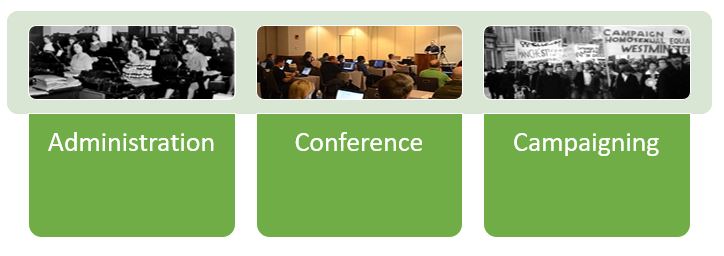
CLPs spend their money on administration, campaigning and conference. Administration varies from basic member communication, inc. printing via room rentals to in some cases wages and property costs. There are usually three conferences per annum, with annual conference being a significant cost often beyond a CLP, many of whom fail to send delegates. Elections vary but some need to be funded by the CLP, some require a tax to be payed to the district or regional party. Some have to fund an election every year, some only three out of every five years. Some get financial help from the Labour Group, if there is one, and others from Party HQ, but the biggest and safest and the weakest CLPs get little help.

We could describe the current capitation as 5% of the membership fees. In my article “Brass“,  I proposed raising it to 50%, I have changed my mind and today

  1. I propose doubling it (to 10%) and revising the rules around a floor so that small parties get what they need.
  2. and I would transfer the costs of Annual Conference to HQ

When thinking about the minimum grant, maybe there should be an investment fund where CLPs bid for the money to support projects aimed at growing the membership, building infrastructure (at the lower end, web sites/services, at the higher end, property maintenance) or growing internal fundraising efforts.

If so, I need to check out Crispin’s proposed motion and offer amendments.

There are some de-facto footnotes below/overleaf. …

Compliance in Government

Compliance in Government

It’s hard to understand what’s happening inside Johnson’s Cabinet, but there has been much, mainly adverse comment on the appointment of Suella Braverman as Attorney General. The AG is the Government’s Lawyer and there have been great lawyers performing this role, in fact often, Government’s have made their chosen candidates members of the House of Lords so that they can get the talent they need without having to filter it through the choices of their local associations/CLPs. You can find comments about the suitability of Ms Braverman elsewhere, but many commentators are worried about the resuscitation of the Tory demand to leave the ECHR and the Home Office’s continued breaking of the law.

Human Rights law is written to protect people from the power of the state!

Another thing that worries me is that I have observed in business, the growing organisational dichotomy between legal departments and compliance. The former tells a company what it can do, and the latter what it can’t and grasses the company up if it believes itself to be in breach of the law. It’s important that Government, particularly the Home Office and DWP get good and safe advice from their legal team, especially if they plan to weaken access to judicial review.

Image Credit: from flickr, CC Marco Vetch 2018 BY …