Byte-ing the ballot

I went to one of the breakout rooms where there was a debate on E-voting and Democracy.

It was chaired by Michela Palese of the Electoral Reform Society who introduced a panel consisting of Areeq Chowdhury from Webroots Democracy & Prof Mark Ryan of Birmingham University, who supported the motion that E-Voting was good and Louise Ferguson of the ORG and Ross Anderson from the Foundation for Information Policy Research who were more sceptical.

Chowdhury’s argument is based on convenience and accessibility.

Ryan was more nuanced and firstly posed the question of time scales, I am unclear if he believes its possible to solve the issue, or that it might become so, that a single system can be built that offers transparency of a result and secrecy of ballot, but he did raise the question of if we can do banking why not elections and answered it in that remediating banking errors is easy compared with remediating a flawed and broken election. The latter is an issue we should all understand because of the Brexit referendum but we should recognise that IT errors caused the failure of Greenwich Nat. West and nearly brought down Knight Capital, so some banking errors are not so easy to remediate.

Ryan quoted Australia, Estonia and the US as places where e-voting is used, but there are problems in all three countries, some of it reported in this blog and much of it catalogued in Chapter 23, “The Bleeding Edge” pages 759-763 of Prof. Ross Anderson’s book, “Security Engineering”.

Ferguson argued that IT does not solve the access problems but did not mention the digital divide. She also addressed the issue of the anti-democratic nature of the adtech industry due to its opaque bidding structures. She argued to ban adverts during elections; it’s a reflection of the arguments made in the TU and Labour movements that postal balloting puts the power in the hands of the press, in particular the Murdoch press. She was also the first person to raise the issue of the unlimited use of postal votes and the extension of the vote to ex-pats. Both these initiatives can be seen to have been done for partisan reasons, but the ex-pat thing has blown up in the Tory’s faces as they seek to regain their votes in the referendum and British citizens in Pakistan claim the same rights as those living on the Costa-del-Sol.

These motivations led me to note that no-one is talking about coercion and personation.

Ross Anderson also opposing started his speech with the statement that elections and democracy have a long kill chain. I am not sure if that’s the right use of the term, but I need to read a bit more before I get into an argument with him. He identified determining who can vote, issues of impersonation, vote capture and counting all as areas where as I.T. is introduced, more vulnerabilities come with it.  He is adamant that there must be a paper trail to ensure the count is verifiable. Much of what he thinks he has put into his book, “Security Engineering” and elections are covered in Chapter 23, pages 759-763. Anderson also attacked the political parties for opening their leadership franchises to their memberships and is particularity hostile to Ed Miliband in letting people vote for £3.

In summing up, the Chair and Ferguson stated that the real answer is political culture, involving both voting to elect governments, but that governments should distribute decision making to local authorities and citizen assemblies and juries.

Someone spoke of the Trade Unions using e-voting systems, in fact they don’t and for many of their ballots, it is prohibited, so I set them right.

So that I didn’t feel to far away from home, someone raised a Point of Order on the vote about the time scales at which benefits to e-voting might accrue, probably a LibDem but the motion was crushed. People that understand don’t like it. …
Reasons to Remain (again)

Reasons to Remain (again)

I am arguing again with comrades in the Labour Party about Brexit and have looked at two pieces of evidence calling for Labour to become a full on Remain Party. Paul Mason has written another piece, this time in the New Statesman, “Without a transformation on Brexit, Labour’s election chances are dead”, and on statsforlefties, who writes a blog mainly on psephology. They have both changed their mind and argue that Labour must now  support Remain. Mason deals with the politics of Remain and Party unity, calls out the fractures in the Labour Parties internal coalition and the short and long-term electoral issues. statsforlefties argues about short term electoral issues. (I might write a review on Mason’s article, but it’s not long, so I suggest you read it in full; I have mirrored it here.)

I present my argument below, it was in reply to someone who had used deaths in refugee camps and the proposed appointment of Von der Leyden as President of Commission as reasons for sticking with a Leave position. I attempt as I have usually done to distinguish between true believers and those who just think ambiguity is electorally expedient.

We all accept that the EU is not perfect; if we’d done better last month, it’s possible that Timmermans would be candidate for President of the Commission and not Von der Leyen. For those for whom triangulation and winning towns in the North is key, it is getting to the position where neither Leave nor Constructive Ambiguity can enable Labour to win and that pursuing Leave seriously jeopardises our ability to be single largest party. The Party has a choice of pissing off Leavers or Remainers, and we can’t win without the Remainers, in fact it would seem that we can’t be the largest party without the Remainers.

I assume you will vote to Leave in the next referendum dreaming for the ability to build socialism in one country, thus leaving the refugees in Libya and Lesbos to the mercy of an organisation you despise and will no longer be able to influence.

I can think of nothing more I might say that will persuade you of the overwhelming justice and solidarity in the case for Remain. Leaving is a right wing project, there’s no socialism at the end of Johnson & Farage’s project and being seen to support leave looks like it will kill us before the 31st Oct, but if we are seen to facilitate it, it will kill the Labour Party and the Left in this country for a generation.

I am so tired of it, as a Party we must unite to build a better world; I am tired of the dishonesty and fantasy of true believer Lexiters. (I distinguish between those and the triangulators, but they need to make their mind up too.)

There is no economic benefit to leaving, the EU’s democracy and rule of law is superior to ours and citizenship rights inc. freedom of movement are better within the EU and this is all before we talk of building a peaceful and democratic ever closer union of peoples. But whenever we discuss this with you, you counter democracy with economics, you counter the economics with allegations of being anti-refugee, you ignore freedom of movement and migrants’ rights or even argue that migration is not in the interests of the British working class and you ignore the allegation that you are supporting the worst of the right in our country. (I have never accused you or any Lexiters of being Putin’s fools & puppets, but it’s beginning to look that way.) This is not the behaviour of comrades.

Von der Leyden is not appointed the President yet, but if she gets it, it’ll because the racists and enemies of democracy in Eastern Europe & Italy got their revenge on the man and movement that called out their racism and autocracy. He and they/we stood by the first rule of the EU, to belong you must be a democracy, with an independent rule of law. This is a fight that everyone who ignored and subverted our appeal in the European Elections (and I would include those whose behaviour corrupted the selection process) is on the wrong side of history.

  …

It’s been awhile since I have heard of Carter-Ruck

Gabriel Podgrund, a Times Journalist has been shown a letter sent by Carter-Ruck to Sam Matthews, once Labour’s Head of Disputes and acting Director of Legal & Governance who have written to him pointing out his duties of confidentiality and asking him to ‘fess up and tell the Party what he’s said to journalists and what else he has. The rest of this article, below/overleaf, shares the letter and I comment that leaking is not whistle blowing but that maybe the Party should have dismissed him and others who were permitted to leave with compromise agreements and in one case, a peerage. I also remind Wes Streeting and Tom Watson about what whistle blowing is, and how frequently the Labour Party goes to court to defend its rules. … …

And in Brussels

We may get our first Socialist President of the Commission since Delors who left office in 1995. (Actually, if playing trivial pursuit, you might get bonus points for saying that that Manuel Marin of the PSOE was the last socialist President of the Commission since he played this role after the European Parliament sacked the Santer Commission in 1999.) It’s not something that you get to read about at the moment, that the EP confirms Commissioner appointments and can sack them. …

Trade Unionists oppose Brexit

YouGov have run a poll, on behalf of the People’s Vote Campaign asking Trade Unionists some questions about their opinions on the EU & Brexit, this was done on 20th-23rd June and it reports on the GMB, Unite & Unison, the top three by size. It makes sobering reading for Labour’s “Lexiters”, as all three samples would vote to Remain by significant margins and that ~35% would be more likely to vote Labour if it supported a 2nd referendum, with Remain on the ballot.

69% stated that they would vote remain in a referendum held tomorrow.

Other articles my focus on the General Election implications but I am glad that the GMB adopted this position at their Conference earlier this month. …  …

Democratising Momentum, that would be nice

Democratising Momentum, that would be nice

You couldn’t make it up but Momentum have consulted (some of) their membership on new rules for the running of Momentum. It seems they don’t plan to change the bits that they can’t keep to, merely bits they find otherwise difficult for reasons I can’t fathom. Perhaps they’re just embarrassed but given what they’ve put up with, I can’t believe that. Simon Hannah describes the changes and the fig leave of a process by which they’ve done it in this article in the Clarion.

The changes relate to the composition, they plan to increase the number of directly elected members and the number of constituencies and term of office of the central committee, aka the NCG.

Simon expresses some cynicism about the pace of these reforms and forecasts the postponement of the next NCG elections. I think it will depend upon how rapidly they want the eight new members. He also points out they have failed to amend the rules pertaining to the embarrassingly absent, digital decision making platform and the strangely abandoned “Member’s Council”.

To be frank, I was waiting for the next elections but wasn’t hoping for much. Time to stop giving them money I think, although I might put in a DSAR asking if their selection for inclusion in the consultation was data based and what facts they hold on me which were relevant to this decision. …

e-voting: transparency and secrecy

e-voting: transparency and secrecy

I have just had a another do-over on the subject of e-voting. It is my view that,

It is not possible to build a single system that offers both a transparency of result and secrecy of the ballot.

Some people argue that our current system fails these tests but this is not so. The UK’s current process involve three systems, one to check that the voter is entitled, one to record the vote, and one that records the intersection between the other two for the purposes of audit. The ballots and their intersections are not indexed. While the systems are designed to be tracked, doing so requires massive privilege and is very expensive. N.B. Expense is an IT security defence. …

PMs and “coronations”

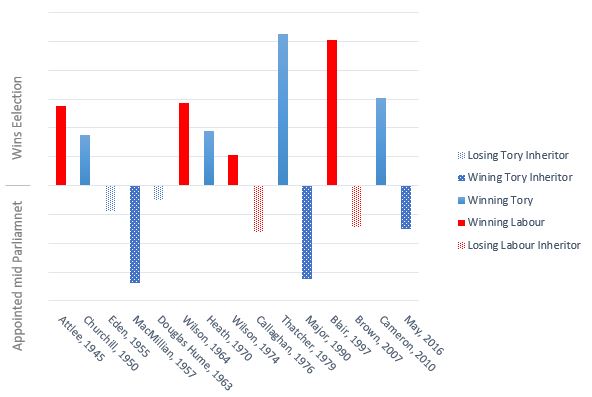
So Theresa May has gone. I had forgotten that this changes the chart I first published in Mandates on this blog. I have revised the chart but I am trapped by my own rules.

My definition of a winning PM is one who fought a General Election and remained Prime Minister, this is what happened to May. However she resigned because she had lost the confidence of the House, the first to do so for a very long time.

While the chart suggests she was successful, in being a winning inheritor, she only ruled for three years, and had to resign. Arguably she failed to win the 2017 GE. The argument that in the modern party age, party primaries strengthen the candidate and the party still seems to hold true. …

There’s a reason we made the UN

There’s a reason we made the UN

This is what happens when I don’t real time blog, I get distracted but its a bad day for news. The usual knob heads are ramping up the acts of piracy in the Persian Gulf and blaming Iran. Earlier in the week, a motion virtually supporting an illegal military intervention in Venezuela was debated at GMB Conference. Some people need to be reminded.

Aggressive war is illegal, “regime change” as a goal of military action is a war crime.

States have a right of self defence, any other action needs the approval of the UN Security Council. The UN and the rule of law are our best hope for a better world.

It’s not good enough to say “it’s broken” and our moral judgement cannot supplant this Law.

I have quoted some bits of the UN Charter, below/overleaf.

ooOOOoo …