Lewisham Council is conducting a review of its governance which it calls a “Democracy Review”. In Lewisham Deptford Labour Party we have a policy position of abolishing the executive mayoralty; however, this paper from the LGIU documents both how and what one might replace it with. …
Delegates & Democracy
One of the reforms made at #Lab18 was to make the adoption of All Member Meetings (AMM) as the Governance structure of a CLP easier. We tried this in Lewisham Deptford in 2012 for six months. I wrote about the debate at which we chose to revert to Branch & Delegate structures in Feb. 2013. It’s another of these ironies that it was originally pushed by Progress and the Blair’s leadership as a means of side-lining local leaderships, but it is seen today as a tool of Momentum to re-engineer the Party in its own image.
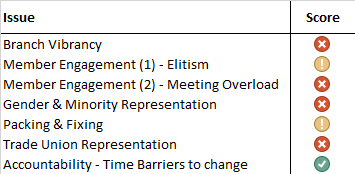
Have my views changed? I have reproduced an updated version of my balance sheet below, but most importantly,
All Member Meetings kill branches, organizationally, politically and socially.
All Member Meetings kill branches, organizationally, politically and socially. They may exacerbate the stridency of factional dispute as the factions do not even unite in the branches around common tasks such as election campaigning and fund raising. Most members given a choice between one of two meetings will choose the CLP level AMM where policy and politics are discussed. Furthermore, my experience is that where branches do policy development and political education, they are more active and vibrant and more likely to grow.
It’s most powerful argument is that the delegate based system is elitist and excludes people. Our experience, we trialled it for 6 months, is that the chief beneficiaries of the move to AMM was those councillors not on the General Committee. We were a party of 750 and about to win every council seat in the constituency bar one. There were few ordinary members that took advantage of the right to attend AMMs although the party is much larger now and circumstances might be different.
We also should recognise that some people may for many reasons not wish to attend meetings, and are happy to elect delegates to represent them. (This may be influenced by the geographic size of the constituency, East Hampshire, not the largest by a long way, is nearly 200 sq. miles, while Lewisham Deptford, where I live now, is 14.)
Gender Quotas cannot be applied to AMMs.
Some people argued that AMMs are easier to pack, but my experience over the last three years that while the left may seek to win meetings by recruiting members[1] and talking politics, there are others who have strong networks and use Trade Union links and the Socialist Societies to win places on delegate based GCs which at times are of questionable existence or compliance with the rules.
On the other hand, when the Trade Union link works genuinely, it’s a tremendous asset to the Labour Party as the good relationships between our CLP and the local Trades Council goes to show, but aggressive or corrupt manipulation of the rules damages the link, and is part of[2] what led to the booing of the Trade Union delegates at #Lab18.
All member meetings will be administratively more expensive both in terms of room rental and real mail, although you can’t claim that it won’t benefit many people and that it will be more expensive. Brighton District CLP had over 600 people at their 2015 AGM (about 10%) and had to circulate people through the room, recent Parliamentary selections across the country have attracted from 35% to 50% of the membership. Some CLPs now have over 2000 members and booking a room large enough to accommodate a high turnout AMM is challenging.
All member’s meetings diminish the Trade Union link as Unions cannot appoint additional voting members. As I have said, so does fraudulent behaviour as obviously occurred in the Newham Mayoral trigger ballot albeit by a socialist society and we all know of CLPs where the affiliate delegates outnumber those appointed by the membership branches. I also know of CLPs where the number of branch delegates is capped[3], but where it works well, it is a massive asset to the Labour Party. The Socialist Society’s relationship with AMM led CLPs is also weakened but the value of the Socialist Societies to the Labour Party is in their policy development and campaigning and as stated here and elsewhere their affiliations in some cases are used to block the will of the individual membership.
We should bear in mind that AMM governance model wasn’t designed to be effective, it was designed to weaken the voice of activists against the leadership.
AMMs increases accountability of the management meeting to the membership because there’s no waiting period for new members to participate in the management of the local party, they need neither wait for a branch AGM nor wait for a space in the GC delegations. I think that the Branch and Delegate GC’s have taken longer to become representative of the current membership because of this built in delay. The competition for places in my local party, means that good people have not been elected to the GC and their contribution to the Party’s management will be missed.
Finally, I think constituency geography counts, I am not sure how but it would seem to me compelling that large rural constituencies might benefit from a branch and delegate structure to maximise the administrative simplicity and minimize the cost of the meetings but I am basically of the view that the arguments to adopt AMM is not compelling.
I would also add that the case that AMM is more democratic is far from proven; I am not sure how you measure the democracyness of a governance structure although I have looked at means in this article and this article.
ooOOOoo
[1] Although it all turned to shit in Falkirk; https://davelevy.info/the-end-of-the-road-from-falkirk/
[2] Another part is the naivete and self-entitlement of the supporters of open selection.
[3] This has the effect in large parties of reducing the proportion of delegates representing and elected by individual members. …
First they came …
First they came for the communists, and I did not speak out—
Because I was not a communist.Then they came for the trade unionists, and I did not speak out—
Because I was not a trade unionist.Then they came for the sick, and I did not speak out—
Because I was not sick.Then they came for the socialists, and I did not speak out—
Because I was not a socialist.Then they came for the Jews, and I did not speak out—
Because I was not a Jew.Then they came for me—and there was no one left to speak for me.
Pastor Martin Niemoller
This is based on speeches made by the anti-nazi German priest Martin Niemöller and sourced from Wikipedia; most versions of the poem seem not to include the sick, the so-called incurables, but I wanted a longer version and think its more relevant to the UK today. …
Vote for me!
I am standing for election as Lewisham Deptford Labour Party’s Secretary. I have been a member of the Labour Party for over 40 years and am an active Trade Unionist in the GMB. I made a video to explain why.
…
Here’s looking at you kid
I have just posted the CLPD motion on Investigatory Powers to conference on Labour’s Policy Hub. But we need to concentrate on the Social Media Service Providers (Civil Liability and Oversight) Bill 2018 which was introduced to the Lords this week. See what the seemingly rejuvenated Big Brother watch have to say. …
Facebook & the European Union
Techcrunch reports that the European Parliament have called for an audit of Facebook’s systems in the light of reported data breaches. Will Facebook be added to the long list of US Tech companies successfully regulated by the EU albeit mainly over monopoly issues. (Google, Microsoft, Intel, Oracle). This is shared power, that the UK will lose should we leave the European Union. …
Power in Momentum
I wrote a piece on Momentum, kindly published by the Clarion, which they finally published early in October.
Momentum democracy: how the organisation ignore its own flawed rules
It looks at the untrammelled powers of the National Coordinating Committee, the lack of the on-line voting portal promised, the lack of clarity on whether non-members of the Labour Party were grandfathered into membership, the necessity for a national conference (with no powers), the unlimited delegation powers of the NCG to officers and committees and the constraints its aims, objects and ethics place upon it. I also talk about the lack of transparency in its IT and finances.
I hope you find it useful. …
Mass Action or Court Action
I have today posted a limited review of Orgcon17 which happened last year. One of the most provocative presentations was this one, “Is the law the best way to stop mass surveillance?” While it documents the heroic struggle by a small group of fiercely motivated lawyers, it’s incredibly slow at the time, the court cases considered in 2017 related to 2015 laws and by the time the rulings came through the law in question had been replaced, but while pursuing legal action, mass action is hard, although crowdjustice.com and other petition sites allow the building of an on-line communities.
The presentation made me think about the numerous, trade union legal actions on collective bargaining issues, most notably their pursuit and criminalisation of Uber. In these cases, the use of the law is a sign of weakness, albeit of both sides, but demos and voting aren’t enough to change politicians minds on issues they consider peripheral. …
On the Labour Left split
This about says it, read the thread
A little clarification re: @UKLabour’s National Constitutional Committee (NCC) elections, because some people might be confused. To recap: the Centre Left Grassroots Alliance (CLGA) traditionally brings groups on the Labour left to agree joint slates for internal elections. (1/8)
— Labour Grassroots (@LabGrassroots) October 12, 2018
Summer of 15
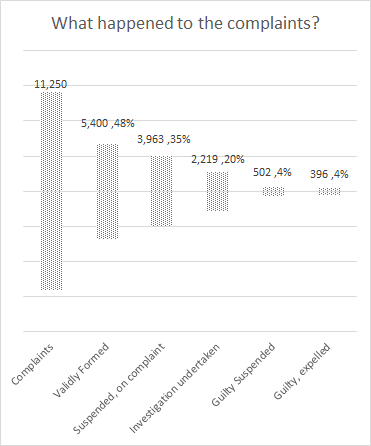
From the summer of 2015, through to the summer of 2016, with time off for winter ski trips[1], the Labour Party Head Office ran a purge of the Party’s membership which otherwise grew from about 180,000 to 550,00, a growth of 206%.
This note describes the impact of the purge. These numbers do not include the 125,000 (about 25%) excluded from the leadership election in 2016 by the imposition of a freeze date, nor the tens of thousands rejected as registered supporters.
These numbers have been constructed using Christine Shawcroft’s data (see here on the CLPD site) and survey techniques[2], [3]. The data values have been normalised[4] between those categories where data is available and those where the values have been derived via survey.
We should bear in mind, that the guilty have been deemed so by the bureaucracy with some oversight from the leadership of the NEC Disputes panel; no hearing, no defence and no appeal.
[1] I dunno, I made it up, I have no idea how many of Labour’s Compliance team ski.
[2] The survey work was conducted by someone else.
[3] The sample was constructed via advertisement and opt-in. It is possible that it under-estimates those whose investigation was terminated or finished with no further action.
[4] My stats professor will be turning in is his grave. …