Growth, institutions and Brexit

Growth, institutions and Brexit

Several commentators on the UK budget, including the OBR, have suggested but there’s insufficient growth stimulus planed. The OBR predict that the economy will grow slightly less than under previous plans; I don’t know how this can be when the proposed deficit is £89bn. They also however predict that the effect of Brexit his -4% of GDP and yet no one in parliament, except for Ed Davey has mentioned this as a growth opportunity.

The OBR and the Bank of England are both institutions designed to protect economic policy from democratic control. Time to abolish one and reform the other. …

Starmer, Berlin, rejoineu and delay

Starmer, Berlin, rejoineu and delay

Even the press and some commentators noticed that Kier Starmer visited Berlin and repeated his Brexit red-lines and yet claimed to want to reduce trade frictions between the two countries.

Germany is not in a position to negotiate this. Trade with 3rd countries is an EU competency. Starmer’s growth mission will be easier if the UK were to rejoin the single market [and customs union]. This involves him changing his mind, and talking to the Commission [FT] to the Commission in Brussels.

The British people would seem to want to rejoin the EU but the Labour Government and too many experts would seem to be still pursuing the chimera of a mercantilist patchwork trade deal which  must be called “Cakeism” in the UK and  will be called cherry-picking  or extrawurst in the EU. This is not available, neither is a swiss style multi-treaty deal.

Starmer’s government seems to think that revamped Anglo-German military treaty will help the cause of reduced friction trade. There are three problems with this. Just as one shouldn’t start trade negotiations in Berlin but in Brussels, military co-operation needs to involve Poland which now has one of the largest armies in the EU. Since the British ambitions are broader i.e. beyond military co-operation  and to include intelligence sharing and cybersecurity but since the UK was kicked out of Europol as part of Brexit because it no longer recognised the EU’s Charter of Fundamental rights, intelligence sharing will need a common recognition of privacy and judicial rights of citizens. The children and grandchildren of fascist and Stalinist societies will not permit their governments to outsource surveillance to an unrestricted and and unaccountable body. The third problem is that suspicious member states will characterise the UK position as wanting freedom of movement for weapons and ammunition, but not of people, and a single market for guns but not for anything else.

As a counterpoint, Richard Bentall writes  in a thread where he states that “the only way to slow it [rejoining the EU] is by saying it’s too difficult”, to which I add that holding out for better opt-outs is merely delaying rejoining. As a reinforcement, Blade of  the Sun argues that rejoining is simple,

  1. You apply to rejoin.
  2. They tell us what you need to do.
  3. You do it.
  4. Rejoin

And it is that simple, no opt-outs, no special deals but I fear that this Government are not yet ready to drop their dreams of a swiss-style/cakeist deal supported by too-clever academics and journalists, who are looking to ‘hack the treaties’. They need to make their mind up, do they want to be seen to be clever, or change the world; too often this is a choice and one that many academics and journalists fail to address or get wrong. …

The colour of my passport

The colour of my passport

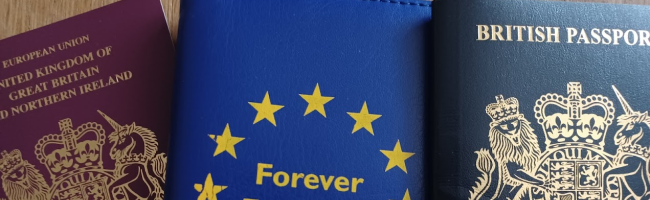
I’m losing hope on my next passport being burgundy.

The only way the UK will rejoin the European Union he’s when it’s ready to be a good citizen.

It is clear that Labour’s leadership despite the opinion polls, have a view that better terms short of membership can be obtained. Firstly, i don’t think it’s desirable, and secondly, I’m not sure it’s available. All the intelligence suggests that the EU has no interest in replicating the Swiss arrangement and that the single market is indivisible.  

Pretending that the Tory deal has failed due to its design and that all it needs is “grown ups in the room”, a view reinforced by numerous academics attempting to prove how clever they are by designing a new relationship, Is unlikely to succeed.

At the moment EU accession requires a unanimous vote on the EU council; this would mean the UK reacquires its political rights and full access to the subsidy programmes. This is unlikely to happen while we have a big bill poster signposts that we proposed to continue to behave as we did before we left.

It looks as if the people are ready to rejoin, but without leadership and a vigorous explanation that the opt-outs have gone and we need to be good citizens within the union I think it unlikely we will persuade the EU that we are suitable candidates.

The EU would almost certainly require a referendum to show that the government mandates is supported. It’s been said many times, that the EU don’t wish to play okie cokie with us.

It is sad that the elections to the European Parliament will have damaged both programmes for reform of the European Union. The Federalist proposition will have been weakened by the losses to the Greens and ALDE (Liberals) in the EP, and the growth of the ECR, who are campaigning to return competencies to the member states, and the alternative, “Sailing the High Seas”, which I characterise as Prix Fixé as opposed to a-la-carte, will have its support weakened by the French and German results where the sponsoring Governments both lost support.

I am of the view that StHS with it flexibility would be a better target to rejoin than the current EU or the Federalist alternative but rejoining the EU is needed to fix our economy and our democracy. People’s sovereignty requires access to human rights courts, and the UK needs an internal subsidiarity agreement, which I hope implementing the Brown Commission proposals will give us although the Labour manifesto promises  the devolution without the funding and structural reform to embed such devolution. …

Brexit, armaments and defence

Brexit, armaments and defence

Reasons that Brexit was a mistake number, well I lost count but the Davis Downside Dossier has the count at 1788. The FT has run an article reporting on the EU’s rejuvenated attempts move towards a defence union. For years now it has been working on common procurement chains and now is seeking to ensure security of supply, which is primarily likely to cause substitution of US weapons with indigenous European weapons but one piece of collateral damage will be the UK’s arms industry ability to supply to EU member states.

The FT article implies that the single market will be extended to defence supply. There are two impacts on this policy. One of them being the exposure of the lack of ambition of Labours plans to ”Fix Brexit”, agriculture, science, touring artists, and a free movement of consultants & professionals won’t be enough and Labour’s plans to trade our defence capability for single market opt-outs will look much less attractive to the European Union.

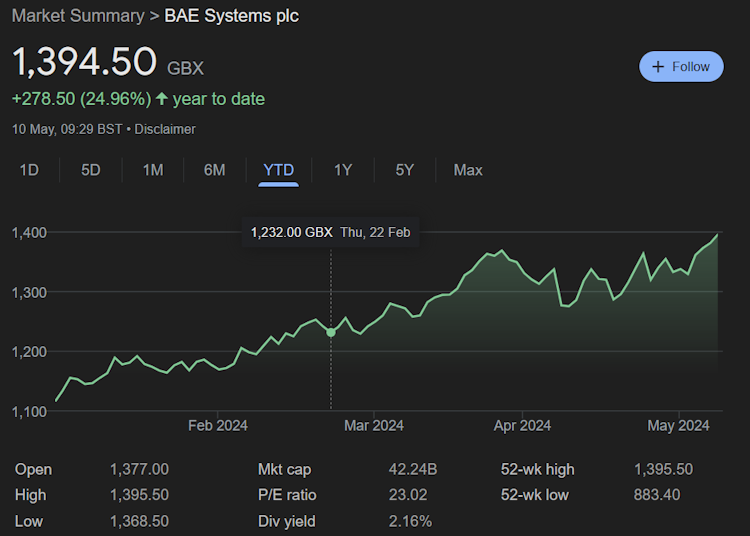
The second impact will be on BAE’s share price, which has done quite well this year.

The Ukraine War has been good for some businesses.It all goes to show that there’s a need to examine how the UK and Europe defends itself, if there is a sensible role for NATO as opposed to an EU institution or competency and to question whether the global i.e. the non-exclusively European nature of the UK’s warplane procurement plans are actually as effective as we need.

 …

Reading Labour’s tea leaves

Reading Labour’s tea leaves

I wrote about the possibility of a youth mobility proposal from the EU; I’d say it’s now dead and that may be what the Commission was trying to achieve, to stop the UK cherry picking, stop us levying the NHS fee and high [unreasonable] visa fees, although the Commission may not give up. The bad news is that it has enabled those that oppose freedom of movement to reinforce their arguments.

During the discussion I was pointed at the FT’s comments on David Lammy’s Foreign Affairs article extolling “Progressive Realism (in foreign affairs)”.  On the EU, it is my view that Labour will seek to use enhanced security co-operation to further their cakeist approach to the single market. The FT article on Lammy’s speech https://www.ft.com/content/7a8484d5-3348-4df6-810f-81c1b53dd4ad?shareType=nongift makes it clear that using our military budget as a negotiating tool for single marker opt-outs will not be easy and everyone in the UK is ignoring the fact  that justice co-operation requires a common basic law and that the majority of the UK’s recent case losses at the ECtHR have been on issues of justice. Lammy also repeated/published his views in a Guardian piece. Lammy in his article, and in his speech to Labour Party conference 23 has articulated the need the greater cooperation with both the European Union and its member states. He always adds the mantra of the new red lines, but he clearly sees and speaks for the need for greater cooperation over a range of issues.

I have also been pointed at Martin Kettle, in an article, “Starmer can’t dodge the Europe question for ever. In office, the economy will answer it for him”. He reckons, it’ll be Reeves who’ll break first, I don’t agree. She’s remarkably stubborn and well trained by the high priests of QMT in the Bank & Treasury. I wonder if it might be Lammy. While I gave up trying to read the tea leaves from the speeches of Labour’s front bench, Lammy’s speeches read as if he may want to do something else but adds the red lines because he has too. …

UK politicians say “No” to youth mobility

The EU flag, before castor and pollux,

The FT ((£ | (-)) and Steve Peers on X report late last week that the EU Commission has sent a request to the Council for a mandate to negotiate a “youth mobility” scheme to allow British and EU under 30’s to freely travel, work and study in each other’s countries.

Cynics suggest this is to hold the Union’s position together as the UK Government has already opened or attempted to open bi-lateral talks with several member states; however, the Commission’s initiative has it seems produced a negative public statement from Labour. (And later by the Government, reported here by the BBC which highlights this government’s disrespectful approach to British and European youth’s interests. )

Labour really seem to be taking a foolishly hard line; I think that agreeing this would make their plan to negotiate a new co-operation agreement easier since their goal seems to be to bargain the UK’s defence capability in exchange for opt-outs from the single market.

The FT reports that Sweden has refused because it wants to act in solidarity with all the member states and the Commission if it gets a mandate will have conditions on visa charges and the NHS surcharge; they will also not permit the UK to discriminate against any member state.

Stella Creasy of the Labour Movement for Europe, welcomes the proposal and the scheme,

Luke Cooper, a colleague on the AEIP national committee comments on X, and also places the issue in the context of Lammy’s recent article on security and defence co-operation with the EU, also reported by the FT, which also reflects on the more frigid end of the EU conversation. It would seem that Luke considers the position of the German Government to be important, as well as the “Report of the committee of Franco/German experts” on the medium term direction of the EU which perceives a multi-tiered commitment to and within the EU on which I comment on my wiki, and on my blog, in an article called, “The (EU) reform train is at the platform”. For a further analysis of this debate on that report and its Federalist alternative see my article, “EU Reform”i. Personally, I think the Franco German report has been lost in a cupboard as the sponsoring governments have new priorities,

It’s a shocking opportunity missed and while I am not surprised at the Government’s reaction; I am bitterly disappointed in Labour’s. …

We can do better than supposed sensibleness

We can do better than supposed sensibleness

Martin Wolf, the Chief economics correspondent at the FT, just before Xmas published a piece of clickbait, entitled, "Britain won’t rejoin the EU for decades — if ever", with a tag line, “The sensible approach for the UK is to seek a closer and more co-operative relationship with Brussels”. He starts with an alleged piece of mystic folklore, that one can’t cross the same river twice, which stripped of its source and supposed wisdom of its age is clearly nonsense. Of course, you can cross a river twice and anyone that commutes from Canary Wharf to Westminster does it twice a day.

This rest of this article, overleaf, article looks at what Wolf said, refutes the arguments, exposes the lack of evidence and concludes that it's a failed project and that failure and the prospect of rejoining cannot be suppressed.

Pipe dream or inevitability

Larry Elliot wrote a piece of click bait in the Guardian on why since Britain is not a basket case, it should not rejoin the EU. He also argued that the growing strongman nationalism, and racism amongst some member states is a reason for avoiding the EU.

I wrote a reply which I shortened and offered to the Guardian, and was eventually published on Another Europe’s  web site. I have also posted a copy on my Medium blog, outside the paywall.

I argued that the economy was in a poor state, certainly worse than it might have been and quoted the OBR and my “Remain” article, from this blog, posted in 2016 that the 4% growth underperformance was about where the forecasters had predicted.

I pointed out that his investment successes were selective good news, and only talk about yesterdays driving technology. He like most seem to fail to recognise that we have already missed the boat on renewable energy manufacturing.

I conclude by arguing that the UK is not inoculated from the racism inherent in authoritarian rule. It must be fought not avoided, starting by the repeal of Tories immigration laws.

I really conclude by stating that rejoining the EU is an inevitability not a pipe dream. …