Beyond People’s QE

Beyond People’s QE

A day or two ago, Alex Little, published a blog post called ‘Lessons for Corbyn in “Lerner’s Law”’. Lerner’s law suggests that using your opponents language limits your ability to make the argument. Little quotes Bill Mitchell, the inventor of Modern Monetary Theory (MMT) as to how Labour’s leadership in articulating the Darling Plan and its successors talk about balancing the budget and fixing the deficit concede the argument to the Tories. Little’s article also points at Lerner’s economic theories, described as “functional finance” and points at the wikipedia article on it. He argues that by describing the proposed pump priming as PQE, and accepting that when growth takes off, the government may transition to bond financing, by even accepting that we need to live within our means, the theory and benefits from the a more overt radical financing will be lost. …

Labour’s next leader, economics, defence and the mandate

Labour’s next leader, economics, defence and the mandate

In the dying days of Labour’s Leadership selection, the key issues remain those of economics & strategy, but also unfortunately now one of mandate.

The debate on economics has come to be between Cooper and Corbyn. Demanding credibility is not an economic policy and so we can ignore Kendall & Burnham. I summarise the other’s two positions below and conclude that Corbyn’s economic manifesto is not just a shopping list of desirable reforms, they are a single set of reinforcing measures to fix and rebuild the economy so it works in the interests of the majority of people.

This was meant to be a short blog, emphasising the economy and virtuously circular, self reinforcing nature of Corbyn’s programme, but I also take the opportunity to look at the defence and foreign policy debate and conclude with some comments on the election process itself and Labour’s future.

I am glad I voted for Jeremy Corbyn, but I am not a Corbynista, I am Real Labour. …

Monopoly Prices

Monopoly Prices

I have been tidying up my hard disks, and came across this paper, written by me called, “Why Monopolies make super-profits?” which I wrote in 2009/2010 to codify my thoughts on monopoly. The pseudo abstract says,

Monopolies restrict supply and offer their goods at prices above an equilibrium price, which is the opportunity cost of the resources used to make the goods. In doing so they make super-profits. This paper looks at how and why this is. It is based on an ABC of Economics, my memories of my Economics classes at school and university and a more recent reading of Begg et al’s “Economics”.

Dave LEVY

It looks at profit maximisation, supply and demand and the nature of competition. It does not look at aggregate welfare underproduction, nor on the lost social costs in building and defending the monopoly. Maybe a re-write is required.  …

About Shadow Chancellors

While this looks like a technical spat over issues of macroeconomic monetary policy, with Chris Leslie, Labour’s stand in Shadow Chancellor arguing classical monetarist i.e. Thatcherite economics, its also about who benefits in terms of policy and for three people, about career advancement.

Leslie said: “Printing money and ending Bank of England independence would push up inflation, lending rates, squeeze out money for schools and hospitals and mean spending more on debt servicing. Higher inflation and a higher cost of living would hit those on the lowest incomes, the poorest people who couldn’t afford those goods and services. The very people we should be standing up for would pay the price – the poor and vulnerable.”

In an interview with The Independent, Mr Leslie issued a wake-up call to Labour members to reject what he called a “starry-eyed, hard left” economic strategy, amid growing signs that Mr Corbyn could pull off a shock victory next month. Notice – no model of cause… the huge discovery over the last seven years is that printing money doesn’t cause inflation and with interest rates at an all time historic low, now is the time to borrow long term to invest in the future. Leslie is as on most of his economics very wrong on this.

He got another bite of the cherry in the New Statesman, where he focuses on QE, and it’s consequent interest payments (there aren’t any) and the independence of the Bank of the Bank of England which for some reason he holds up as a great reform. There’s no doubt about it – the Labour Party has reached a fork in the road and on 12 September the fate of the progressive centre-left in Britain will be sealed. There are millions whose living standards and working conditions depend on Labour winning government in 2020 to fight for power, wealth and opportunity in the hands of the many not the few. The independence of the Bank and the foundation of the Office of Budget Responsibility are both anti-democratic reforms, reducing the power of the elected Chancellor and the House of Commons. The ideology behind these reforms is that these decisions are too important to be taken by politicians, and I’d like to remind Leslie of Mervyn King, the then Governor of the Bank’s behaviour in both 2008 and 2010.

Chris Dillow performs a technical analysis of the proposition, critically pointing out that with the current levels of unemployment and underemployment, it’s highly unlikely that anything would be inflationary. It’s widely agreed that Jeremy Corbyn’s popularity is due in large part to the mediocrity of the alternatives. As if to demonstrate this, Chris Leslie – Shadow Chancellor – claims that Corbynomics would be inflationary. This isn’t wholly unreasonable. A money-financed fiscal expansion – which is all “people’s QE” is – would increase employment and aggregate demand.

Richard Murphy, a Corbyn advisor and author of taxresearch.org.uk opposes Leslie in the most robust terms, in this press version of his radio interview, The author of the economic plan set out by Labour leadership contender Jeremy Corbyn has defended “Corbynomics” in the face of an attack by the shadow chancellor, Chris Leslie. Richard Murphy, the fair tax expert recruited by Corbyn to draft his economic policy, deepened divisions on the left by saying “Leslie has got this completely wrong.” The article states that when challenged on Leslie’s point about high inflation, Murphy said: “Any system of people’s QE would be turned off if we got to a situation of high wages and full employment, but we are so far from that at the moment that we have to tackle the low-wage economy and the lack of productivity in the UK by creating new investment, which is the foundation for new prosperity.”
I have heard Chris Leslie speak, and these issues are at the crux of the debate, but it still surprises me to find Labour people using the economics of the ’80s to understand today’s problems; this isn’t the first time he’s spoken this way. QE clearly doesn’t cause inflation, because we have one and not the other. He’s another of Harriet Harman’s partisan decisions taken as interim leader, the job’s beyond him, and he’ll be gone if they reintroduce elections to the shadow cabinet.

Finally if the choice of Shadow Chancellor is between Murphy, Leslie and Rachel Reeves, it’s just another reason for voting for Jeremy Corbyn.

Mind you, Murphy is not an MP and so cannot serve as Shadow Chancellor, Chief Commissioner of HMRC anyone?

ooOOOoo

This was originally published as a storify and reposted in Oct 2018 as this blog article. …

It’s still the economy stupid

It’s still the economy stupid

Is the economics getting lost in Labour’s Leadership debate? I think so. Only Jeremy Corbyn is talking real economics, the others led by Liz Kendall are talking about credibility, which I assume is code for reducing the deficit through fiscal policy i.e. expenditure cuts and tax rises. I am disappointed in Yvette Cooper, yet strangely not surprised by Andy Burnham.

Corbyn is not arguing for a Soviet style economy, the macro-economics is Keynesian, the micro-economics maybe socialist because he argues, in contrast to the Tories and their media shills, that wealth is created by both workers and entrepreneurs.  …

London’s Labour Leadership Hustings

4 leaders

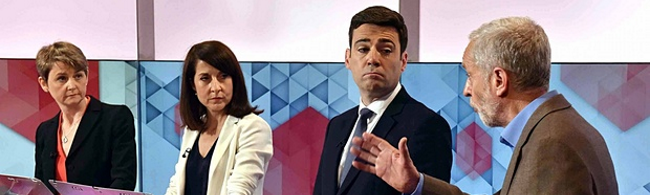
So the Leader debate is becoming about winning in 2020, how to win back the Tories and the Presidential qualities of the candidates, that’s what the Press are saying and that’s what the supporters of the three wise monkeys are arguing. The question that needs to be proved by them is that they are any more likely to win than Corbyn with his Keynesian anti-austerity policy. I attended the London Hustings for Labour’s Leadership yesterday. I don’t think it will have changed many people’s minds.  …

On the economics of copyright

On the economics of copyright

When looking at the furore surrounding Julia Reda’s report to the European Parliament’s JURI committee, I am coming to the conclusion that those of us who argue for a fairer, more pro-consumer copyright settlement have won the economic arguments. The massive focus on the tiny change in duration reinforces this. All arguments I have had recently with proponents of the current settlement have rapidly moved from public good arguments to the issue of equity in investment, and the moral failure to compensate creators for their speculative investment.  …

Banks Eh?

Banks Eh?

Have you got outraged over FATCA yet? Over the last quarter, I have received several pieces of correspondence from different banks asking me to certify that I have no income that the US Government might be interested in. It goes to show just how poor, the Banks’ whole person/customer knowledge is. …