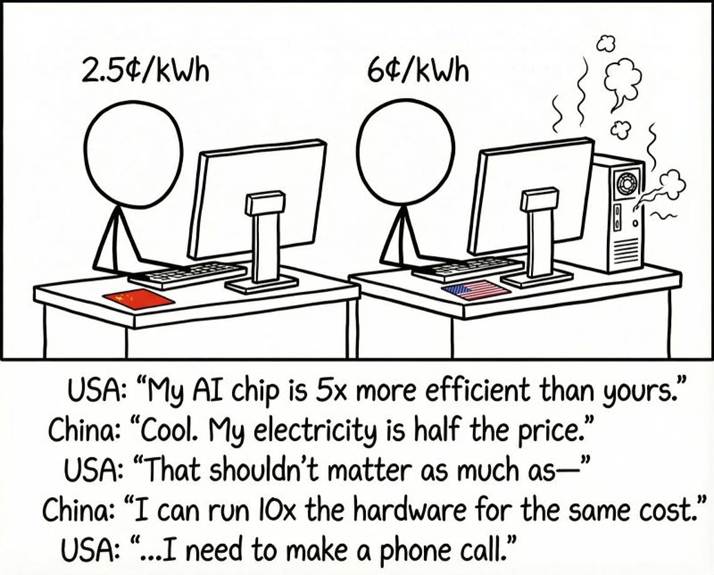
I came across this cartoon, on linkedin, which reminded me of a comment made at a recent ORG meeting that the UK cannot be an AI powerhouse because our electricity is too expensive.
It’s also possible that this is one reason why the bitcoin miners are now all located in China.
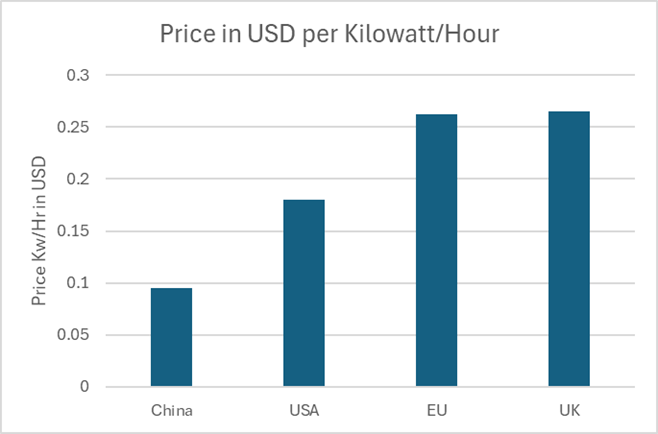
It set me thinking, and I made this chart.
International Energy Prices 2026: Source google
The UK is expensive, and it would seem that this is true of the EU too.
The linkedin article argues that China’s energy investment has been about energy sovereignty. Perhaps its time the EU and UK governments thought about these issues. …
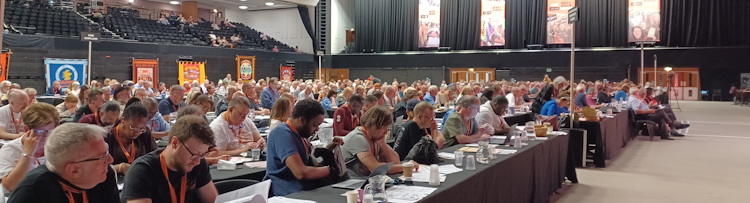
Both for the GMB, on the country at large, one of the most important debates that takes place at GMB conference is on energy and climate change. Today’s debate on Congress floor was fore shadowed in an article in the Guardian quoting the general secretary Gary Smith calling on labour to think again about his proposals to limit expansion of North Sea oil and gas extraction. This was reinforced by the Scottish region question to Kier Starmer in the Q&A session.
The debate occurred in two sessions. The first session passed M227, on the role of energy prices in the cost of living crisis and to prioritise work with the equality strands, also Composite 16 on prepayment meters, M234 on North Sea Oil & Gas, and M237 on water shortages.
The second part of the debate, held after lunch, dealt with M238 on costs and tax of decarbonisation, M239 on the Hydrogen Economy, and the need for a just transition on jobs and wages, M240 on electricity and 2030, 242 called environment which called for the GMB to run education programmes on personal energy efficiency and finished with a debate on M229 which calls for the re-nationalisation of the Electricity and Gas industries .
I have reproduced the words of the motions on North Sea oil and gas and electricity and 2030 below/overleaf, the other motions texts are published in the Final Agenda document on the GMB web site. Also, of interest and relevance is the CEC 2017 special report, which would still seem to be the baseline for policy. …
The Congress Political Speaker this year, was Sir Kier Starmer. The text of his speech is available from the Labour Press Office; like Corbyn he is not a great orator but that skill is exceptionally rare in today’s parliament. I feel the speech was tuned for a GMB audience, but no harm in that, provided the commitments offered are genuine, and not part of “I’ll say what it takes to win” strategy, although you’d have look very hard to find any new promises.
The video of his speech starts here, on YouTube. After the speech, GMB Congress asked each region to pose a question to Sir Kier. This year questions were posed on, the new deal for workers, the minimum wage specifically in social care industry, plans for energy industry infrastructure manufacture, plans for in-sourcing, public procurement and anti union firms, the blocking of new offshore mining licences, and finally, the regulation off hire & fire especially by firms in dispute with their union, but interestingly, despite a CEC special report on pubic sector pay, nothing on public sector pay nor on the public sector disputes,
The issue of the politics of energy supply and the GMB was fore-shadowed in an article in the Guardian, where Gary Smith, the GS, strongly criticised Labour’s plans to ban new North Sea drilling licences, in what might be called a “shot across the bows”.
Smith is quoted in the article as saying,
“We are critical friends of the Labour party and I think this is just a lack of intellectual rigour and thinking about where they have got to on oil and gas,” he said on Sophie Ridge On Sunday on Sky News. “They are focusing on what they think is popular rather than doing the proper thinking to understand what is right for the country.”
Below/overleaf I have posted the video of the Q&A session, and written a précis of the session. … …
In terms of developing public policy, one of the most important debates at GMB Congress is the Energy Industry debate.
This, like all the others is on Youtube and focus on two composite motions, one calling for continued investment in Sizewell C and the nuclear industry as the only reliable zero-carbon generator source, and the other calling on an acceleration of the use and creation of Hydrogen. The latter motion makes the point that with Tories globalisation strategy, capability and jobs in the renewable sector are often offshored. It does not call for the reopening of the gas storage facilities closedby the privatised gas industry which it should because electricity cannot be stored at scale, gas can be if you have the storage capacity. Much of what it says in the Gas motion would make more sense in the context of a nationalisation or at least a mandatory national plan. The motions calling for nationalisation were marked existing policy and so not scheduled for debate.
The CEC qualified its support on three of the motions stating that it could not support words that suggested discrimination against migrants, (hooray), could not support policies in breach of the WTO trade rules, although would campaign/lobby to change them and that it considered OFGEM to be a flawed institution and asking for anything from them would be a waste of time and effort.
Earlier in the day, two motions (140 & 141) were debated. M140 calls for an integrated approach to tax and subsidy on generation and transport for low-carbon energy. It was compellingly moved by Adrian Stohr with a brave statement about the limits of incremental change today’s energy infrastructure. M141 calls for a renewables development authority and an economic plan to reduce carbon in steel manufacture. Again, it mentions the import of goods, and the export of jobs and tax spend. …
The Economist reports that spot gas prices have fallen but that UK energy prices cannot because the energy companies have already agreed a price; this is known as a forward rate agreement.
Someone is making a shit load of money here because there is a secondary market consisting of options and CFDs. So either the Gas providers or the derivative market makers are making a lot of money beyond the excessive profits of the energy companies. The use of FRAs is, it would seem, is a poor decision. Maybe if OFGEM didn’t nod through the price increases requested by, the so-called energy companies, most are commercial billing entities, they would be more careful.
I recommend you look at the article as it has a chart, and references a further articles on the UK Energy Market and the broken gas market. …
A twitter correspondent posted a chart on European electricity prices, showing the UK as significantly more expensive. Is this legacy Thatherism, or Brexshite? Bit of both it would seem. There's more below/overleaf ...
This website uses cookies to improve your experience. We'll assume you're ok with this, but you can opt-out if you wish.AcceptRead More
Privacy & Cookies Policy
Privacy Overview
This website uses cookies to improve your experience while you navigate through the website. Out of these, the cookies that are categorized as necessary are stored on your browser as they are essential for the working of basic functionalities of the website. We also use third-party cookies that help us analyze and understand how you use this website. These cookies will be stored in your browser only with your consent. You also have the option to opt-out of these cookies. But opting out of some of these cookies may affect your browsing experience.
Necessary cookies are absolutely essential for the website to function properly. This category only includes cookies that ensures basic functionalities and security features of the website. These cookies do not store any personal information.
Any cookies that may not be particularly necessary for the website to function and is used specifically to collect user personal data via analytics, ads, other embedded contents are termed as non-necessary cookies. It is mandatory to procure user consent prior to running these cookies on your website.