The GMB and the single market

The GMB and the single market

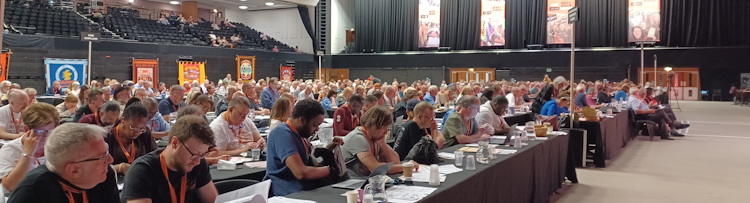
The GMB voted to rejoin the EU’s customs union and align with the single market yesterday. The text of the motion is below/overleaf as are the notes I used to make the speech. The debate is posted on youtube, I was supported by Joe Dharampal-Hornby. In the GMB, the Central Executive Council has the right to make amendments to all motions, these are called qualifications. The regional delegation, the moving entity,  have the option to accept the qualification or have the motion opposed by the CEC. I have reproduced the qualification below. We took the view that the qualifying comments on migrants and wages are an observation not a negation of the need to re-establish the reciprocal right to find and perform work throughout the EU. The debate followed the General Secretary, Gary Smith’s interview in the Observer. …

GMB23, EU Law Revocation & Reform Bill

Two motions from London Region were assembled into a Composite, opposing the Government’s EU Law Revocation and Reform Bill. I have clipped the video, the words of the motion and Bismilla’s speech identify the rights at risk, and I talk about the move to a government by decree with the repeal of laws being at the whim of ministers, who also gain the right to amend the laws if they so chose. The Union passed the Composite.

 …

GMB23: defending a new deal for workers

GMB23: defending a new deal for workers

Congress Composite C11 concerned Labour’s “A new deal for working people”. Hours before, Starmer had promised that this would be legislated for in the first 100 days. The motion, or the part of it that comes from London Region was designed to make it clear that there must be no backtracking and that the weaknesses in the proposals must be remedied. You can find Labour’s Policy statement here., the new deal for workers starts on P18 and cross references the green paper.

In my speech, see below or watch the video, I said,

The best defence against poor working conditions and low wages is a strong union movement, it has been since the Labour Party’s foundation that political and legislative programmes are also needed. There are many wrongs in UK employment protection law, and those members whose cases I help manage are often deeply upset that Britain the home of “fair play” has so few remedies for the poor treatment that they are suffering.

These are good documents but we need to ensure that the promises make it into a manifesto and into Government.

Apart from the failure to promise the repeal of pre-2016 trade union laws, the major disappointment is that the New Deal document promise on the minimum wage is unlikely to increase it. GMB policy is that this must be £15 per hour, we must reiterate this. The document is also sadly silent on statutory sick pay and redundancy compensation. It is necessary to rectify these injustices. The motion was carried, with qualification.

As in my other reports on GMB Congress, I have reproduced the motion, the qualification and the notes for my speech, which are below/overleaf. … …

GMB23, Energy and climate change

GMB23, Energy and climate change

Both for the GMB, on the country at large, one of the most important debates that takes place at GMB conference is on energy and climate change. Today’s debate on Congress floor was fore  shadowed in an article in the Guardian quoting the general secretary Gary Smith calling on labour to think again about his proposals to limit expansion of North Sea oil and gas extraction. This was reinforced by the Scottish region question to Kier Starmer in the Q&A session.

The debate occurred in two sessions. The first session passed M227, on the role of energy prices in the cost of living crisis and to prioritise work with the equality strands, also Composite 16 on prepayment meters, M234 on North Sea Oil & Gas, and M237 on water shortages.

The second part of the debate, held after lunch, dealt with M238 on costs and tax of decarbonisation, M239 on the Hydrogen Economy, and the need for a just transition on jobs and wages,   M240 on electricity and 2030, 242 called environment which called for the GMB to run education programmes on personal energy efficiency and finished with a debate on M229 which calls for the re-nationalisation of the Electricity and Gas industries .

The video stream for the 1st session starts here, the 2nd stream starts here, and the debate on M229 starts here.

I have reproduced the words of the motions on North Sea oil and gas and electricity and 2030 below/overleaf, the other motions texts are published in the Final Agenda document on the GMB web site. Also, of interest and relevance is the CEC 2017 special report, which would still seem to be the baseline for policy. …

GMB ’23, Workers and the World Trade

I seconded a motion on world trade governance, the motion welcomed Biden’s Inflation Reduction Act, which legislates for a Keynesian reflation and implements a state aid scheme which may be in contradiction to the World Trade organisation rules. The motion calls for reforms that will make the WTO treaties ‘worker centred’, oddly quoting the US Trade Representative, a role not well known as being in favour of workers or consumer rights. In my speech, I called this out, by saying, “We should be careful of the initiatives of the US in the areas of international trade, its commitments to workers’ rights abroad are to say the least variable. “

Heather and I worked on a proposing speech, but Heather was asked to use a speech written by the person that proposed the motion at the branch. I think ours was better, and some of what was said I disagree with. It’s a bit too autarkic.

Below/Overleaf is are a link to the video, the words of the motion and my notes for the speech.  …

LOTO speaks to GMB23

The Congress Political Speaker this year, was Sir Kier Starmer. The text of his speech is available from the Labour Press Office; like Corbyn he is not a great orator but that skill is exceptionally rare in today’s parliament. I feel the speech was tuned for a GMB audience, but no harm in that, provided the commitments offered are genuine, and not part of “I’ll say what it takes to win” strategy, although you’d have look very hard to find any new promises.

The video of his speech starts here, on YouTube. After the speech, GMB Congress asked each region to pose a question to Sir Kier. This year questions were posed on, the new deal for workers, the minimum wage specifically in social care industry, plans for energy industry infrastructure manufacture, plans for in-sourcing, public procurement and anti union firms, the blocking of new offshore mining licences, and finally, the regulation off hire & fire especially by firms in dispute with their union, but interestingly, despite a CEC special report on pubic sector pay, nothing on public sector pay nor on the public sector disputes,

The issue of the politics of energy supply and the GMB was fore-shadowed in an article in the Guardian, where Gary Smith, the GS, strongly criticised Labour’s plans to ban new North Sea drilling licences, in what might be called a “shot across the bows”.

Smith is quoted in the article as saying,

“We are critical friends of the Labour party and I think this is just a lack of intellectual rigour and thinking about where they have got to on oil and gas,” he said on Sophie Ridge On Sunday on Sky News. “They are focusing on what they think is popular rather than doing the proper thinking to understand what is right for the country.”

Below/overleaf I have posted the video of the Q&A session, and written a précis of the session. … …

Moving the deckchairs, new rules for the CEC election

Moving the deckchairs, new rules for the CEC election

The CEC also proposed to change the way in which its elected. This was done in a paper, “OUR RULEBOOK – A PROCESS OF CHANGE”. The current CEC is elected within the Regions, of which there are now seven rather than nine. The rule book review has been going on for a couple of months but in order to change the CEC composition, they needed to postpone the planned elections. Not changing the rules would have led to a reduction in size of the CEC which is probably a bad thing. Small committees are too easily dominated by leaderships.

They also took the opportunity to change the aims and objectives. They strengthened the Unions’, emphasis on workplace organisation, regulation of terms and conditions, international working class solidarity, the need for a political intervention and the accountability of GMB supported public officials to GMB policy. These are both welcome and overdue and represent an important restatement of the Union’s goals and focus.

So what changes are proposed to the composition of the CEC.

The paper proposed that the Union reduces the number of sections from three to two, and lets each Region define two additional industrial foci. One will have to work in these industries to represent them. I am concerned that allowing each Region to define their additional seats will cause a lack of certainty, illustrated by the creation of an additional seat in the Midlands Region for which only ~2,500 people can stand and a seat for the Irish members, and here I am unclear how many members would be eligible, but the number of members in Eire is very small.  I am also concerned that the definition of these new constituencies will be used to reinforce power within the union, not focus on growth.

All Unions have a problem in how to organize industrially and geographically. The CWU is probably the most industrially focused, the GMB are probably the most geographically focused. The proposals to have two additional industrial seats should help the union grow and organise, but again there needs to be more clarity as to how these seats are defined.

They are of course silent on the voting systems to be used in the few divisions that have more than one seat/winner. Using a form of proportional system would be of advantage to candidates from under represented groups; it’s easier to come second than first.

There are changes to the way that Conference delegates are chosen which should help women’s representation in big branches, but does not change the ultimate selection authority which is not the branch. Not all branches are represented at Conference, and disappointingly this has not changed.

It is also my view that moving the deck chairs on the top floor is not enough. The whole organisation needs to support these new representatives and industrial representation needs to be funded and democratically accountable to the members it seeks to represent. …

A hole in the wall?

A hole in the wall?

It was a strange day, the first day at Congress after lunch usually considers rules and internal issues which is what happened today, also the CEC has the right to produce special reports. One of its papers this year, was called, “GMB Taskforce for Positive Change Final Progress Report to Annual Congress 2023”. The Task Force was set up after the Monaghan Inquiry which found the GMB to be institutionally sexist. The Inquiry had been set up after sexual harassment complaints were made against the then incumbent General Secretary, Tim Roache.

As one might guess from the title, the report proposed winding-up the task force. Despite being only able to report completion of 11/27 recommendations with five yet to be started.

The rest of this article, below/overleaf looks at the arguments for and against winding up the task force, and reports on the debate to backtrack on Monaghan’s recommendation 3. …

How wrong was I four years ago?

How wrong was I four years ago?

I was tidying up my hard disk and came across the notes of a speech I gave GB 2019. I reported the speech on this blog but while many are saying that time moves on and things of changed, I feel the speech is prescient in its prediction of the failures of Brexit and the collective failure of much of the Trade Union movement to represent its membership. I wanted to say that the pusillanimous position of the CEC should be rejected as you can see in the speech. The 2019 European Parliament elections had just taken place showing the compromisers that the nation wasn’t willing to do that. It was make your mind up time. The Union leaderships allowed themselves to be captured by the Party. Anyway, this is what I planned to say, as they say on press releases, check on delivery.

President, Congress, Dave Levy, London Central General Branch, London Region, 1st time delegate, speaking in support of the CEC Special Report on Brexit

Brexit is poisoning politics and stopping us from addressing the issues that matter to people. It stops us talking about how a radical manifesto can heal the country from the ravages of both Thatcherite and 21st Century Tory austerity.

Not only do Labour’s promises of investment in infrastructure and education offer hope, the answer to low wages is labour marker reform, stronger minimum wage legislation, and to empower the Trade Unions and regulate management. It is not to blame migrants and to extend the hostile environment to another 3m citizens, our neighbours & fellow members and continue the Tory’s voter suppression, excluding them from votes to which they are entitled.

It has been clear since June 2016 and the failure of Leave.EU to articulate an exit model that there was always going to need to be a final say referendum. At the time, or shortly after I argued that the negotiations should be done by those that believe in it. That’s what happened but now we should be asked, all of us, those who voted leave,  those who voted remain, those too young to vote last time, citizens abroad denied their vote and EU citizens resident in the UK,  asked with humility if that is what is still wanted.

Constructive ambiguity is no longer an attractive position. It loses both remain and leave votes. This is proven to all except the most blinkered by last month’s EU Parliamentary results, the worrying subsequent polls and for those of us that have been out there, personal experience.

Labour lost nearly 60% of its vote, mainly to explicitly remain parties. In my home in Lewisham, despite the Council’s position of strongly supporting a 2nd referendum, the Mayor would be a LibDem. The inconvenient truth is that loosely aligned Remainers leant us their vote in 2017. We should also remember that most of labour’s members and presumably ours and voters want to remain.

While I can respect the voters who voted leave, the result is so criminally flawed that courts would have ordered a rerun if it had been deliberative. i.e. not consultative.

The CEC paper does not go far enough and while stating we oppose a no deal Brexit is welcome, that’s where we were in 2016 and yet we are now in an extension period and running out of time to get a satisfactory deal.

Imagine a worse case situation in the spring, a chaotic Brexit has led to queues on the M20, factory layoffs, food & medicine shortages and high inflation after a currency collapse. We will be telling people that all this is very terrible and should be fought, but, oops… if we actually facilitated Brexit, we won’t be heard. It won’t wash.

It maybe time to make up our mind if we want to alienate the majority or minority of our voters.

Labour’s Conference has been clear since 2016, on the basis of GMB motions that its position is to oppose leaving on inadequate Tory terms and now is the time to say that the Tory’s terms fail to meet our needs. Both May’s deal and No-Deal fails to meet Conference 16 policy; it fails to meet the six tests and fails to meet Conference 18’s thresholds. There’s no protection for jobs, employment rights, environmental protection or consumer rights. And no deal means the reimposition of a border in Ireland.

It’s time! We need a public vote and Labour should declare for Remain. There’s no other option on the table. I’d also urge delegates to look with favour on M xxx. . It’s not a London Region motion so we will listen to the debate before deciding which way to vote.

The picture is not of that speech, may equally not be the correct conference.  …

GMB agrees to “Oppose Refugee deportation to Rwanda”

My branch proposed an Emergency Motion on the Rwanda deportations, here is the debate, sorry about the sound,

and here are the words,

EM2. Oppose Refugee deportation to Rwanda

Congress notes that on the 14th April, Priti Patel announced that the UK and Rwanda would sign a deal allowing the UK government to send unprocessed immigrants to Rwanda. On the 10th April,  the High Court refused an application to stop the Govt’s planned removal of people seeking asylum by offshoring them to Rwanda despite the UN warning the Home Office off the likely illegality. This decision was unsuccessfully appealed on Monday 13th June 2022.

The move to offshore those seeking asylum is racist , breaches human rights and our international duties to welcome refugees which are embedded in  treaty commitments.

We instruct the CEC to raise awareness of the High Court’s decision on 10.6.22 ensuring our members working in detention centres and work ancillary to the detention centres are informed of the justice and rights of those in their care.

Congress agrees to support the actions of any members in the detention centres and other impacted businesses if they choose to refuse to perform work effecting the deportations

Congress calls on GMB sponsored MPs to campaign to reverse this programme, and for the Labour Party to oppose any parliamentary resolutions enabling this programme. They must recognise that many/most of the transportees are unprocessed asylum seekers fleeing threats of death and war.

London Central General

The CEC issued a qualification which is important to understand the position of the Union.  …