The Labour Party has published its plan for remediation of the failures identified by the EHRC report.
These things have a habit of disappearing and so I offer a mirror. It’s called an Action Plan, and written in PowerPoint and excel so that’ll work then. …
So Momentum have decided that unlike in their own internal affairs, that the best answer to the crisis in democracy in the Labour Party is to elect its General Secretary. I think this is wrong, critically, without a recall, this would be worse because the individual elected would have a mandate to do what they wanted. It would be poor even with a realistic recall mechanism. This article summarises my proposals, and republishes the idea of a member’s ombudsperson.
In my article, Labour Leak – Closing the Stable Door , I look at a series of reforms that Ithink would make things better. I argue that the Party needs better “controls”, segregation of duties, and better record keeping. I also argue for a new disciplinary system that needs a segregation of duties between, investigators, prosecutors, judges and a right of appeal and that it conforms to the principles of natural justice guaranteeing the right to a fair trial, innocence until proven guilty, the proportionality of any sanctions and that our rules respect the rights to privacy and free speech. The powers and inclination of the NEC to hold the GS accountable to policy, rules and law needs to be examined, there may be some changes that can be made but this is a cultural change, without a change of culture most of the rest of the reforms will fail. I also argue for a more professional management of money and financial controls, greater transparency on staff management, recognition of Chakrabarti’s comments on staff recruitment and management and accreditation by “Investors in People” and “A great place to work”.
There are a number of roles that should be examined to ensure they are sufficiently independent of the GS and the NEC and accountable to the law or their professional ethics. In this part of the article, I note, that proposals for an Ombudsperson were made to the Democracy Review but didn’t make it to the final report. I have with help retrieved the Ombudsman proposal as I think that it’s worth reviewing and should be part of a reconfiguring of the compliance function where the Head of Compliance is made independent of the NEC & GS and accountable to the rules and law. Compliance should tell organisations what they can’t do, while they retain the right to legal advice.
What’s needed is a renewal of a culture of decency so that the bureaucracy and the elected NEC members behave properly and fulfil their duties of trust. I have argued to change Labour’s rules to incorporate the Nolan principles as duty on all role holders but especially the NEC members, but unless recent wrong doing is punished, it’ll become just another policy to be ignored and circumvented. …
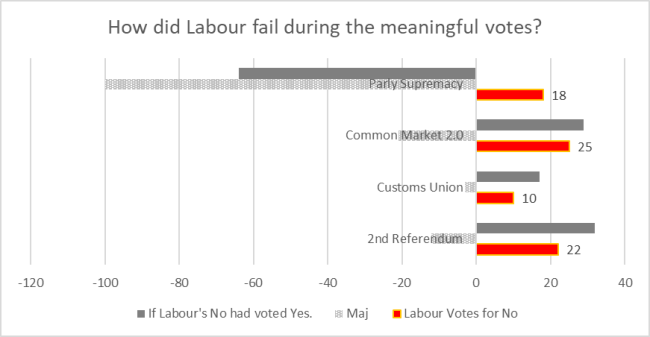
When the last Parliament had its Brexit meaningful votes, nothing passed. I wrote about the politics and consequences and said that others would write about Labour and the TINGE, it’s taken until now. My article is mainly just reporting but it seems I wanted a 2nd Referendum in which I would have campaigned for remain, The question I ask today is what would have happened if Labour’s No voters had voted Yes, the chart below shows what would have happened.
See https://en.wikipedia.org/wiki/Parliamentary_votes_on_Brexit#Second_Round_of_Indicative_Votes_(1_April_2019)
A requirement for a 2nd Referendum, the Customs Union and the so-called Common Market 2.0 which contained most of the single market commitments would have passed if Labour’s No voters had voted Yes. This isn’t a Labour problem made by Remainers.
I should add the other’s No votes to see the blame shared by the Lib Dems & SNP, maybe tomorrow and we should note that there were 91 Labour abstentions on the vote on Parliamentary Supremacy, (represented in Wikipedia as “Revocation of Article 50 to avoid No Deal”), enough to have changed the result but I have assumed otherwise that all abstentions were pairings and would not have made a difference. …
I wrote today to my MP and to Sir Kier Starmer about the proposal to vote with the Govt on any trade deal with the EU. The words were originally drafted by the Labour Movement for Europe. In Vicky's case this is not the first time I have written to her on this subject, the text of the letter/email is overleaf.
McDonnell is now proposing the left need to have a proper manifesto for Party reform with a clear plan of restructuring and reforming the Party. Would have been nice if that had been done when those like Dave [,that’s me that is,] and CLPD were pointing out these things years ago! Assuming McDonnell means it and is not just trying to divert energy to stop the current boat rocking it is a worthwhile idea. In my view the whole Rule book should be re written. It is a mess. A top to bottom rewrite to democratise the whole thing. Take away the kind of NEC discretion that gets abused , Local Govt selection rules, PPC selections, officers, Regional Officers etc. It means though a movement of ‘real’ democratic power to members. Jeremy and others talked about it but were not very good at giving actual power to members. The current leadership seem to be graduates of the Mussolini/Kim Jong Un school of democracy, so it is hard to see them agreeing to relinquish any real power to members. It is the right thing to do but it is hard to see it happening in the currently circumstances.
I am struggling through Minkin’s “The Blair Supremacy”, and have come across Eric Shaw’s reviews, which I plan to skim through today, but on the first page, Shaw states,
Minkin locates the origins of Blairite managerial thinking in the formative historical experience of its central protagonists, the internal strife that tore the party apart in the early 1980s. Blair, Brown and their allies were resolved to end what they saw as the party’s ‘dangerous proclivity to public exhibitions of internal conflict’ (p.131). Obsessed by what they saw as the party’s ‘lurch into extremism’ ‘New Labour’ was driven, Minkin cites one minister as saying, by ‘an icy determination that it was not going to happen again’ (p.130). Hence the core New Labour principle of party management: an electable party was one that was tightly managed and regulated.
Eric Shaw – The Blair Supremacy: A study in the politics of Labour’s party management
Looking at the disgraceful shenanigans going on at the top of today’s Labour Party, it’s clear we’ve been here before, although the New Labour project persuaded the Party to turn off it’s democracy; it didn’t impose it. Is this another example of “History repeats itself, the first time as tragedy, the second as farce”?
I have now read the EHRC Report, Investigation into antisemitism in the Labour Party, and this is what I think needs to be done. I have published some thoughts already and I believe that it is necessary that the Labour rectify its rules and culture to make it a place where discrimination is both absent and shunned, where perpetrators have the opportunity for contrition and that suspensions and expulsions are a last resort applied only after a fair trial. I am particularly incensed to find there has been no policy nor procedures to guide the investigation nor the determination of discrimination complaints because it’s so basic. However, before I look at the specific recommendations, I want to look at some context. The first is Human Rights law, and the second is that the failings are so basic that anyone of good faith will insist that any remedy is applied to all complaints and disciplinary processes and affairs because the failings are systemic, not specific to handling antisemitism complaints. The article then looks at what a fair and independent process might look like and asks that it take account of the ECHR’s Article 6 and 11, the right to a fair trial and freedom of association. It calls for the retention of the NCC and the provision of legal advice to ensure its independence from the Leader and the NEC. It recognises that the Party must be considered institutionally racist and that attempts to fix the problems have been dogged by factionalism. It calls for the adoption of the Nolan Principles. It recognises that things were worse under McNicol until Formby was appointed. It reaffirms that Labour’s policy and rules are made by Conference and not announcements by the Leadership. These issues are explored in greater detail overleaf …
It is clear from reading the EHRC report, Investigation into antisemitism in the Labour Party that things improved when Jenny Formby became General Secretary in 2018, but the EHRC’s sample data looked back to 2011. The EHRC report states several times that the failure to act on the Royall & Chakrabarti Inquiries is a failing and evidence of Labour’s complicity in the inadequacy of its processes. Much of the failure needs to be placed at the door of the then incumbent General Secretary, Iain McNicol, Formby’s predecessor, and the NEC members that allowed him to act with impunity. Additionally it should be noted, to give an idea of the scale of McNicol and Harman’s ambitions, that over 10,000 complaints were lodged over the summer of 2015, leading to over 5,000 suspension and nearly 4000 investigations, all of them with no policy to guide the investigators and the NEC members making judgement. To expedite the process the NEC set up a wonderfully named Procedures Committee to supervise this purge/examination of eligibility, it consisted of Harriet Harman MP, Margaret Beckett MP, the then general secretary Iain McNicol, Jon Ashworth MP, Keith Birch (Unison), Paddy Lillis (USDAW), Jim Kennedy (Unite), Diana Holland (Unite) and Ann Black (CLP). It’s interesting how some of the names are still around and even more powerful today; the Guardian story exposes how the committee rejected legal advice on using the canvassing records as reasons for exclusion. Canvassing records should only be used for the purpose for which Labour holds them, electoral campaigning, anything else is a likely breach of the electoral secrecy laws. I was advised that I must not use the canvassing records as a source of information when recommending people to be rejected as members or registered supporters during this period.
The Labour Party in an attempt to improve the antisemitism complaints handling process has changed its rules three times (Conference 2017, 2018 & 2019), the 2017 amendment removed/weakened the free speech defence, the 2018 amendment made breach of codes of conduct disciplinary offences and gave the General Secretary powers to delegate their authority to people other than staff, and 2019 introduced ‘fast track’ process where the NEC and not the NCC heard cases related to discrimination without hearings. These developments show that the Labour Party took the problem seriously but focused on end stages of the process and in doing so, ignored the investigation stage and decision to prosecute which the EHRC has excoriated. The Party also in making these changes created a special class of complaint, that of discriminatory behaviour, which is treated differently to bullying, slander, thuggery and breaches of the rules for factional advantage.
In the LRB review of Jones’ “This Land” and Pogrund & McGuire’s “Left Out”, the James Butler, says, that
His [Jones’s] account is an improvement on the defensive response that the public’s perception of the problem with antisemitism in Labour was distorted, or that positive changes were made to disciplinary procedures after they were taken out of the hands of anti-Corbyn party staff.
James Butler – LRB
This article is not an attempt to say that Labour solved its disciplinary problems under Formby, it clearly didn’t but she inherited a system far distant from what was needed. Its crap etherealness and its then and current inability to address corruption within the bureaucracy are further reasons why the EHRC recommendations should be pursued. …
It seems my proposal to ensure the Labour Party complies with Human Rights law has got lost somewhere on this blog, possibly inside a CLPD boost. I reckon, this is needed and so below/overleaf is my proposed words amending C1.X.5. ...
On Jeremy Corbyn’s whip, which Starmer has withdrawn, somehow, certainly in breach of the standing orders of the Parliamentary Labour Party. Momentum have drafted a letter to Starmer, Angela Rayner and the CLP Reps calling for the whip to be restored which you can send too. I have sent it although I amended the letter to make it clear that I believe it, and the original suspension to be in breach of the party’s rules, in breach of the EHRC recommendations and in breach human rights law, and the whip withdrawl is an act of double jeopardy. I also pointed out that in my experience, some of his supporters are now leaving as they consider the act unfair and unreasonable.
I consider it to be at least one of capricious, perverse, irrational and/or arbitrary. …
This website uses cookies to improve your experience. We'll assume you're ok with this, but you can opt-out if you wish.AcceptRead More
Privacy & Cookies Policy
Privacy Overview
This website uses cookies to improve your experience while you navigate through the website. Out of these, the cookies that are categorized as necessary are stored on your browser as they are essential for the working of basic functionalities of the website. We also use third-party cookies that help us analyze and understand how you use this website. These cookies will be stored in your browser only with your consent. You also have the option to opt-out of these cookies. But opting out of some of these cookies may affect your browsing experience.
Necessary cookies are absolutely essential for the website to function properly. This category only includes cookies that ensures basic functionalities and security features of the website. These cookies do not store any personal information.
Any cookies that may not be particularly necessary for the website to function and is used specifically to collect user personal data via analytics, ads, other embedded contents are termed as non-necessary cookies. It is mandatory to procure user consent prior to running these cookies on your website.