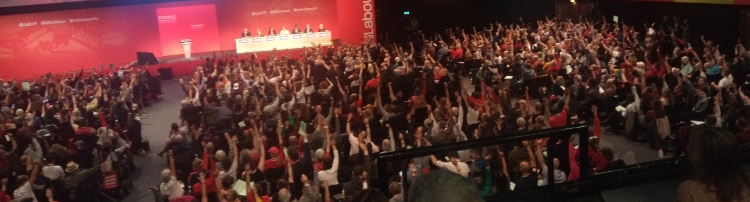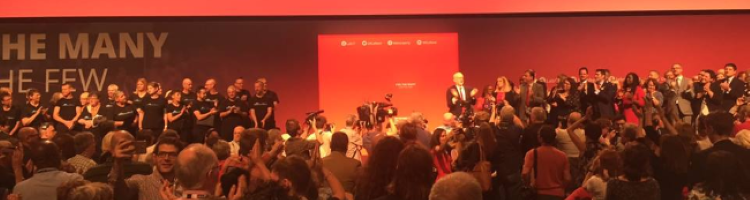
So we had a coffee and talked about the coincidence that in a room of 3,500 people that we should sit together as she observed, the number of people who will have read the paper is very limited, which is a shame.
Labour Conference failed yesterday to take the opportunity to declare itself a remain party. I am of course deeply disappointed. I am told of resignations already. The debate was conducted in the best traditions of the Labour Party which means lots of games were played. The quality of the debate was not good but one or two speeches shone out. This article documents the games played in the NEC, the composite meeting and on the floor and platform of the Conference hall itself. Read More ...
I missed most of Saturday but bumped into a friend and we discussed the culture around points of order, it seems there had been a few. I wrote about this last year and in that article I observed that “Point of Order: You haven’t called me, or people like me” isn’t a point of order. While talking to my friend, I remembered my transition from CPSA to SCPS; in the former, there were points of order all the time, and in the latter not, in fact, I still remember the strange faces I got when I moved my first point of order at SCPS. In some places it’s done, in others not.
I sort of wonder if the proximity of the average member to the student movement is a factor and the very high number of first time & young delegates. At GMB Congress, this year, there was only one point of order over 5 days, and they gave notice to the President and were called to the rostrum as an emergency agenda item. Also, I was asked if we i.e. London Region should move one on the CEC position on Venezuela. I demurred as the disruption makes one unpopular.
It’s sort of clear that conferences have a high or low point of order rate. It would seem in Parliament, the rate has gone up, much of them nonsense and in Parliament, they have a culture of allowing interruptions, so you don’t need a point of order to make your point. In fact, and it’s very rude to everyone else in the room, it is at times, or even mostly, used to jump the queue to make a point rather than wait to be called to speak.
I should also say, that, “Point of Order: the last speaker is talking bollocks” is unlikely to get you anywhere, as this little clip shows!
In fact, the Labour Party’s rules, at Conference, now make it clear that a point of order must start with a citation as to the rule that has been broken; eventually, they required people that want to make one, to quote their rule to the speaker desk before the point of order would be accepted. Good! People should consider, that all that can happen is that the Chair agrees with you, unlikely, or says that you are wrong and tells you to sit down, at whch point you can challenge the chair’s ruling for which you need a ⅔ majority. 🤔 Wonder if that would force a card vote!
I finish this little note with the observation that the acronym for Point of Order is POO!
Image Credit: Lenin: Right outside the Finland station (Finlyandsky vokzal), sits this statue of Lenin, looking out over the river. He might be raising his hand to catch the Chair’s eye to make a point of order. From flickr CC 2008 Stephen D Strowes BY-SA …
On Saturday, Labour Conference changed the rules as it pertained to the Local Campaign Forums now named Local Govt. Committees, the Rule changes were published in CAC 1 and I have made a copy that exclusively refers to Chapter 12, LCF Rule Proposal extract from CAC1
The key reforms are,
Voting power on the LGC will be ⅓ for the Council Group, ⅓ for the CLP Reps, and ⅓ for delegates from Trade Unions. This is voting power it is not dependent on the number of delegates.
Councillors may only sit in the Council Group class of delegates
The Leader/Deputy Leader are to sit on the LGC Executive.
There are strong, or maybe weak, but at least some rules to constrain Councillors from impacting seats they are interested in, but obviously not swapping favours.
CLP’s delegate numbers will be representative of the number of wards represented in the LA area.
The authority for the manifesto remains unclear.
This does not increase the accountability of the Labour Group.
Have a look and make a comment if I have missed anything. …
Jeremy Corbyn and Laura Pidcock made speeches to the TUC which covered the Party’s commitment to fairness at work. They commit to a worker’s protection agency to enforce the minimum wage and the necessary ban on zero hour contracts. To these two critical reforms the need to reduce the employment service qualification for access to Employment Tribunals should be added.
I have made a proposal to Labour’s Policy Forum to this effect, although I might be a bit moderate in that I suggest a 3 month period where others are asking for Day Zero. Absolutely, the 2017 manifesto was to implement Day 1 rights as it should be. You can login and vote it up if you like. …
I met up with some people who had seen Labour’s Conference Agenda items and they said that the following rule amendments were to be debated, or at least rules on the following topics. N.B. I have not yet read these, so my comments may be a bit off.
A proposal to amend the so-called three year rule on rule changes, allowing popular changes to be debated within the current three year moratorium.
There will be a rule change about OMOV for Executive Mayor’s and Council Leaders (& Deputies).
An amendment to re-establish Clause IV, the rule not the group
A proposal to permit amendments to motions at Conference.
A rule change to clarify the rules on access to membership data lists.
A rule change to permit BAME only shortlists; I have not read this rule change but am aware that this is likely to require legislation.
A rule change on democratising the LCF, barring councillors and increasing the size, and having 25% of delegates as TU delegates.
A proposal to submit both a rule change & a motion. Again I have not read this so I don’t know if it changes the number to be submitted beyond one of each.
A motion changing the rules to ensure the transparency of public official’s/candidate’s finances
A proposal to revise revision of disciplinary rule, C2.I.8. (I have not read this, but it’s a clue to search it out and read it.)
A proposal on greater diversity in CLPs.
It seems the NEC will be proposing to amend the disciplinary process. The desire is to create a fast track process but the fear is that they are proposing to fatally weaken the legally necessary separation of powers/segregation of duties between the NEC and the NCC. Obviously one needs to read it, but this sounds like one to oppose.
Rules are currently proposed to be debated on Saturday afternoon. Delegates will need all their credentials, including their card vote books which are *not* sent by post. …
In 2013, Edward Snowden, a contractor at the US’s National Security Agency blew the whistle on the NSA, and it’s five-eyes’ allies attempt to bug the whole of the internet, exposing the lengths that the intelligence services were prepared to go in building a surveillance society.
A debate exploded about the legality of their activities and we came to see the importance of their failed attempts under both Labour & Coalition Governments to legalise their activities with the Communications Data Bill versions 1 & 2.
In 2014, the Court of Justice of the European Union struck down the Data Retention Directive as in violation of the EU’s Charter of Fundamental Rights; in the UK a law was rapidly passed to leave the rights of the intelligence services in place.
Over time these surveillance powers have been extended by via both Legislation such as the Immigration Act, the Counter Terrorism and Security act which authorises Prevent and by “voluntary” agreement such as the #getitrightfromagenuine site programme.
This has been capped of by Theresa May’s Investigatory Powers Act, which has since been declared in contravention of the Charter of Fundamental Rights because the captured information can be retrieved for reasons other than serious crime and these retrievals are not reviewed by a Judge.
To this list we should add the Data Protection Act’s immigration exception, which means that immigration data is not subject to the GDPR rights of accessibility and correction.
At the centre of this is the intelligence service’s desire to treat everyone as suspects and to infringe their privacy without proving “reasonable suspicion”.
This is also about political power and how to exercise it; these measures are designed to take power away from us, from citizens and our neighbours.
If you look at the laws that underwrite the surveillance society, Immigration, Counter Terrorism and the DPA Immigration exception, you can see that the first victims of the surveillance society are migrants and ethnic minorities.
We should say and conference must state that freedom of expression and the right to privacy are universal human rights, that the current surveillance and investigatory powers regime is in breach of these rights.
It’s time for Labour to get on the right side of this debate, for too long the portfolio has been in the hands of fans of, or those that fear the securocrats.
250 words is too short to make the whole argument which is why I propose a commission to develop the policy further.
This motion is unlikely to be passed elsewhere so it’d be great if you voted for it and agreed to send it to conference.
The motion carried but we decided to send a great motion on social care. Does anyone have time to put it to conference? …
I cancelled my direct debit to momentum. I find I can no longer honestly represent my politics while remaining a member. Their lack of democracy and transparency means that I have no confidence it speaks for me and even when I agree with it, its agreement diminishes my voice. … …
This website uses cookies to improve your experience. We'll assume you're ok with this, but you can opt-out if you wish.AcceptRead More
Privacy & Cookies Policy
Privacy Overview
This website uses cookies to improve your experience while you navigate through the website. Out of these, the cookies that are categorized as necessary are stored on your browser as they are essential for the working of basic functionalities of the website. We also use third-party cookies that help us analyze and understand how you use this website. These cookies will be stored in your browser only with your consent. You also have the option to opt-out of these cookies. But opting out of some of these cookies may affect your browsing experience.
Necessary cookies are absolutely essential for the website to function properly. This category only includes cookies that ensures basic functionalities and security features of the website. These cookies do not store any personal information.
Any cookies that may not be particularly necessary for the website to function and is used specifically to collect user personal data via analytics, ads, other embedded contents are termed as non-necessary cookies. It is mandatory to procure user consent prior to running these cookies on your website.