There’s no useful half way house

Earlier this month, Michel Barnier made a speech in which he suggested that the European Union would welcome the United Kingdom rejoining the EU even with some of the opt-outs previously negotiated. Barnier is very clear that he is only talking about Schengen and the Euro. The huge problem with the speech and the suggestion that opt-outs remain on the table is this will be interpreted by lukewarm supporters and political weathercocks as permission to haggle on the terms of re-entry.  
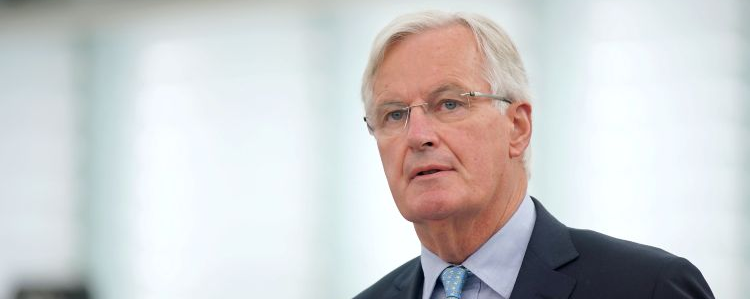
Michel Barnier – European Parliament cc 2019 BY

The unacceptability of UK opt-outs within the EU, specifically, staying out of Schengen and the Euro, is illustrated in a recent You Gov poll. Unfortunately, for rejoiners, the French and Germans will only accept a UK application if it includes Schengen and the Euro, while support in the UK falls if we do not rejoin on the terms we had. It would be interesting to note what people believe those terms to be, as apart from Schengen and the Euro, they include a partial opt-out from the justice pillar, together with the famous rebate.  

I am concerned that while a number of campaigners have been trying to prove their cleverness by suggesting there’s ways to rejoin without agreeing to the Copenhagen Criteria, others have been encouraged to consider EU membership as an a-la-carte process. It is not.

On the question of opt-outs, we, i.e. rejoiners need to show some leadership. Schengen comes with the right to freedom of movement. This is a popular and positive benefit of full membership of the European Union. Politicians, particularly Labour politicians should be showing some leadership.  The opt-outs are gone; there may be some technical reasons why Schengen and the Euro will take some time but being a net contributor is one reason why we’re wanted and full membership of the justice pillar gives each citizen access to the Court of Justice of the European Union acting as a backstop against the authoritarian instincts of the British State with judges appointed by the children of opponents of fascism and Stalinism. Being members of the Digital Single Market would have the benefit of defending our democracy against US Oligarchs and Putin.

I want my European citizenship back, I want to vote for MEPs and a Parliament that appoints a Commissioner and Judge, and has a seat on the European Council. And since this is a metaphor in common use, I want it in my lifetime. I also want to participate in improving the democracy of the EU to make it accountable to the views of citizens and residents.

Another reason for pace, is that the EU is about to move on in a big way. Many argue that its changed too much to rejoin anyway; it’s not yet true and just something that Brexiters say but if the industrial policy takes off, it will damage the UK’s ability to export and further damage supply chains. …
After Makerfield, what next?

Is winning in Makerfield a new dawn for Labour, or just that this time, voters chose Labour as the “Not Farage” candidate. Since they won in Runcorn & Helsby, Reform have failed in Caerphilly, Gorton and Denton, and now Makerfield, losing to Plaid Cymru, the Greens and now to Labour. It was a great victory for Burnham and Labour, but the question has to be asked together with has Labour learnt the lesson that to fight Reform, you need to fight it. (I think not!)

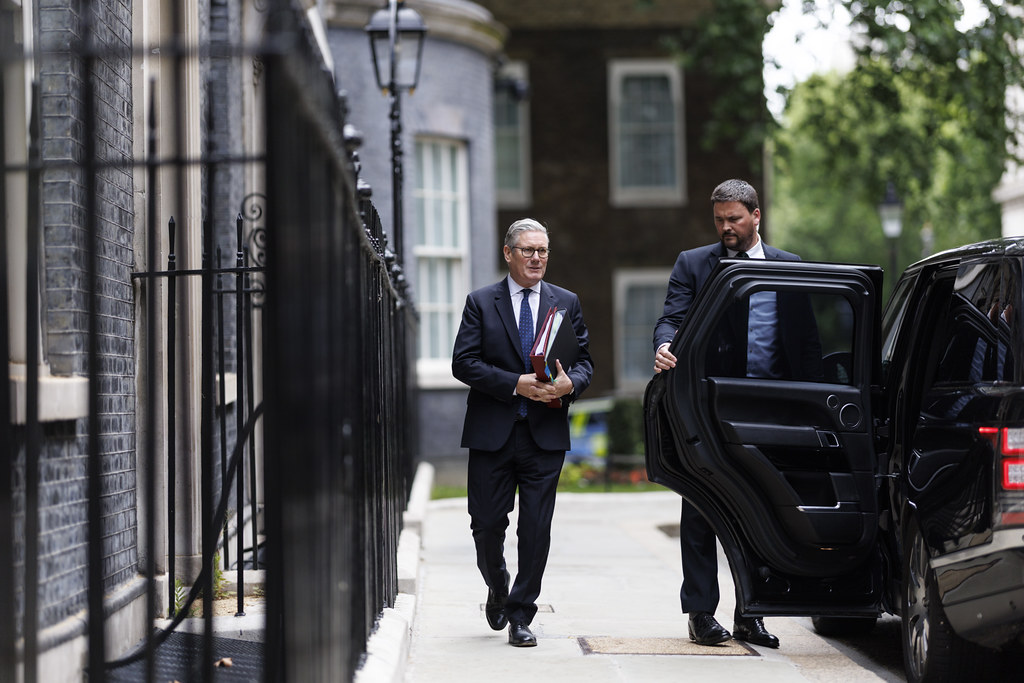
Source: No10@flickr 10th June 2026 CC 2026 BY-ND-NC

Having returned to the House of Commons, Burnham has forced Keir Starmer to resign and a time table for a Party leadership election has been declared.

Much has been written about why he had to go; I have been calling for it since February when the likely defeats in Scotland and Wales became obvious. On the day, Labour also lost three more London Councils.

Starmer’s resignation speech starts in the same way as his election campaign to be leader of the Labour Party, with lies. When Starmer inherited the Labour Party, it was in the strongest financial position it had been for decades and anyone who has closely read the Forde report and the EHRC report knows there is still work to do to eliminate racism from the Labour Party. The focus on macroeconomic statistics repeats the mistakes that Biden made. While I do not subscribe to the meme that “perception is reality”, perhaps it is truer in politics than in engineering. Claiming the credit for growth doesn’t work if income equality remains at the current miserable level and if the growth in the economy goes into the pockets of a few. If people don’t feel better off, then it’s pointless claiming they should. It’s also difficult to understand, how Starmer can claim credit for the abolition of the two child benefit cap when he initially suspended seven MPs for voting for that abolition.

Much has been written about Starmer’s weaknesses as a politician and Prime Minister. For a lot more words you can check out Jonathan Freedland in the Guardian, who focuses on personality and the politics of Downing St., and fails to mention Gaza and the Middle East, and alternatively, Phil Burton Cartledge, who does mention them, together with the dishonesty of his mandate within the Party. Phil also repeats his accusation that Starmer and McSweeney deliberately sought to break up Corbyn’s electoral coalition.

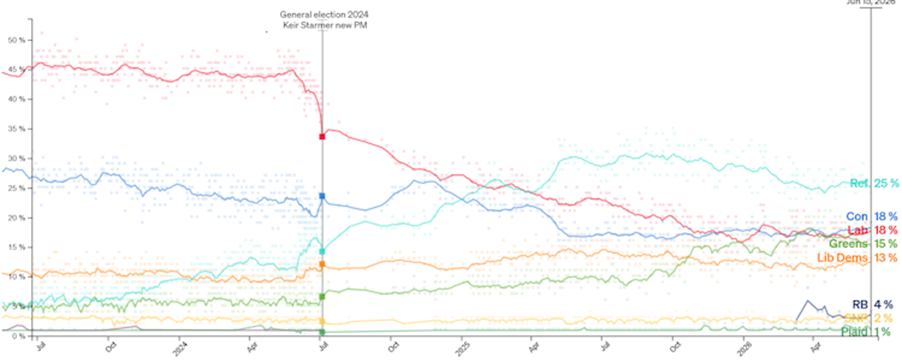
 Although some would seek to claim he’s been good on the world stage; this does need to be contrasted with his speeches and actions on Gaza, which is one of the primary causes for Labour’s loss of political support. Labour started the general election campaign with a poll score of 44%, finished with a vote of 34% which has since  collapsed to a score in the high teens.

Source: politico.eu – British polls 24 June 2026

It is expected that Burnham will be crowned as Labour’s new leader. If so he will be beholden to the fixers and not the membership and his retreats from his beliefs in order to win Makerfield are worrying because Labour and the country need a change of direction not a change of personnel.

The new leader also needs to turn Labour’s democracy back on. It is clear from the ending of Blair’s New Labour government that this Government and Labour leadership have run out intellectual steam; the Party needs debate and new ideas to sustain its relevance and energy.  We can also see by observing the last two years of the PLP what happens when MPs fear their whip more than their members and voters.

Clive Lewis, in an article entitled, ‘After Burnham’s Win in Makerfield, the Answer Cannot be Managerial Politics with a Different Accent’, speaks for me, when he says,

“Climate breakdown, war, energy insecurity, financial shocks, technological upheaval, and democratic decay are here. They will not wait for Labour to finish its management seminar.”


 …

On “Stop killing video” games

On “Stop killing video” games

The ECI “Stop killing video games” was accepted as having reached its one million signature threshold earlier this year. The initiative seeks to prevent the remote disabling of videogames by their publishers. They also say, this prohibition can be met by providing means for the game to continue functioning  independent of publisher. This article looks at the Commission response, the campaign’s next steps and questions the Commission’s strategy in responding to ECIs. …