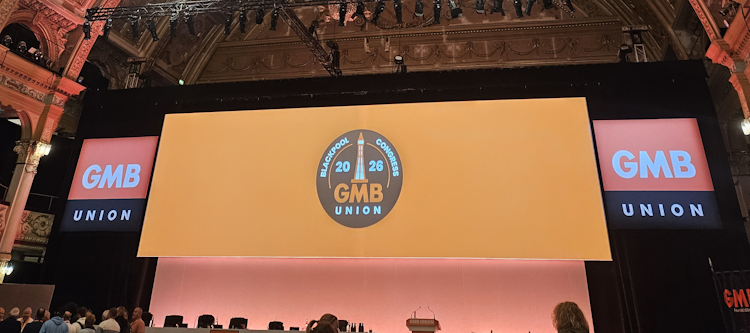
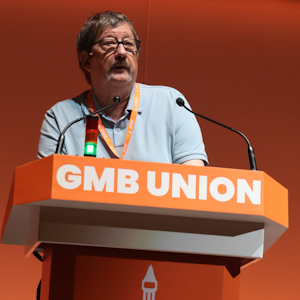
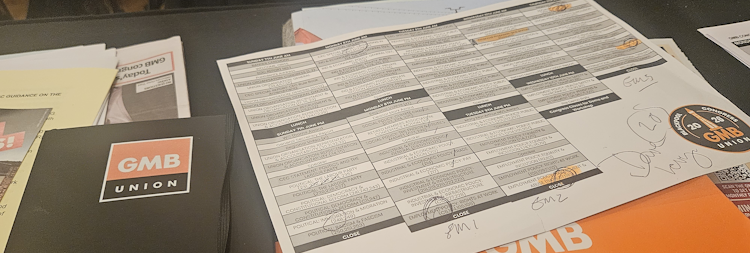
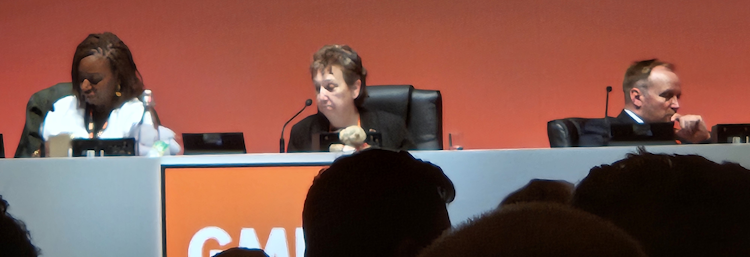
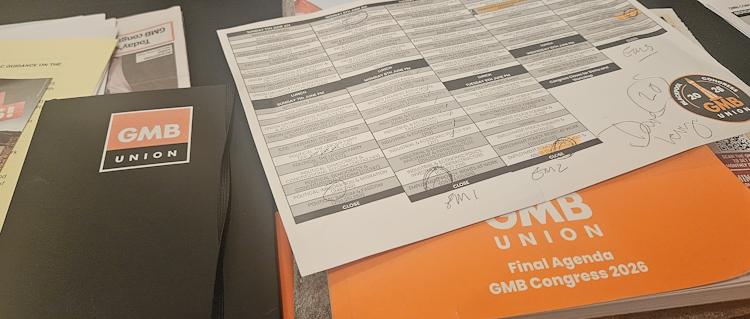
The debate on Employment Rights, started the day, and dealt with Composite 6 and motions 104-6 pp 73-74 in the final agenda document. The debate is published on youtube. I have clipped the whole debate so that you can see/hear the CEC reply to all four motions.
Composite 6 Employment rights bill is on pp163-164 of the final agenda document. It argues that the compromises necessary to secure passage of the ERA were needed and necessary reforms and that further legislation is needed. Below/Overleaf are my speech notes and links to the motion texts. I also comment on two important topics, bullying and 3rd party removals. …
Congress then considered its policy on the Water industry. This took place in two debates.
The first was on a composite motion, C13 p169 in the final agenda document, entitled, “Public interest environmental reporting, GMB seat on new water super regulator, and trade union representation on water company boards. “
To me the purpose of the motion, is well summed up as follows, when decisions are taken behind closed doors, accountability & transparency suffer! This debate was followed by a guest speech by Fergal Sharkey.
…
Later in the day, we debated, M222, p122 in the final agenda document, 222. Proposal to design oil and gas exploration contracts in the UK for the benefit of British citizen .
This argues for nationalisation and/or the adoption of the Norwegian model,
When people criticise motions on trivial grounds, which I am about to do, I often claim we are not writing legislation, that he direction of policy is good enough, which is so for this motion. The motion does not recognise that Norway has a special petroleum industry tax, and that it also acquires value through its state ownership of the industry and its supply chain, but writing and designing fallback positions is very difficult. Zak Kahn’s moving speech is very good. The debate is published on the video stream, and since the CEC supported the motion, I have clipped the moving and seconding speeches.
There followed a debate on investment and infrastructure, which was well informed, arguing to protect farm land, yet reinvest in manufacturing, I fear we’ve missed the boat on renewable energy as a manufacturing competitive advantage, the failure of the giga factory and the windmill company. Google AI perspectives tells me, “The United Kingdom is a global leader in renewable energy generation and deployment—particularly in offshore wind—but lags significantly behind major global competitors in domestic manufacturing of clean tech hardware.” I also fear that we are starving the universities and the NHS of research funding, so it’s unlikely that the next technological breakthrough will occur within the UK. Greater access to Horizon Europe would of course help in the development of ideas on which growth can be built. (The more I examine the question of industrial policy, the more I can see the damage that the Tories did to the UK’s productive capability. Brexit of course is one culprit, but their refusal to engage in an active industrial policy is another, illustrated by permitting the further collapse of British steel and as identified elsewhere within this report the ceramics industry. ) …
Current Congress policy is recorded in the GMB’s policy book and the key differences between GMB policy and the more radical campaigners is that it wants to see the new jobs before the old systems are turned off, their goal is 2050, they support nuclear power and retaining gas as a source of consumer energy. Importantly the GMB wants to see the energy companies renationalised. The union still has policy supporting fracking and to issue more drilling licences in the North Sea.
The motions debated were M293 and 294 available in the final agenda document, also here, and the debate is recorded on the video stream. I congratulate Val Brooks moving M295 for her speech. Both motions call for the development of campaigning coalitions and for member education. They are both steps away from the hard luddism of some elements of the GMB. There may be room for hope because the big problem with the GMB policy is that given a choice between jobs & members and net-zero, GMB’s leaders choose jobs. They show little understanding that “Just Transition” is two words.
For procedural reasons, I only have the CEC comment/qualification on M294, they say,
The CEC is seeking to refer this motion to explore further working with our worker-led Workers Power the Future campaign and Climate Jobs UK, which is a coalition of trade unions representing tens of thousands of energy workers, campaigning for a jobs-first clean energy transition that delivers high-paid, high-skilled work here in the UK.
The CEC does not agree with the motion’s assertion that GMB has “failed to identify and articulate broader long-term interests of workers and how jobs can be sustainable” given our longstanding work with the above two initiatives which has been precisely to empower our members to have their say over the nature and type of work that they do and play a role in determining the future of their industry.
It remains GMB’s belief that our belief that there are paths for all the GMB-organised industries to play their part in meeting the net-zero emissions target. It must be recognised however that some industries will always be difficult to decarbonise, and while every effort should be made to achieve carbon reductions within individual industries, it is the overall balance across the UK that counts. Any decarbonisation plans should also be subject to full and genuine consultation with the workers who are most affected by industrial change.
I have never heard of the two campaigns and agree with the motion that the GMB has failed to identify and articulate broader long-term interests of workers and how jobs can be sustainable. Given the choice between renewables and legacy energy systems, GMB chooses the latter, the phrase, “it is the overall balance across the UK that counts”, is basically code for agreeing to keep dirty energy systems running. The good news is that this is being questioned by members and delegates
It’s a difficult problem for the GMB, I hope it finds a way to do the right thing by the rest of the country. …
This is quite a long paper consisting of 23 pages. I made a personal wiki page, Notes on the GMB & AI. I passed the special report through two LLMs to summarise and deduplicate it, this final summary is available on the wiki page. Its headings are: Workers’ Rights and Collective Bargaining, AI Regulation and Worker Protection, Transition Support, Skills and Training, Apprenticeships and Industrial Strategy, and Employment Security. I am of the view that the summary could be further distilled.
One of the best ideas might be the demand to create a “Just Transition Fund” for workers displaced by automation or autonomous vehicles, funded through industry levies.
On reflection, the paper is not revolutionary, nor in reality particularly organisationally focused; AI adoption is clearly, a least to me, an issue where political power and strong state regulation is needed. It’s likely that the classic trade union approach of “what’s in it for me” is not enough, although personally I am a sceptic and am deeply unclear that there is a +ive ROI in using LLMs and that the biggest threat is the sunk finance cost in the rapidly ageing infrastructure,
Matt Williams of the CEC gave a powerful advocacy of how it can work, although given where he works, his employer, one of the contractors building the nuclear power stations, will be a late adopter of AI because AI gets things wrong which is unacceptable in nuclear power management, it can’t yet perform construction work and it may not be cheaper to run the project management software with AI support.
The debate was under special report rules, is available on the video and I spoke for London Region.
My words,
President, Congress, Dave Levy, London Region speaking in support of the Special Report.
Work is changing around us and changing fast.
New rights on paper will only matter if we turn them into real workplace power through strong organisation and updated agreements that reflect the modern economy.
We need to use the new freedoms in the Employment Rights Act to win better recognition and better agreements, otherwise workers will be left to navigate an underfunded tribunal system, while employers bank the benefits.
AI is already in our members’ workplaces and on our desktops – not as a distant threat, but as a daily reality.
The report is honest: AI is not necessarily the enemy – it is the boss’s intentions that matter as has always been true.
Used with workers, AI can cut drudgery and improve services; imposed on workers, it risks discrimination, surveillance, deskilling and displacement.
We demand consultation when tasks are automated, guarantees of redeployment and paid retraining, and stronger legal protections on data, bias and automated decision‑making building on the rights established by the EU’s GDPR and its UK implementations.
Our existing agreements were written for an analogue world, not one of algorithms, data centres, continuous surveillance and automated vehicles.
We need new agreements that say that no dismissal or disciplinary decision should be based solely on an algorithm; and AI should not be introduced without genuine consultation, risk assessments that cover health and safety and equality and data protection before anything goes live. We need to engage with the GDPR data privacy impact assessments.
As a union we need to link AI to the wider fight on skills and industrial strategy.
The report reminds us that rights are meaningless without jobs – and that without serious investment in skills, technological change will deepen regional inequality and de‑unionisation.
The report is very clear: we should treat AI as another organising issue.
I do have a concern that maybe it’s not the next big thing, and we should be arguing politically for greater regulation, and a cautious planning approach for the data centres.
But Let us leave Blackpool determined to organise harder, bargain smarter, and go back to every employer we deal with and say – our agreements must change, because the world of work has changed, and workers deserve protection, power and a say in every decision that shapes their working lives.
The debate was recorded on video and several of the speeches are really quite good. I have said previously that the “special report” format will often reduce debate in the union especially on a topic like this where negotiating ideas and demands are only just being tested .
At lunch time, the London Region held a fringe on the topic of AI. The speakers were Dr Antonio Weiss, an independent expert and author, Jenni Tennison of Connected by Data, Dawn Davidson of Whistleblowers Uk, Aparna Surenda, an employment solicitor from AWO.
There was massive interest, by which I mean that all the speeches/questions from the floor were well informed and seemed to come from workplace engagement not a hobbyist’s interest. Given the restrictive nature of the debate format in the Congress Hall, it was good to hear from shop stewards and reps that were engaging. The promise by Steve Garelick of London Region to continue to engage with the shop floor on this issue is hopeful but perhaps it needs a national committee.
The panel introduced me to the term bossware, I hadn’t heard it before but the GMB and many of its members particularly in Amazon and Uber will be used to it. It’s an enhanced form of surveillance and needs to be resisted as it is dehumanising for the workers and dangerous for their customers. While automated/autonomous vehicles were not raised at Congress or in the fringe, there will be pressure from the US software/vehicle authors to permit them to be used.
We briefly spoke of how to organise in the hyperscaler service providers and noted such tools as the corporate compliance requirements established by the GDPR, such as whistleblowing to the DPO, using the GDPR & engaging with Data Privacy Impact Assessments. I may have mentioned European law and the digital market, the GDPR and the AI act. The GDPR adequacy agreement is one means by which we can acquire enforceable rights from European law, extending the Trade & Co-operation agreement and the “Reset” would be others. Full membership of the EU single market or political union is a third.
If these laws aren’t sufficient, we can and should use Health and Safety laws, although H&S enforcement hasn’t helped us in the Amazon warehouses.
One of the platform speakers raised the issue of copyright, framing it as stealing to fuel the training processes. It’s not, such propositions misunderstand the ‘training process and fail to understand that we probably need different intellectual property laws, for science publishing and art.
The notes I took when composing my intervention, are that,
It is a massive threat to privacy.
There is no evidence for an ROI through job loss.
It’s a bubble based on circular debt, which maybe the biggest risk.
Yesterday morning, we tturned tot the topic of immigraion. This debate consisted of two motions from London Region. I usually post the words and my speech notes to these blog reviews, but motion 249 in particular is quite long as is the CEC qualification. I have posted the motions and qualifications to a document; they can be read here, or the motions can be found in the final agenda document.
I made a video clip of the debate. I moved the second motion and was able to commend the speeches of Mark Livingstone and Jonathan Coles on M248 p132, and in fact commented in my speech that I felt they humanised the issue in a way that I do not, as did Funmi Nwagagbo seconding M249.
By proposing and passing these motions, we establish that the GMB opposes the policies pursued by the Starmer administration of making entry to the UK harder and that we oppose the vicious rhetoric of the Home Office. We support a right of entry to workers, and refugees, oppose the extension of the waiting period to allow application for indefinite leave to remain and citizenship, oppose the restriction on family reunification and the offshoring of refugee processing.
Here are my notes for my speech,
President, Congress, Dave Levy, London Region moving motion 249
Over the last few years, the GMB has been developing stronger policy on immigration centred around the rights of immigrants, decent treatment for all citizens, and the inclusion of new arrivals in a relationship of solidarity in our communities and workplaces.
Last year we also explicitly opposed the suspension of the Syrian refugee route of entry as unacceptable and wrong.
We also called for the repeal of the Tory immigration legislation, for a guarantee of safe and legal routes for asylum seekers, day-one rights to work, education, and social security for asylum seekers and a right to family reunion for asylum seekers and citizens.
Our Labour Government’s response would seem to be to do the exact opposite. Being in the room would seem to have failed on this policy area.
Over the Autumn, the newly appointed Home Secretary, Shabana Mahmood, made two announcements, “Restoring Order and Control: A statement on the government’s asylum and returns policy”. which was supplemented by A fairer pathway to settlement which extends the time required to obtain Indefinite Leave to Remain and to be eligible for citizenship.
The worst of these proposals include measures to prohibit entry to families of researchers, the extending of the time required before obtaining indefinite leave to remain, the residence longevity before access to citizenship, and the recurring visa costs are which are discriminatory, cruel and counterproductive.
We should be welcoming migrants and refugees and extending them the solidarity on which our movement is based. People without rights will find it harder to build a secure life, to join unions and offer us the solidarity we need.
These measures in particular the proposal to make refugee entry subject to review is a fundamental attack or refugees ability to build their lives having fled from the fear of death or torture.
It would seem that the intellectual driver, if you can call it that, of this these proposals is the current Labour Party strategy of triangulated against reform, pursuing the failed strategy of courting “hero voters”. When will they learn that Labour can never win racist votes through the pursuit of racism. Reform voters are not going to vote labour. The movement can’t fight reform by copying them, all it does is legitimise their politics.
This union needs to say No as it has done for many years and seek to persuade the Labour Party in government this is the wrong way to build a better society.
The CEC might also like to consider an action plan as it would seem our previous one has not been effective.
I believe that the movement cannot outperform Reform UK on this topic and that we and the Labour Party must stand for an immigration and refugee policy based on dignity and welcome.
For some reason, a motion on the cost of living crisis (M242, pp 131) was debated in this section, I note it because of the coherence and power of the moving speech by Margaret Lewis which gets to the bottom of the failure of the Starmer government and in my mind should have been the centre piece of Gary’s speech. See the youtube clip. The CEC asked for referral as the motion focussed on machinery of government and not on policy outcomes. …
Congress moved onto a debate called “Politics and the UK Constitution”. My branch had submitted a motion on proportional representation for Westminster, but failed to get support from our Region, so I withdrew it in the knowledge another Region has passed a similar motion. When we got to Blackpool, we discovered that that motion had also been withdrawn. One of two important lessons I learnt or re-learnt in this case, delegates need to be committed to the policies of their branch and their motions.
We debated a motion on rectifying the injustice to voters of MPs crossing the floor. It seems simple, but one of the speakers started from the assumption that a vote was a positive affirmation of support, which is violated when an MP or Councillor crosses the floor. Under 1st past the post this is not necessarily true, people often vote against people rather than for them, and now we can see that the electorate need to be protected against the malicious use of disciplinary and membership rules by parliamentary and council caucuses. The CEC asked for, and Conference agreed to refer the motion to the CEC. …
On Sunday afternoon, on day one, the CEC presented a special report on “Politics and the Labour Party”. For special reports, each region is asked to make a speech, and no other speeches are permitted. It is unusual but not unheard of that Regions oppose the CEC and on this debate Southern Region opposed the paper. A Southern Region branch also moved a motion (231), calling for a consultation on political strategy, and a special rules revision conference to discuss the consultation.
The CEC Paper is to my mind too complacent about the achievements of the Starmer government; the paper concludes that political organisation is about power and influence and that Unions must organise politically just as employers and wealthy interests do. Remaining affiliated to Labour gives GMB the best opportunity to secure better jobs, stronger rights and a fairer outcomes for workers, together with the ability to pursue other policies of interest to the union’s membership. They also argued, correctly in my mind, that pursuing additional political affiliations would likely weaken, rather than strengthen, the union’s influence as should the Union spend money on a Party that opposes Labour, Labour would expel it as they did the RMT in 2004.
Motion 231 argued for the building of a new workers party, standing and supporting workers candidates, and calling for a conference across unions to build a political alternative for workers based on a pro-worker, socialist programme. The choice in the motion was quite clear.
The debate is on the video, and there are some good speeches and some not so good.
The basic weakness of the arguments in maintaining the status quo policy is shown by the shopping list of demands that the Labour Government has failed to deliver, often at the behest of its own internal factional interests, these include, the remediating the poverty of the WASPI women, a failure to meet GMB & TUC aspirations on the minimum wage, together with the social security cuts proposed and then back tracked. Apart from Sharon Yates speech, who spoke of the ceramics industry, no-one addressed Labour’s industrial policy, although Les Timberly and Fazuma Umma presented lists of disappointments, inc. Labour’s policies and positions on Palestine and Gaza. It’s true that being at the table gives the Union power; I just wish we had more confidence that the whole of our policy portfolio was pursued as vigorously as our positions on Gas, Oil, Ukraine & Nukes.
The speakers opposing the CEC were calling for a consultation and the great weakness is that, while people only agree when it suits them, that Congress has no need to consult; it is the sovereign policy body of the Union. While their criticisms of Labour representing the working class, maybe based on fact, some of the language around this issue could have been delivered by Reform politicians. I also doubt as claimed, that more GMB members voted Reform rather than Labour, but I suspect that very few in the room have read the level of opting into the political fund which is at a historic low.
The CEC paper was carried, and the alternative motions fell.
I feel that over the period of Starmer’s opposition, the GMB and TULO have in my opinion sold us short, in terms of what we expected and with the exception of the New Deal for Workers has allowed Labour Together to write the manifesto and the government programme. If the GMB had pursued and won the full spectrum policy initiatives then the first two years of the Labour Government might not have been so disappointing. The Union leaderships, and not for the first time, sold us short.
I am pleased that we remain affiliated, but I wish that the GMB leadership showed more sympathy and pursued all the policy aspirations of the GMB. …
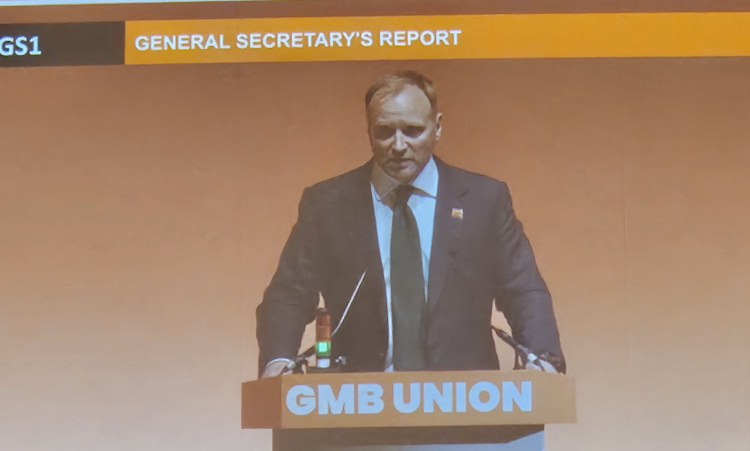
After lunch, Gary Smith presented the Annual Report. In previous years, I have entittled the article, “His Master’s voice”. I should note that he has been re-elected unopposed for a second term as GS.
In his speech, also on video, he toured around the regions highlighting what he saw as important campaigns, one of which is the Midland Region “Save our Ceramics” campaign. [I am curious if they understand its role in future computing architectures, I asked google, “how important is ceramics to future computing” and while the AI perspective was quite interesting, I was not impressed with the sources.] Gary mentions in passing the government response documented at government steps in to back long term resilience of UK’s chemicals and ceramics industries as an indicator of success of the ceramics campaign.
On politics, he almost expresses disappointment in the Labour Government but says that he doesn’t believe in washing the dirty linen in public, but that he has made it clear that they have been “too slow, too timid, and to open to business lobbying”.
He looks at the Greens and criticises them for jeopardising jobs in defence and energy, concluding this part of the speech with the statement, “Hands of our Jobs”.
I feel, that the Union’s soporific support for Starmer is a blind alley that makes it difficult to campaign politically and the backward position on energy and defence is also difficult. We should be looking at organising in the renewables sector, arguing for an industrial policy that invests in renewable manufacturing although its possibly too late to build batteries and windmills in the UK; we used to but the Tories supported by us presumably, let them go and I suspect that Brexit did not help. On defence, I support Ukraine, but no one is talking about effective capability and Gary has taken us to a position where we support Trident before an effective army.
Unlike with his criticisms of the Greens, Gary starts the attack on reform with the phrase that he hears the pain, but argues that Reform are not and will not be the answer. His most powerful rejection of the politics of Reform is in his summary, where he repeats that the central value of the GMB is solidarity irrespective of race or religion, or I should add birthplace.
Before that summary, he looked at some macro-economic issues. He’s right that energy prices are too high but pessimistic that decarbonisation won’t bring good jobs, however I agree that the “Stop the War” claim of welfare not warfare, echoed in reverse by the defence establishment is a false choice. See On-defence-sovereignty on my blog for a longer statement of my comments on defence. …
This was particularly anodyne with even the rule amendments being surprisingly non-provoking.
The change of consequence in my view is that they regularised the CEC’s right to vet General Secretary candidates. This may seem odd, but the GMB is a very large organisation with an extensive compliance burden. In principle, I believe, any member in good financial standing should be able to stand and seek the necessary supporting nominations but the Union disagrees . (In order to be on the ballot paper, a candidate needs the support of 30 branches from at least two regions, and earlier this year, the CEC voted to prohibit four candidates from going forward, leaving only one candidate on the ballot paper.) …
This website uses cookies to improve your experience. We'll assume you're ok with this, but you can opt-out if you wish.AcceptRead More
Privacy & Cookies Policy
Privacy Overview
This website uses cookies to improve your experience while you navigate through the website. Out of these, the cookies that are categorized as necessary are stored on your browser as they are essential for the working of basic functionalities of the website. We also use third-party cookies that help us analyze and understand how you use this website. These cookies will be stored in your browser only with your consent. You also have the option to opt-out of these cookies. But opting out of some of these cookies may affect your browsing experience.
Necessary cookies are absolutely essential for the website to function properly. This category only includes cookies that ensures basic functionalities and security features of the website. These cookies do not store any personal information.
Any cookies that may not be particularly necessary for the website to function and is used specifically to collect user personal data via analytics, ads, other embedded contents are termed as non-necessary cookies. It is mandatory to procure user consent prior to running these cookies on your website.