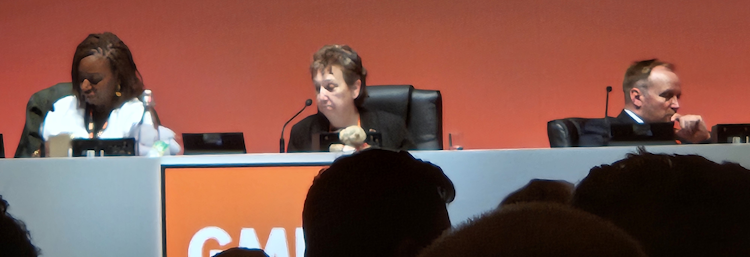
On Sunday afternoon, on day one, the CEC presented a special report on “Politics and the Labour Party”. For special reports, each region is asked to make a speech, and no other speeches are permitted. It is unusual but not unheard of that Regions oppose the CEC and on this debate Southern Region opposed the paper. A Southern Region branch also moved a motion (231), calling for a consultation on political strategy, and a special rules revision conference to discuss the consultation.
The CEC Paper is to my mind too complacent about the achievements of the Starmer government; the paper concludes that political organisation is about power and influence and that Unions must organise politically just as employers and wealthy interests do. Remaining affiliated to Labour gives GMB the best opportunity to secure better jobs, stronger rights and a fairer outcomes for workers, together with the ability to pursue other policies of interest to the union’s membership. They also argued, correctly in my mind, that pursuing additional political affiliations would likely weaken, rather than strengthen, the union’s influence as should the Union spend money on a Party that opposes Labour, Labour would expel it as they did the RMT in 2004.
Motion 231 argued for the building of a new workers party, standing and supporting workers candidates, and calling for a conference across unions to build a political alternative for workers based on a pro-worker, socialist programme. The choice in the motion was quite clear.
The debate is on the video, and there are some good speeches and some not so good.
The basic weakness of the arguments in maintaining the status quo policy is shown by the shopping list of demands that the Labour Government has failed to deliver, often at the behest of its own internal factional interests, these include, the remediating the poverty of the WASPI women, a failure to meet GMB & TUC aspirations on the minimum wage, together with the social security cuts proposed and then back tracked. Apart from Sharon Yates speech, who spoke of the ceramics industry, no-one addressed Labour’s industrial policy, although Les Timberly and Fazuma Umma presented lists of disappointments, inc. Labour’s policies and positions on Palestine and Gaza. It’s true that being at the table gives the Union power; I just wish we had more confidence that the whole of our policy portfolio was pursued as vigorously as our positions on Gas, Oil, Ukraine & Nukes.
The speakers opposing the CEC were calling for a consultation and the great weakness is that, while people only agree when it suits them, that Congress has no need to consult; it is the sovereign policy body of the Union. While their criticisms of Labour representing the working class, maybe based on fact, some of the language around this issue could have been delivered by Reform politicians. I also doubt as claimed, that more GMB members voted Reform rather than Labour, but I suspect that very few in the room have read the level of opting into the political fund which is at a historic low.
The CEC paper was carried, and the alternative motions fell.
I feel that over the period of Starmer’s opposition, the GMB and TULO have in my opinion sold us short, in terms of what we expected and with the exception of the New Deal for Workers has allowed Labour Together to write the manifesto and the government programme. If the GMB had pursued and won the full spectrum policy initiatives then the first two years of the Labour Government might not have been so disappointing. The Union leaderships, and not for the first time, sold us short.
I am pleased that we remain affiliated, but I wish that the GMB leadership showed more sympathy and pursued all the policy aspirations of the GMB.