Labour in London, not so good

Labour in London, not so good

Even now, on Saturday morning, it’s probably too early to say what the local elections mean politically. I feel I made a mistake commenting too early last year.

Over the last two days, the story has been that Labour did well in London; there are two punctures in that balloon, Harrow and Tower Hamlets. I believe these losses are caused by a sickness in both the Labour Party and possibly in society itself. In the Labour Party left-right factionalism allied to ultra-communalism/ethno-nationalism has broken both the Party and its connection with its electorate. When one stirs in two spoons of careerism this becomes deadly to the Party and to democratic politics.

I thought Harrow was vulnerable from looking at the Mayor & GLA results last year, as the early declaration of the Harrow & Brent seat results in the GLA elections (last year) had given us all a squeaky bum moment. Given that both councils were Labour, it was expected that there would be a strong vote for Sadiq; there wasn’t. Closer examination of the results suggested that Labour would  Harrow council; I thought that the polling predicted swing to Labour across London would be enough to save it. I was wrong.

The Tower Hamlets result is the culmination of 11 years of bad politics in both the Labour Party and Tower Hamlets; the community is now split on ethnic grounds. Some say it was the poor policies of Mayor Biggs, particularly on liveable streets/low traffic networks which was seen by many as serving the interests of a middle class party against the interests of brown (& white) working class who needed the mobility. In addition, the cuts, in public nurseries, and the notorious ‘fire and re-hire’ programme of the Mayor were unpopular with the Party and the community. This loss is made worse, for Labour, by last year’s referendum in TH to retain the Mayoral system in which Bigg’s Labour campaigned to retain it. My feelings on Mayors is well publicised but it’s possible that Aspire would not have been able to do so well if there wasn’t a ‘whole boro’ mandate being sought.

In Harrow, Labour lost to the Tories, and TH to Aspire. Harrow is over 52% ethnic minority and over 26% Indian, Tower Hamlets has over 55% ethnic minority and over 32% Bangladeshi.

While it is easy to name names in those two borough Labour Parties the true sickness is in Labour’s governance. London Labour has colluded with the leaderships of these two borough parties, specifically the MPs, and in the case of Tower Hamlets for over a decade. This is reinforced by McNicol’s attempts to use senior regional staff as weapon in the factional war, and then Evans’ redundancy programme. I believe that there are only two field/campaign staff left employed by London Labour.

Big governance decisions are not being taken with a view to building a democratic campaigning party or even a democratic parliamentary party. Wrong things have happened and are still happening.

There are plenty of people arguing that by prioritising a ‘blue labour’ policy vector, that Starmer’s Labour is telling the new members of Labour’s coalition that it has nothing to offer them and in doing so jeopardises the support of the young, workers, renters and ethnic minority voters. The relatively good results for the Lib Dems and Greens (& Aspire) shows that people do have somewhere else to go, and some have found out.  …

Labour & NATO

nato flag and badges

The Times ratchets up the argument in the Labour Party about NATO by repeating threats against those, including MPs, who take a more critical view of its history. A friend writes to me.

… it’s an interesting debate as to the role of NATO. The destruction of Libya and role in the Balkans doesn’t do wonders for its reputation. Yet I see Kier is concentrating on those MP’s who possibly question NATO’s role in conflict.

Haven’t we got more pressing priorities with this government both at home and abroad?

In my humble view the rhetoric of this government is very dangerous and upping the ante with Russia. Our leader needs to be urged to urge rapidly [that] Truss and Johnson to tone down their words of incitement.

We are an outlier in Europe after Brexit they are making us an outlier with our NATO partners.

This is not about opposing arming Ukraine or opposing NATO but opposing childish bellicose language from our Government to mask its other areas of scrutiny

Anonymous

It is a serious problem that Labour’s front bench seems more concerned with fighting it’s left wing, and not opposing the stupid, uber-military virtue signalling by this Government, led by a lazy man-child who if he has any sense of military strategy has learnt it from playing Risk. I think that the Tories’ boasting and grandstanding is unhelpful to the people of Ukraine and designed for home consumption but is in fact dangerous; it’s the Tories’ equivalent of ‘come on if you think you’re hard enough’. For the record, I believe that NATO is necessary, Russia’s invasion of Ukraine shows that. Finland & Sweden’s reaction is obvious and if they decide to join should be supported.  …

Memories are made of this

Shrimsley in the FT reckons (£|θ) Starmer has long way to go to emulate Blair. He argues that if Starmer doesn’t define himself, then his enemies will do it for him. An interesting insight given what his advisors are leaking (£) to the Times. Shrimsley also argues that Blair focused ruthless on voters, not members or activists although I wonder if that trick can off pulled again but the biggest jog to the memory was the pledge card; and Labour cynics just thought it was important to say anything other than “to secure for the workers by hand or by brain the full fruits of their labour by the public ownership of the means of production, distribution and exchange.

This shows how far we’ve come, in 1997, I wished for more radicalism, today, this would be welcome, although as a harbinger of the government’s programme, nothing on housing nor employee protection.  …

Is there a Starmer Project?

Is there a Starmer Project?

Oliver Eagleton has had a book, “The Starmer Project” published by Verso. Eagleton is the assistant editor of the New Left Review and has been doing the circuits to get the book some publicity. I placed my order late last week. It has been previewed by Eagleton himself on Novara Media, and reviewed by Richard Seymour in the New Statesman (£).

Eagleton compares Starmer with Blair, and finds him wanting as, he argues, does Blair, whom he suggests is exploring a Macron like personality based centrist project. Eagleton argues that despite Blair’s essential centrism, his politics had an optimism, originality and Blair was a great orator although, on the downside, he accuses Blair of introducing a crime for each day of office and he went to war in Afghanistan and Iraq and lost 5m votes between 1997 and 2010. He argues all that’s left for Starmer is the authoritarianism and the need to expunge left social democracy as a political option for Britain. Eagleton also notes that Starmer’s cleaving to the Tory agenda is a result of Labour’s unwillingness and lack of ambition to rebuild/build a winning electoral coalition. Eagleton also did an interview with Caitlin Doherty of Jacobin which reprises these arguments and also reinforces the argument that Starmer is a bureaucrat, which is one of the reasons that Starmer’s attack lines are about managerialism and competence, and not on policy values. It’s a sad observation that the anti-corruption legal remediation comes from NGOs such as the Good Law Project.

Seymour writes a pen picture of Starmer’s route to today, his youthful leftism, his early days as a human rights lawyer, his slow route to becoming the DPP and his record in that role. Seymour summarises the position in 2015 as

By the time Starmer launched his political career in 2015 as Labour MP for Holborn and St Pancras, his radical days were behind him. He was a middle-of-the-road Atlanticist with close ties to the state. A number of “activists”, including City financier Paul Myners and Guardian journalist Polly Toynbee begged him to stand in the Labour leadership contest in 2015. He declined, backing Andy Burnham, with whom he was politically aligned, while favouring economic austerity and a tougher line on immigration. 

Seymour – New Statesman

I cannot believe the hubris of suggesting an MP with no time in the House of Commons stand for Leader; it’s on par with appointing people with no election campaigning experience to senior roles in the Labour Party’s organisation and field operations teams.

Seymour looks at Starmer’s role in Corbyn’s cabinet as the shadow spokesperson on Brexit. This is where I part company with Seymour. Labour’s slow move from a worker’s Brexit to a second referendum was driven by three things. The first, the unacceptability of the Tories terms, whether May’s or Johnson’s. Neither Labour Conference nor the 2017 manifesto agreed to “Brexit under any terms”; Fisher, its author, always reminds people, that Labour supported the results of the referendum, provided the terms were acceptable. Secondly, the majority of Labour’s members and voters wanted a second referendum and wanted to remain, much of Labour’s astonishing performance in 2017 was due to remainers having nowhere else to go with only Labour offering any hope of either better terms or remaining. This support within the Party for the EU and the obvious economic damage is what led Corbyn’s closest and longest term allies to come to the conclusion that the Tory Brexit had to be stopped. They became more public after #lab18 and Starmer’s speech. The third factor is that an influential faction within the Labour Party wanted Brexit on any terms; it proved impossible to persuade them to co-operate with the Party and its whip and their parliamentary allies were encouraged by senior members of Corbyn’s office. The reality was that there was no path to Lexit and while Seymour presents Corbyn as seeking to find one, it was never on the table and I question Corbyn’s commitment to it; LOTO were freelancing. May would not or could not compromise enough to get Labour on board and Seymour is silent on the role of Labour’s so-called Lexit MP votes in the meaningful votes (or on medium) in the Spring of 2019 which in retrospect can be seen to have sunk any chance of remaining and although not known at the time sank Corbyn’s leadership. If anything, Starmer’s ’18 speech prolonged Corbyn’s leadership; his interventions on immigration were unhelpful to the Remainer’s cause and to Corbyn.

I have no doubt that many of those inside the Labour Party campaigning for a second referendum did so in bad faith and in the hope of bringing Corbyn down, but not all and the so-called praetorian loyalists who wanted Brexit played into their hands and eventually legitimised the votes of those who voted for Johnson’s Tories for the first time because they too wanted Brexit.

Starmer in his election run for leader did not mention Brexit or the EU and neither did his 10 pledges. This was an obvious clue for those for whom Brexit was the critical issue. Throughout the Corbyn leadership, Starmer has been poor on immigration for instance insisting on toughening up the words in the ‘17 manifesto, other events are listed in Seymour’s review. He was not a serious remainer. Many Labour remainers will have voted for Starmer, but must be disappointed although the clues were there. Some of them have left.

I sort of wonder, why did he lie in his 10 pledges. Has he been captured by the progenitors of New Labour? Or as Seymour says, is triangulating with the Tories where he always wanted to go. Seymour also suggests that oddly like Johnson, the ambition to get the job, is more than the ambition to do something good. There is no doubt he has powerful friends and allies who sustain him in his uber-factional, yet politically empty project.

To get more of the story, we’ll have to wait for Michael Chessum’s book, “This Is Only the Beginning: The Making of a New Left which is not yet available; I am also hoping that Michael looks at the efforts of Labour RemaIN as Labour’s self-destruction over Brexit probably started within that campaign, or even in the seventies when Wilson allowed the Cabinet to do what they liked. This established the precedent that unlike elections, Labour members could campaign against the Party. …

Is exit from the single market dead?

Is exit from the single market dead?

This needs to reported; the UK Government, is postponing the introduction on import checks on goods arriving from the EU. The announcement was made by the Minister for Brexit Opportunities Rees-Mogg. It is reported in the Guardian with the following comment,

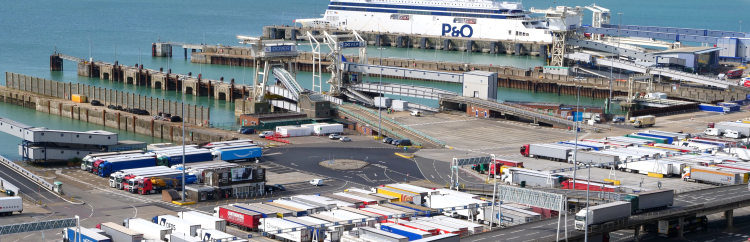
You read that right. Jacob Rees-Mogg, arch-leaver and longtime loather of the EU, is now parroting lines from the remain campaign. He is admitting that implementing Brexit in full, honouring the 2016 promise to take back control of Britain’s borders, would be “an act of self-harm”. There’s plenty to attack here, starting with the nerve of hailing this move as “saving” Britons £1bn, when this was £1bn that Britons would never have had to spend at all if it hadn’t been for Brexit. Or you could share the outrage of British farmers, appalled that, thanks to Brexit, they have been left at a serious competitive disadvantage: they now face onerous and costly checks when they ship their goods across the Channel, while French, Italian or Spanish farmers face no such hassle moving their products in the other direction. Or you could worry along with the British Veterinary Association, which warns that not checking food imports leaves Britain exposed to “catastrophic” animal diseases such as African swine fever – a risk that was reduced when Britain was part of “the EU’s integrated and highly responsive surveillance systems”. Or you could join the lament of the UK Major Ports Group, whose members have spent hundreds of millions of pounds building checking facilities, which now stand unused as “bespoke white elephants”.

Jonathan Frredland – TheGuardian

The BBC also report with a comment from Faisal Islam, their economics editor, although they find a quote to illustrate the benefits, or at least the avoidance of further harm. This is the fourth postponement. The critical politics is that this Government, things that the customs checks are a harm.

Luke Cooper of Another Europe, in an article on Brexit Spotlight also highlights the announcement and concludes with,

This is why the Rees-Mogg announcement shows that the game is up for the British exit from the single market. … This [the asymmetric checking system] is self-evidently unsustainable. If the most nationalistic government in recent British history is not able to fully extricate the country from the European market, then it simply isn’t possible. The question now is when – not if – Britain re-joins the single market.

Luke Cooper – Another Europe

At the beginning of the year, I thought that the critical failure of exit from the single market would be in Northern Ireland but maybe not; the new lorry park in Kent is another pressure point and a number of EU exporters were just giving up on the UK as a market. …

Miscarriage of Justice

I am reading the Secret Barrister’s first book, I provide a quote,

“In the Crown Court, I have prosecuted many appeals from the magistrates’ court of unrepresented defendants and have lost count of the number of cases where there has been a conviction that is completely wrong in law, or completely wrong in evidence, the fact of which only emerges upon close inspection of the papers. “

The Secret Barrister

If the courts get it so wrong, and when we examine the Labour Parties rules …. …

CoFoE, Climate Change, environment and health.

Those of you following me, know that I have been following the EU’s Conference on the Future of Europe. I have been mainky tracking Citizen’s Panel 2 on Dempocracy and values, but also reviewed ECP 4 and their recommendations on Migration. I have had a brief look at ECP3’s Climate Change and Environment proposals; I looked at these in January and the proposals that made the final plenary will differ.

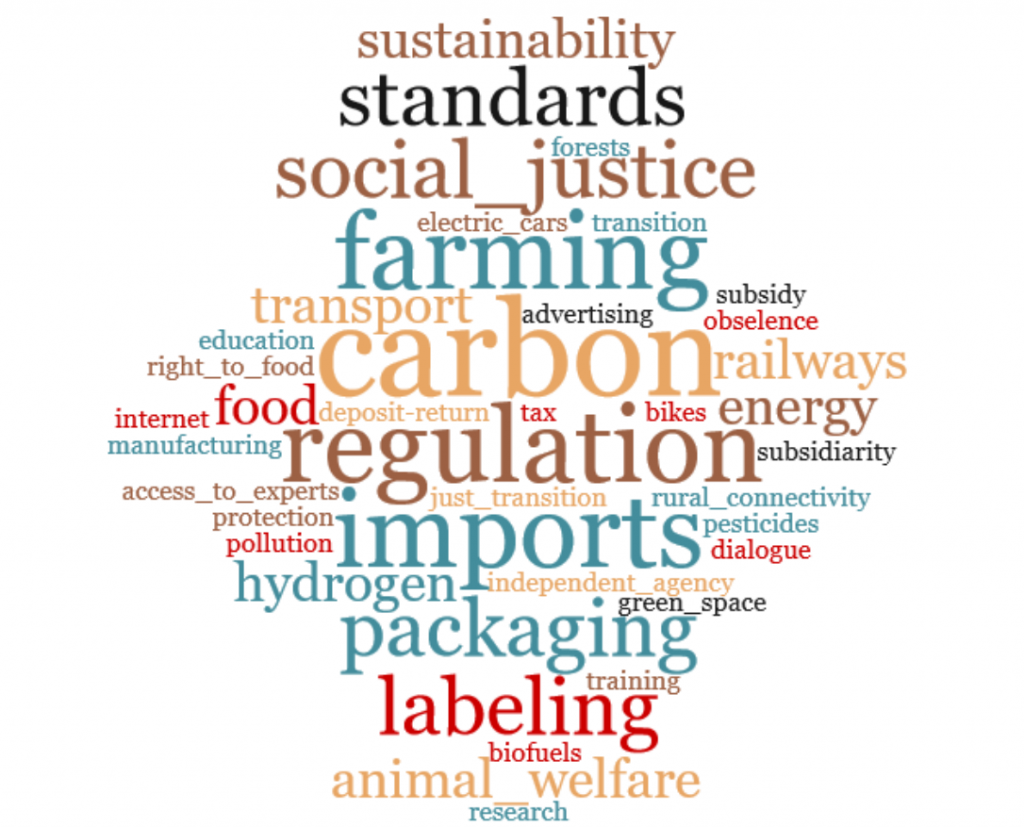
I made a word cloud of the proposals other than health. Carbon should read carbon reduction, but the generator wouldn’t work with such a long phrase. I have created summary keywords for each proposal, this would be better if I had crowd sourced this allocation stage, but I didn’t.

Word Cloud, ECP3, Climate, environment & health

The Citizen’s panels full proposals are published by the Conference. The panels work in sup groups and so can produce multiple, very similar recommendations.

My highlights are that the panel recommends, the reinforcing of the health care system and the assumption by the EU of competency for health with equal access for all. It also takes a powerful stand for a sustainable energy economy, together with transport system reform: more public transport, particularly buses and trains.  …

No to offshoring!!

No to offshoring!!

Boris Johnson and Priti Patel have finally pressed the button on their plans to ‘offshore’ asylum processing, Labour’s Yvette Cooper, labels this shameful, unworkable, unethical & extortionate. The Independent reports on previous countries attempts to ‘offshore’ refugee reception their failure, cost and disgraceful conditions applied to people who have done nothing wrong. It also seems the Government plan to use the military instead of Border Force. This is truly outrageous.

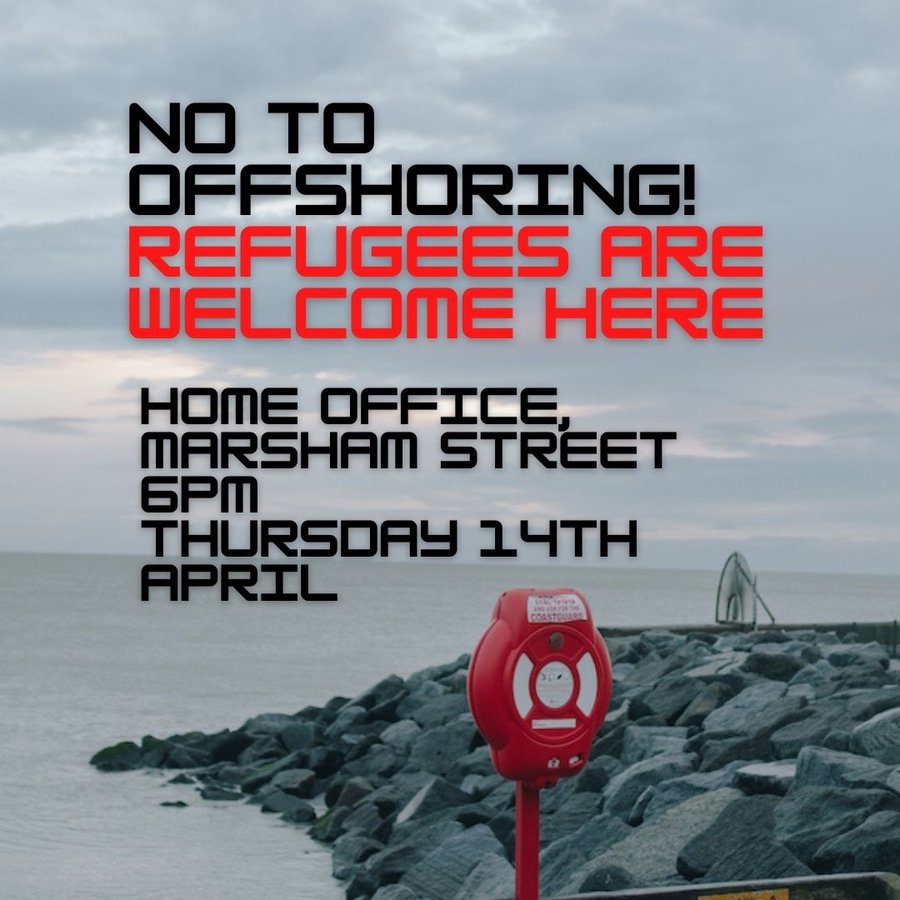
Labour Campaign for Free Movement have called for a demo outside the Home Office tonight.

No to Offshoring Demo 14/4/22
No to Offshoring

And some campaigning comrades, have started a petition,  Stop Priti Patel’s offshore refugee camps – Ripples

And then there’s those who think it’s a dead cat to distract from the partygate fines.  …

Natural Justice in the Labour Party

Natural Justice in the Labour Party

Skwawkbox has been reading the new rule book and reports on the new rule (C2.I.4.D/P14) which seeks to protect the expulsion process from judicial interference and a duty of fairness.

D. Neither the principles of natural justice nor the provisions of fairness in Chapter 2, Clause II.8 shall apply to the termination of Party membership pursuant to Chapter 2, Clauses I.4.A and C.

Labour’s Rule book 2022

Chapter 2.II.8 guarantees the right to dignity and respect and a right to be treated fairly by officers of the Party 😊

Clauses 2.I.4.A and C are new rules and create an offence of a proscribed act (A) which are listed in …(B), and the evidence which is deemed to prove these acts (C). The acts are related to standing against the Labour Party, or pursuing a vexatious law case against the Party.

It seems to me that the rule may have the opposite effect to its design.

The exclusion of the right to natural justice is only applicable to auto-exclusion on the basis of grounds listed in C2.I.4.B; these do not include being a member of a proscribed group, nor committing the acts defined by NEC resolution proscribing them such as selling a newspaper, writing for it or being interviewed by it.

The attempt to exclude the duty of fairness and the language used, while refusing to accept the constraints of the Nolan principles is shocking. It’s so bad that I was asked if it had actually gone through conference, and the answer it has. It was listed in CAC 2 for Conference 21. Conference was asked to debate and pass 37 pages of amendments with 4 hours notice of the text. I have drafted a rule change to prohibit this abuse.

I add, that given the current NEC and General Secretary’s view of the rules, there are only three,  (or on Medium) which count.


 …

The Budget 2021, the highest tax burden in 70 years

The Budget 2021, the highest tax burden in 70 years

I wrote a short piece on the potential need for the EU to acquire direct taxation powers which led to me checking how much the UK government raised from income based taxes vs. VAT. The article reproduced some charts from Parliament but I was surprised to discover how low a share of government revenue it now represented. The article was written after the budget, which had not really made an impact in my consciousness; it just seemed ‘meh’ to me. It is however yet another turning of the screw in a largely successful attempt to make the working classes pay for the crisis in national income and wealth facing this country.

John Crace reviews the speech and budget in this article on the Guardian, A mini budget full of lies from Rishi Sunak, the people’s millionaire , and says,

[He can ] deliver a spring statement – AKA a seismic budget in any other year – that offers nothing to the poorest and most vulnerable members of society while sobbing on their behalf. Who can tell the chamber with a straight face that he is committed to cutting taxes even when the Office of Budget Responsibility is saying that the tax burden is set to go up to 36.3% by 2026: the highest level since the 1940s.

John Crace

I recommend you read Crace’s article in full.

It also reports on the budget, in an article by Philip Inman, their economics editor, Rishi Sunak ‘protecting Treasury from inflation at families’ expense’ | Spring statement 2022

Critics of UK chancellor’s spring statement say it prioritises debt reduction and fails to provide support to lower-income households

Philip Inman

This despite the sub-headline concentrates on the macro-economics, reflecting the argument that since the Govt has borrowed on variable interest rate bonds,  as inflation kicks in, they argue they need more money to service the debt. The article concludes by observing that inflation may fall, that soaring energy costs are a drag on prosperity, and that the real reason for increasing tax revenues is to be able to give it back in the run-up to an election.  

Despite being under pressure to minimise the effects of the cost of living crisis, driven by Brexit and energy cost inflation and help households across the country who are being forced into poverty, all the budget did was announce a cut on fuel duty, Labour are asking for a VAT cut on energy bills, although instructing Ofgem to implement a price cap would be more effective. He also raised the threshold at which people start to pay National Insurance, which is a means of alleviating the fiscal drag created by freezing the tax free allowance.  

From Inman’s article, I also note that Sunak has frozen the income tax free relief for the next four years, together with the IHT limits. The effect of this is that before, people could expect the tax free allowance to rise in accordance with inflation, giving them small amounts of extra disposable income, even if they did not get a pay rise. This has now gone. It will also have the effect of raising the share of income tax paid by the low paid.

He also, in contradiction, to the Tories election promise suspended the pension link with earnings for 2022/23 although he claims to be willing to reintroduce it next year. He has also cut the amount the poorest in our society get by clawing back the uplift paid in 2019-2021.

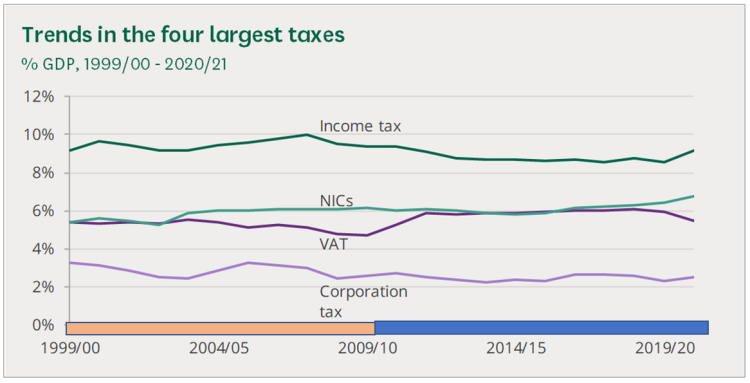
My segue into this piece was the low proportion of government income attributed to Income Tax vs VAT. The House of Commons Library  produced a report called, Tax Statistics: an overview, and my previous article reproduces some charts from it while making the point that treating NI as separate category minimises the impact of employee contributions, which are levied at 12% until one begins to pay higher rate tax and allows Income Tax to be described as more progressive than it is. NIC’s also are paid by employer’s and so clarity on corporate contribution to the exchequer is also reduced.

Chart, line chart

Description automatically generated
from the HoC Library Report : Open Parliament Licence v3.0.

VAT is 20%, for the less well paid more than they pay from Income Tax. This needs to be rebalanced.

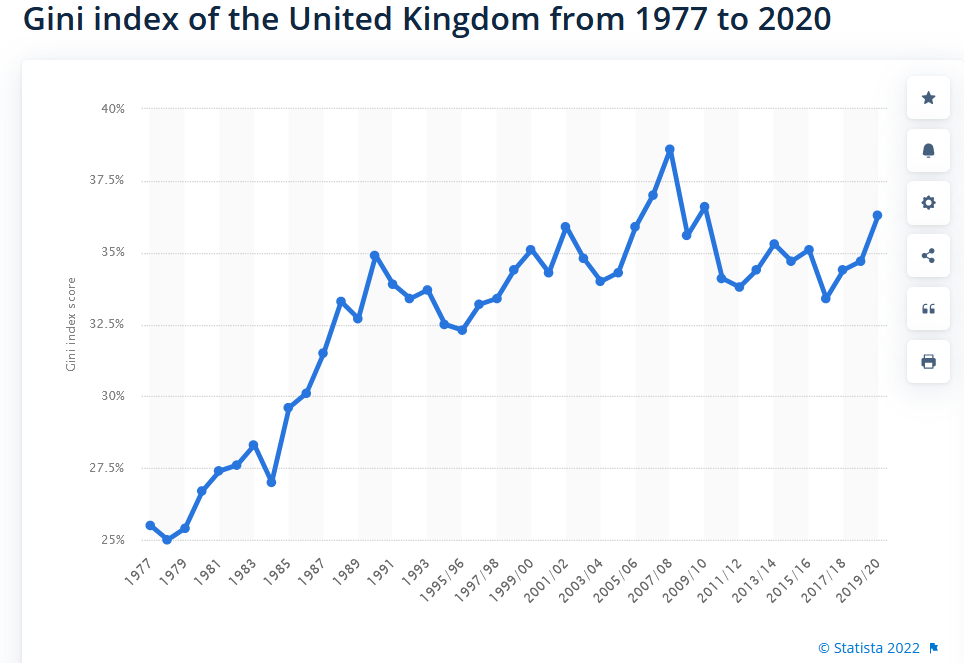
I finish with Statista’s charting of the Gini Coefficient over time., which measures the level of income inequality in our society,

Chart, line chart

Description automatically generated
Statista UK Gini Coefficient over time , used under Statista Terms of Use

We have the lowest social security net in Europe, the lowest pensions and amongst the most strongly regulated Unions. Something’s got to give. …