
Govt money

Govt money

I was considering the EU’s NextGenerationEU and the idea that this was the tipping point into a fiscal union. I am not sure because the EU’s tax raising powers are as pre 16th Amendment United States; it cannot tax people or companies. This led me to consider the proportion of Govt. income rasied through income tax and other sources. This is a blog in two part, the first on the EU & the 16th amendment, the second on UK income tax and income equality. I comment on direct taxes and and the 16th by writing the following,

While looking at EU common tax policy, I thought about the need of the US to pass a constitutional amendment to allow federal direct taxation since previously the US required direct taxes to be apportioned to the States. The amendment is the 16th, and was designed to permit Income Tax an overcome a Supreme Court ruling which prohibited it; which came in two years later and has never been repealed. The Constitution Center has a review of the amendment arguing that the 16th only authorises income tax and the court has for instance constrained capital gains taxes. The Atlantic, also comments although the latter is more a history.

Dave Levy

The obvious development of income tax within the US led me to have a look at just how much of the UK Govt’s income is raised through income tax, the most progressive tax we have. The House of Commons Library has described the 2020/21 tax revenue sources, it seems that they’re no longer posting it out to everyone.
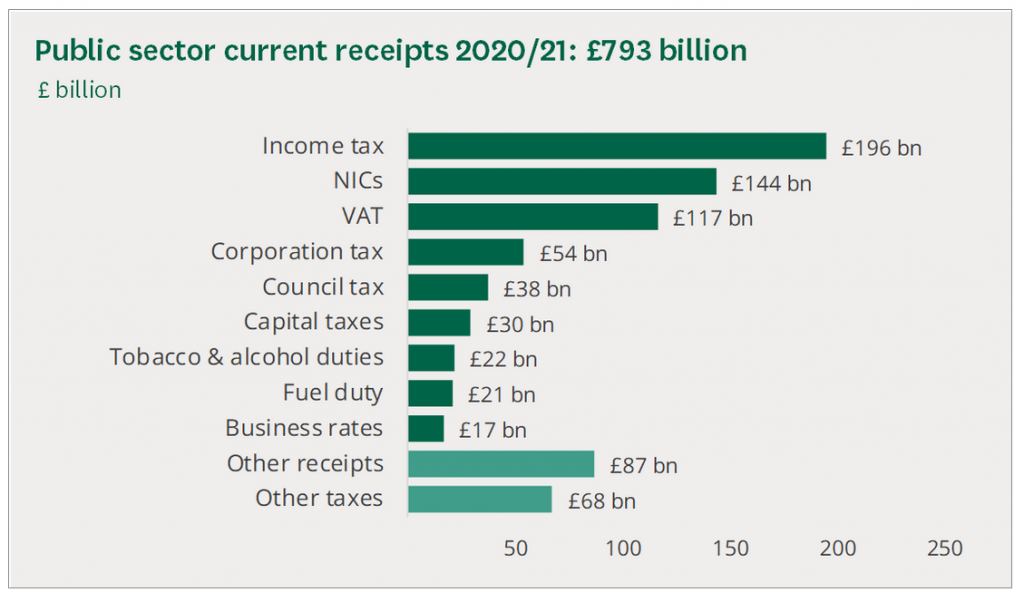
from the HoC Library Report : Open Parliament Licence v3.0.

The report landing page also has a chart showing the proportion by source over time, and its remarkably consistent. I also note that Income Tax is separated from NI and while some NI is paid by the employer most is paid by the employee. The Govt gets 43% of its income from these two sources and on top of this charges 20% of what one spends. There is also a compulsory private sector pensions levy on workers too, which does not appear in this chart. No wonder the low paid are struggling.
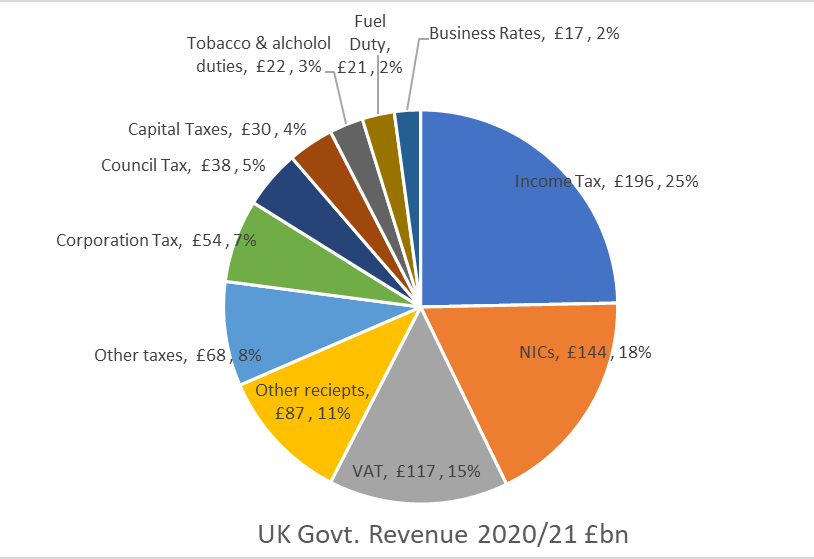
made by Dave Levy, from the HoC Library Report : Open Parliament Licence v3.0.

The separation of NI from Income Tax also permits them to claim that “The 10% of income taxpayers with the largest incomes contribute over 60% of income tax receipts”.

If you want to look at income inequality, Statista have the Gini Coefficient over time.
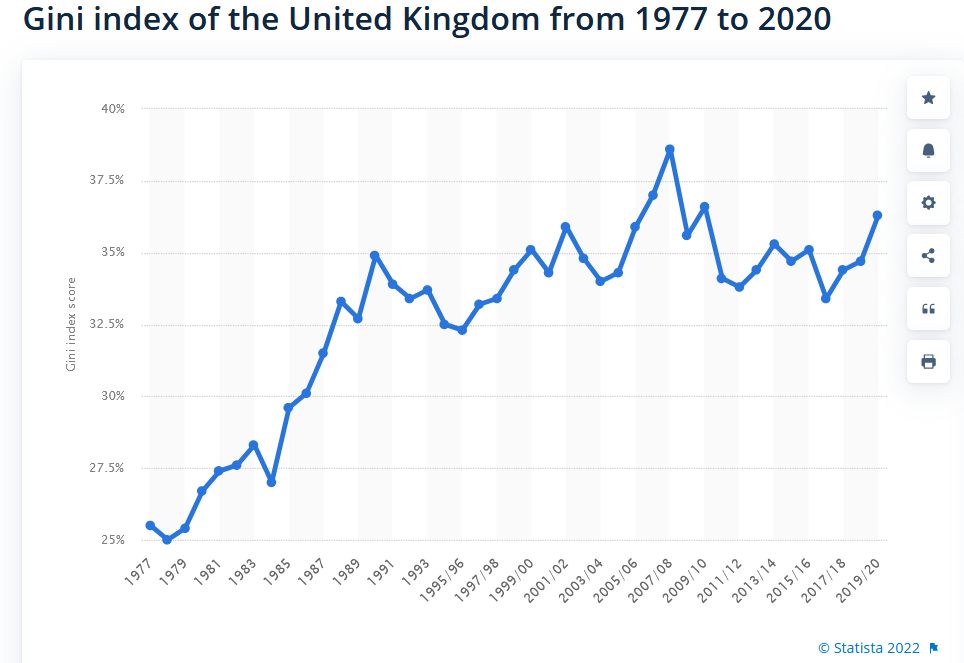
Statista UK Gini Coefficient over time , used under Statista Terms of Use

We need more income tax, less NI & VAT


This article contains Parliamentary information licensed under the Open Parliament Licence v3.0. The featured image is from Images of Money, on flickr, via wikimedia.org and used under the Creative Commons Attribution 2.0 Generic licence.  …
The economics hurdle for rejoining!

This was published on the London 4 Europe web site, arguing that the Euro and “Banking Union” are potential political obstacles to rejoining. I just observe that the author has not caught up with the change in macro-economic management, the Stability and Growth Pact has serious credibility problems given the numerous breaches. We can hope that with a new coloured government in Germany the deficit fetishism of the EU will be weakened. Secondly, banking regulation is global and emanates from the G7 and BIS in Basel. The EU has little room for manoeuvre, although of course, should it be in a position to join BIS that would change things. This is an article designed to show how clever the author is and fails in that goal.

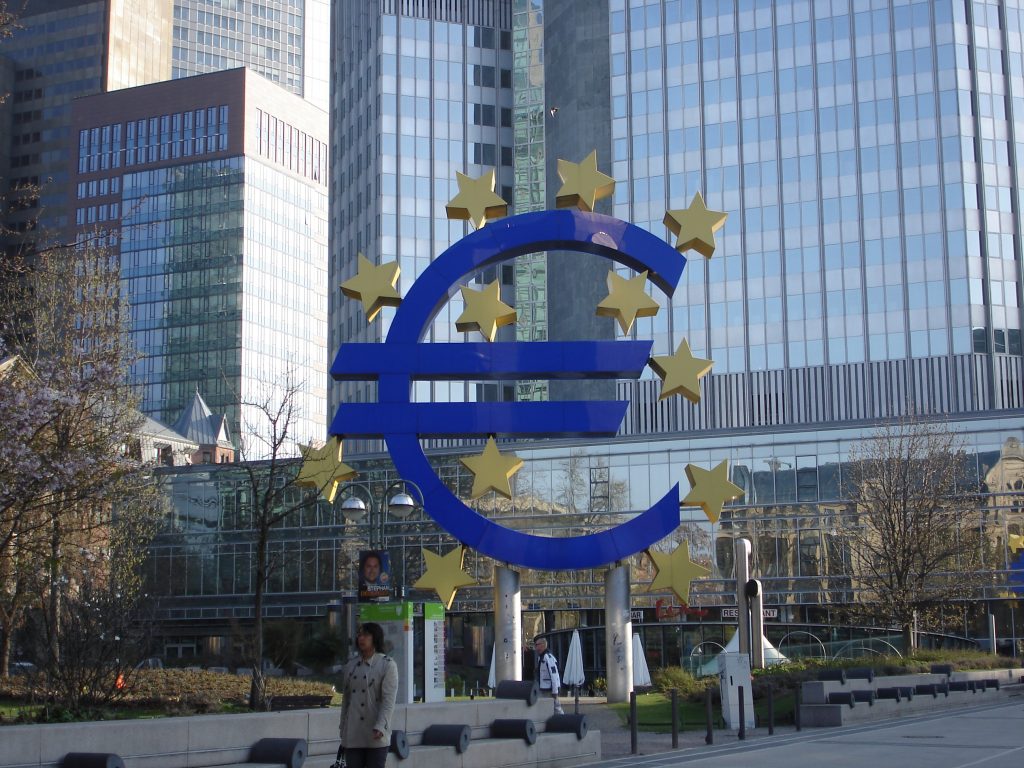
The ECB, Frankfurt CC DFL 2011 BY-SA

I note the article focuses on Sweden, which has agreed to adopt the Euro and not Denmark which has an opt-out. When we get to negotiating re-entry, the size of the UK economy and the sterling zone will be issues which may lead to us being given an opt-out or a Swedish deal, although I was interested to note that Nordea, Sweden’s largest bank has moved to Finland to locate in the Eurozone.

A serious analysis will come later, when both parties need an answer dealing with transaction volume, prudential regulation and fundamentally macro-economic policy. Let’s note that we had an opt-out of the compliance clauses of the SGP, we doubt we’ll be getting that back.

Macro-economics will be a problem if we have a left led Labour Govt., that wanted to pursue a policy of full employment but more importantly will be the need to meet the democracy criterion of the Copenhagen Criteria, where parliamentary sovereignty, the House of Lords and first past the post together may be seen as obstacles. Starmer’s Labour lacks the will to confront the issue of rejoining the EU but would probably welcome the shackles of today’s Stability and Growth pact. Actually, the Stability & Growth Pact is a serious barrier to rejoining for the Left; perhaps the sterling zone will save us from that too.  …

Software Piracy and supply

Software Piracy and supply

This is interesting. From the Register, an article called, “Software piracy pushes companies to be more competitive, study claims • The Register“, sub-titled, irreverently as ever, “So, do copy that floppy?”

The article is written by, Wendy Bradley, assistant professor of strategy, entrepreneurship, and business economics at Southern Methodist University’s Cox School of Business, and Julian Kolev, an economist at the United States Patent and Trademark Office. The article describes their methodology, and links to their paper. They define the launching of Bittorent as a shock and examine the intellectual property development of vulnerable companies to that shock.

“When comparing the IP strategies of software firms at risk of piracy (the treatment group) against those of not-at-risk firms (the control group), we find that our treatment group significantly increases its innovative activity after the piracy shock in terms of R&D expenditures and granted copyright, trademark, and patent applications,”

Bradley & Kolev – Software Piracy and IP Management Practices: Strategic Responses to Product-Market Imitation (August 2021)

Interestingly it seems, that Entertainment software companies behave differently. although the academic work done, as quoted in the article does not suggest that piracy reduces the supply of content.

Basically the big software firms use their superior cost structures, achieved by size and source code ownership to increase the rate of innovation to keep their customers coming to them. The entertainment companies don’t. I don’t think they look at the size and cost of investment into regulatory barriers to entry, both buying the laws they want, and pursuing newly created malefactors.


Bradley, Wendy and Kolev, Julian, Software Piracy and IP Management Practices: Strategic Responses to Product-Market Imitation (August 2021). USPTO Economic Working Paper No. 2021-3, Available at SSRN: https://ssrn.com/abstract=3912074 or http://dx.doi.org/10.2139/ssrn.3912074 …

Community creates value

Community creates value

Cory Doctorow comments on Games Workshop’s latest legal initiative against its fans, I chose some quotes from the article, including the allegation that they behave like sociopaths and created their IP in exactly the way they're pursuing others for. I conclude with, the probably not original statement, "Open source campaigners have always argued that community creates value, here's another battleground where it will be tested.".

The Northern Ireland Protocol

The Northern Ireland Protocol

I was originally going to write something which I hope might be profound or provoking, but in the end, this just noted more of the Govt's myopia. Northern Ireland Protocol was agreed to avoid border infrastructure on the island of Ireland. The UK Govt agreed ... Boris and the DUP blew up May's previous solution to the problem , which was to belong to the Customs Union while working out something better. I look at the 'command' paper, which is an attempt to renegotiate the Northern Ireland Protocol, part of the Withdrawal Agreement which left Northern Ireland in the EU’s customs area for the purposes of intra-Ireland trade. It looks at the EU's response. ...

Meals Ready to Eat. Not!

Meals Ready to Eat. Not!

Reuters reports on a meeting between food distribution industry representatives and DEFRA. Using the Army was only one idea expressed, and it’s an indicator of the com9ing food shortage crisis created by Priti Patel & Boris Johnson’s “controlled border” policy and Brexit. One of the massive labour shortages at the moment is HGV drivers, and we can’t get the food to the supermarkets, even if we can pick it from the fields. The problem is compounded by the relatively low wages paid these people . UK PLC is failing because its low wage economy cannot get people to work for it any more.

from team voyas, via unsplash

My evidence for the coming crisis is that. in Tesco’s yesterday, there was no cabbage. and the garlic came from China. (I have grown garlic in my garden in previous years, so there is a food miles carbon cost thing here too..) …

Why inflation?

Why inflation?

Have we returned to the Phillips Curve which described a macro-economic policy choicei.e a trade off between inflation and unemployment? The Bank of England predicts an inflationary blip, and yet labour shortages in the UK seem endemic. The Govt’s policy is to constrict labour supply by restricting immigration which is increasing wage costs and effectively reducing gross national product. It’s not wages that are problem, although in many sectors they remain are too low and subsidised by in-work benefits, but a lack of workers. Time for the QMT loonies to pull their heads in, as explained by Simon Wren Lewis in his near rant on the elitist pessimism of the inflationary hawks.  …

On economic migrancy

On economic migrancy

The dirty secret that makes a non-racist immigration policy difficult is that economic migrancy is demand led. Post Brexit, we are short of farm workers, lorry drivers, hospitality workers, and health workers because they’ve gone home and aren’t allowed back in or don’t want to come because of the xenophobia. All of this is causing food shortages, price increases and reduced and delayed health delivery.

On the whole immigrants are younger and of working age; as our population ages we need more people of working age, to produce stuff, deliver services and pay for the pensions of our old and education of our children. The quid pro-quo must be that we offer them citizenship and treat them as neighbours, not to harass them using the hostile environment laws.

A further problem is that the work not being done reduces the tax income of the treasury.

Migrants and young workers pay old people’s pensions.

I salute those who made the single market and freedom of movement the centre of their opposition to Brexit; the facts on the ground today show them to be right, and this is before we consider those Brits in Europe who’ll have to give up their homes and jobs, and those people who travel to Europe for work, such as musicians and actors and others, it’s not just building workers anymore.

If it’s in our interests to welcome migrants, then there’s only one reason for behaving as our government is!

ooOOOoo

The ageing of the global north, and its funding sustainability was observed and publicised by the IMF in the paper,  “Immigrant Swan Song”. For more, from me see tag:immigration

I was thinking of linking to a video clip from “Auf Wiedersehen, Pet”, but the quality on youtube is not good and it’s probably not as funny or insightful as I remember. …