The Green Benches blog asks ex-Labour voters why they stopped. It’s one of the most popular threads he’s run with 73 comments in under 36 hours. Not one of them says it’s because of increases in public debt, or that they didn’t privatise more, or they introduced a bankers bonus tax or introduced the 50% super tax rate or the minimum wage was too high. Every single comment is based on a left criticism of the Labour Party and its leadership, both past and current.
In the “Refounding Labour” discussion document, published by the Labour Party in 2010, the point is made that Labour lost 5m voters between 1997 and 2010, 60% of these had deserted us by 2001. It’s hard to see what left wing policies would have scared off the New Labour voters before 2001, and while the UK’s interventions in the Balkans started during this time, the drive to war in Iraq had not, neither had the Labour Government set their top up fees to £3,000 p.a.
Some in the Labour Party leadership accuse Ed Milliband of seeking to “retreat to a core vote” and that Labour needs to retain its “Aircraft Carrier” policy straight jacket, where turns to the left or right lead to disaster. Others of course, including many of Eion Clarke’s correspondents reckon that he’s not fulfilling his Red Ed promises. I reckon our 2010 vote is our core and that attacks on trade unionists, the unemployed, the young and the disabled will only weaken us. Standing up for them might begin to win back that decent majority that have left Labour.
The problem with “Triangulation” is that your enemies define your politics. (Look what’s happening in the USA, and that’s what happened in the 1990’s to Labour, and its where some in the right of the Labour Party still are). Labour has a huge left wing hinterland that wants a fairer society built to serve the interests of the majority. We should stand by or return to that vision.
One of the most important tasks for a political party is to persuade people that your ideas are right, not to merely adopt popular ones.
End Triangulation ; people do change their minds… our strategy should be to tell the truth.
ooOOOoo
I wrote this early in 2012 and for some reason failed to publish it. Obviously some of the thoughts here went into the “If Only” article on this blog. I am tidying up the blog drafts list and decided to publish this, but have back dated it to the time I started it since that’s my usual policy to make the blog a diary. …
I recently wrote to Loz Kaye, the leader of the UK Pirate Party, to congratulate him and his party on their brother’s and sister’s victory in Berlin. I pointed out that in Europe they were at a cross roads. As they grow in maturity and power as a political party, something yet to occur in the UK, it will become harder to talk to and work with supporters in other political parties. There is a mature balancing act to be taken in advancing their ideas, most of which I agree with, and winning political power. In my mind, they have to find a route between supporting the growth of broad campaigning groups such as the ORG or building their own organisation. There is a tendency in both the Liberal Democrats and the British Trotskyist movement to consider each new party member a victory for the cause. Both parties often win these cadres at the cost of those they create, dispirited by defeat who give up on politics. Each person who gives up on politics and hope is a loss to democracy, and we are not winning. …
The Labour Party are boasting about their, or is our ‘Open Day’. They have invited 2000 ‘ordinary members’ to have their say at an ‘open’ session during the Labour Party Conference. This should be good, but they’ve done it before, and it wasn’t. …
Earlier this year, the Liberal Democrats at their annual conference voted down their platform position to support the Coalition Government’s NHS “Reforms”. The platform position was proposed by Paul Burstow, the Minister of Health and a Liberal Democrat MP. I am pleased that the left Liberal Democrats are finding their voice, but a historical look at the effectiveness of democratic conferences’ ability to manage their parliamentary parties in opposition, let alone government doesn’t give one much hope.
The NHS revolt is led by some of the most senior Liberal Democrats, but being in Government is new to this generation of Liberal Democrat activists. Its conference and democracy was not built to manage a party of government. Julian Huppert , now an LD MP, and Isabel Fox have twice taken opposition to the Digital Economy Act/Bill to the Liberal Democrat Conference, have twice won their votes and motions, and yet the Liberal Democrats in Government have failed to get repeal of the DE Act into the “Great Freedom Bill”.
However, at the least the Liberal Democrat conference agenda is still under the control of its members and they can criticise and advise their leadership in this public and collective fashion.
One really has to wonder if the Labour Party is still capable of undertaking such an action. Labour Party Conference had a long and proud record of attempting to lead its party and for many years was “sovereign”, subject to the law of the land. (Not a constraint that it understood well!) 1
It’s common currency that Blair proved his electability to the British electorate by taming the Labour Party and the most visible victory was the re-writing of Clause IV. However, this was a fight at the end of long process, one that, it’s often forgotten was started by John Smith; all ‘reforms’ aimed at taming the Labour Party and its membership. These reforms either took power away from the membership, or weakened the leadership’s accountability to the policy of the Labour Party. They include,
One man (sic), one vote for Party Leader,
Prohibiting MP’s from standing for the Constituency Section of the National Executive Committee
Inhibiting CLPs from sending the same person to conference in consecutive years
Prohibiting CLPs from proposing policy at conference, this is a result of the creation of the National Policy Forum, which now proposes policy to Conference
Individual Balloting for the Constituency Section of the NEC
Individual Balloting for the membership of the National Policy Forum
The result of these reforms is to take policy development and even debate away from the membership and restrict it to the National Policy Forum. Individual balloting stops the members holding the leadership accountable to policy because successful candidates have mandates of their own. Before 1997, the Parliamentary leadership chucked in some rallies as consultation and listening activities but this stopped soon after they won the election. Labour has turned its conference into a rally to which they now sell tickets to its members. Its policy development now takes place in poorly lit broom cupboard.2
I rejuvenated my involvement in the Labour Party during the last election because a number of its members and campaigners convinced me that the Labour Party was where people that wanted a fair society were. I am delighted to meet new (& old) friends and comrades as I expand my contacts and resuscitate old ones, and proud to meet people that campaign for a better society and use their elected council positions to do their best to protect those at the brunt of the cuts. But in the 70s & 80s, I believed and felt that the Party’s policy belonged to the members of the Party, Unions and affiliated socialist societies, but with the changes made in opposition in the early 90s I am not so sure.
The election in May was not a single election. Many things happened, but one thing that is true is that in many parts of the country the Labour Party on the ground had a better election than the Party in Millbank. The national leadership owe the party on the ground a huge debt that allows us to begin to oppose the Tory led Government from a considerably stronger position than might have been the case. The least they can do is listen to its membership on policy.
Labour’s National Policy Forum was designed to take policy away from conference. It was designed to isolate the policy makers from their mass movement and the people they represent. Its designers wanted policy to be set by the Parliamentary Labour Party, or more truthfully its front bench. Despite their rhetoric, which they backed with successful action to reverse the decline in membership since 1945, the membership, especially individual members weren’t to be trusted with policy. The National Policy Forum was created and Conference prohibited from deciding on policy. The irony is that the Party Blair and Brown recruited in the mid ‘90s probably didn’t need such treatment. Its successor gave Dianne Abbot, the only Left wing candidate 7½% of 1st preferences. It’s a long time ago since Tony Benn won 49% of the Deputy Leadership elections.
When conference was the Labour Party’s policy making body, it was possible to know and be involved in the selection of the conference delegate. The National Policy forum does not have this accountability. I suggest it had zero impact on the policy of the last Labour Governments, which is, shamefully, about the same level of influence as the NEC.
This article was started a long time ago and I have participated in two meetings to discuss this since. In one of them, Ellie Reeves, one of the NEC members responsible for the review made the point that there are two dimensions to the disenfranchisement that members feel, repeated here on YouTube, one is that their ideas disappear into a black hole, there is no commitment to transparency, and secondly that some of the ideas that the Labour government did pursue, such as Privatisation of the Post Office and the Digital Economy Act were never put to the Party. To most Party members, they came from nowhere.
I think the NPF has to go. It was not designed to enhance democracy, nor to ensure that Labour Party policy represented its member’s views. Let’s start with a blank piece of paper and a will to listen to what members want. I hope that that is what Ed Miliband and Peter Hain have promised, a rejuvenation of the party’s democracy, that allows members to be more than cogs in the phone bank.
1. I originally went down a rat-hole about the great and not so great events at Labour’s Conferences and the lessons of the past for today’s activists, I shortened it to make it more readable and focused the article about making Labour Party policy today, but the research, as is often the case with the Labour Party, is hard, as there is little on the internet but it seems to me that a history of Labour Conference is one worth writing.
2. The old jokes are always the best. (No they’re not!). …
It seems that #yes2av is #downthetoilet, but I was watching Twitter tonight and two tweets passed me by the first says,
“congratulations cameron, congratulations murdoch, your lies have denied the country a democracy. #yes2av #vote2011 #libdems #tories #labour”
and the second, which I can no longer find says something like
“Nick Clegg , you #fail HAHAHA etc….”
You get the idea. There is a very short term view here. I hope some of my Labour friends understand what they’ve done. It’s a huge mistake. First past the post is not democratic, it’s also not helpful to our cause. …
MPs representing communities should have the support of the majority of their voters,
AV may nationally exaggerate the size of popular majorities, but it is likely to constrain the power of unpopular minorities and this is a good thing,
the choice of government should not be taken by a small number of swing voters in middle English constituencies, and I mean English,
AV is harder to ‘game’, people will be able to vote for their first choice, it gives more people a reason to vote and we’ll all see the real attraction and support of each of the parties,
AV means that more people’s vote will count,
many MPs will need to appeal to more than their tribal support,
the British system asks people to vote for an MP, not a government, the voting system should support this,
‘First Past the Post” is dying, we use other systems for the European parliament, executive mayors, the Greater London Authority and in Northern Ireland, it’s time to move on.
I shall be voting for AV today, it’s not my first choice, but its better than what we have, why don’t you join me?
On issues of tribalism I was unhappy to receive a No2AV leaflet, with a picture similar to the one on the left. I have tried to scan the original to share with you, but my scanner isn’t good enough. Interesting that they have Cameron’s back to us. Are they hoping that Labour and other left wingers will forget that the coalition is Tory led by the simple ruse of having him turn his back on us?. (It won’t be the last time!) The leaflet is decorated with text in UKIP’s Purple and Yellow. (Did they have some ink left over from the General Election?). The text suggests that we should oppose AV because of broken promises and back room deals, and that we, the voter, should punish the dishonest. It’s merely another attempt to keep the interests of the Tory party out of the debate. How stupid do they think we are? Why should we punish only Clegg and the Lib Dems for a deal they did with the Tories! Anyway, outside London we can punish them both in the local & national elections by voting against them.
The biggest lie is that the current system is in democracy’s interest. If you vote on the merits of fair voting, you’ll support change, otherwise you have a party agenda, and the Tory Party agenda at that. …
Martin Kettle, in an article at Comment is Free, on the Guardian’s web site, called “Vote yes to AV if you want to see Tories feel the fear again” among other arguments says something I have been struggling to say. I don’t know if he is Labour Party member of supporter, but I am and so I have quoted it here, and hope that fellow Labour supporters consider it before voting next week. I also suggest you read the article in full. I am unsure if his focus on Labour and anti-coalition activists helps make the argument that AV is fairer than FPTP, but for those who won’t, or don’t want to consider the issues on their merits, but only in the context of the current Government’s longevity and programme he has some interesting things to say which you should read in full. He concludes the article saying,
“Labour still thinks short-term and tactically, not long-term and strategically. It is obsessed with the wrong target, with battering the Lib Dems, with punishing Clegg for the coalition and the cuts, and using those votes to propel itself back into an overall majority. The first part of that may well happen, starting with the local and devolved elections. The second part, though, is much less certain. It depends on breaking the coalition quickly and winning an early election. But that isn’t going to happen, even if AV goes down.
If everyone in Labour thought straight they would see there is a powerful argument for saying that the coalition will be more weakened by a yes vote than a no. If you want to weaken the coalition you want the Lib Dems to be bolder in standing up for themselves against the Conservatives on a range of policy issues. That is more likely with the security of AV, which favours the Lib Dems because it is fairer, under their belt.
You also, however, want to weaken Cameron’s standing in his own party and strengthen the influence of the more rightwing Tories to create mayhem. A yes vote would be a lightning rod for these angry Tories. That’s why, if you want to harm the coalition, vote yes to AV. If you want to make the British establishment fear Labour again, vote yes.”
I understand how, in particular many Londoners, who will not have a chance to use their vote may wish to vote in the referendum to punish the coalition partners but this isn’t a vote of confidence in the Government. Voting No won’t save the NHS or stop further privatisation, or reverse the cuts.
Use your vote in the referendum to change our politics, vote “Yes”, that’s what I shall be doing. …
Earlier today, Ed Miliband and Alan Johnson announced the latter’s resignation as Shadow Chancellor. Ed Balls has been moved from his Home Office position to replace him. The commentariat seem divided in their opinion with Labour’s friends welcoming an expert who’ll give Osbourne, the Tories and the Liberal Democrats an exceedingly hard time, and their enemies who are trying to re-start the feuds that emanated throughout the lifetime of the last Labour government.
I am excited that Labour’s finest economist is on the front bench and in a position to nail the tory lies
the current crisis is a crisis of debt and not of unemployment
the last crisis was a crisis of public finance, not banking solvency
the Tory cuts are designed balance the books not to shrink the state
we are all in this together
Those who hope that Balls will restart past feuds are wrong, he will not destroy the current state of unity of the Labour Party; and while he may have ambitions to run for Leader again, the big and obvious difference is that he has just lost a Leadership election. Things would need to change a lot for him to win one and he should know it.
Also the Labour Party, finally having been asked last summer, and having had a better general election than the leadership, has a renewed confidence to hold the leadership to account.
I am going to enjoy watching Balls take Osbourne apart. I hope he wipes that smug smile off his face. Watch the video below if you need to be reminded.
So we have a new government, I have been fearing a repeat of 1979, but I think some important things are different. I was taken with this article at Though Cowards Flinch and quoted at Socialist Unity and Lenin’s Tomb in an article called Labourism and the working class, which together with some of the results suggests to me that Labour may have found its heart (or stomach, if you prefer). They suggest found its soul, I think that’s a bit optimistic. Although the Liberal Democrats decision to join the Tory led coalition will not be forgotten by those who expected something different. Labour now needs to turn its back on neo-liberalism and find a way of posing a social democratic vision against those of the CONservative/Liberal DEMocrat coalition. It may even have found the confidence to find its way to truly oppose this government.
I may of course be badly let down by the Labour Party’s leadership election, I can’t see anyone that wants to take us there throwing their hat into the ring. The real problem is that Blair gutted the Labour Party’s internal democracy, so while they’re all busy thanking the foot soldiers or a magnificant campaign I am unsure if they know how to listen to us in the next few months.
I look forward to meeting and making new friends; I am one of those that came home to Labour last week. …
I don’t need Ed Balls and Peter Hain to tell me how to decide to vote tactically, and I don’t need Tony Blair to tell me to vote for the party I believe in. I have never before voted for the winning candidate in a general election; I have just lived in Tory areas. I was quite excited when I voted in Camden but since that was 1982, (I think), I still didn’t vote for the winner. This year, I hope I will since I plan to vote to return Joan Ruddock to represent Lewisham Deptford.
In the viral video,where, Cameron sings “Common People”,
the penultimate image is the statement,
It’s been a while since they were in power.
But there’s a reason for that.
They fucked the country before.
Don’t let them do it again.
Too true, I rember the ’80s. Some people are trying to suggest that it’s not enough to oppose the Tories, unfortunately for them it’s my vote and I remember the mess they left the country in. They are still only looking to serve the interests of a minority, so they’ll have to try and do so with out my vote. Gordon Brown, once released from the straight jacket of Sky’s Leader’s debate, spoke from his heart at Citizens UK,
and reminded me, and many of us, the reasons we have always supported Labour and are on the left of the political spectrum. Gary Younge, in the Guardian’s “Comment is Free”, reinforces this in an article called I hate Tories. And Yes, it’s tribal.
I’d also like to thank those Labour MP’s and councillors I have spoken to over the last six weeks reminding me that in the Labour Party, I meet people who will work with me to build a better society.
In order to be able to vote in Deptford I have left Hampshire East where there has been a boundary change, which means that my house has moved from an impregnable Tory seat, into a more marginal Tory/Lib Dem constituency. The Guardian writes it up on their web site here…, and there’s a largish Labour vote to squeeze. I am not a huge fan of Adam Carew, the LibDem candidate, but I know what I’d do if I was voting there. The Tory can be beaten here.
The Daily Mirror has published a guide on how to vote for those of us to whom stopping the Tories is our main priority. It is mine.
However, I have been drawn back into a small level of political activism through the campaign to stop the Digital Economy Bill. In my blog article, called “Get your own facts”, I argued that supporters of internet freedom should ask their candidates what they think and make up your own mind. ORG have offered you the chance to find out what your candidates think on digital freedom, their web page is currently at http://www.openrightsgroup.org/campaigns/disconnection. It’s crucial that you do. If the DE Bill is your priority, use the ORG tool to find out what your candidates think, although it’s probably a bit late now, or go and ask them. While some Lib Dems are arguing that their’s is the only party to offer repeal, it is my view that the 23 Labour MP’s who broke their whip to vote against the 3rd reading and the 20,000 campaigners have had an effect on the Labour Party who are beginning to listen, (like so many issues, a bit bloody late) and both the Green Party and the Pirate Party have better policies than the Lib Dems whose manifesto is actually silent. Find out what your candidates think, understand the electoral arithmetic in your constituency and cast your vote accordingly. But remember, it was the Labour rebels who were & remain the true friends of internet freedom. The Lib Dem frontbench at no time opposed technical measures and disconnection and is still talking about curtailing piracy.
If you want a hung parliament, it’s a similar process, understand your constituency electoral arithmetic, and vote either Liberal Democrat or Labour, which ever has the best chance of winning, unless you live in Brighton Pavilion, where voting for Caroline Lucas, the Green Party candidate may lead to the Greens getting their first ‘Westminster MP’. I feel that Parliament would benefit from having a Green Party presence, their best chance looks to be Brighton Pavilion, where their leader, Caroline Lucas is standing. If I lived there, I’d be really torn.
If you want a fair voting system, again understand the constituency electoral arithmetic, and vote either Liberal Democrat or Labour, which ever has the best chance of winning, unless you live in Brighton Pavilion, where you should consider voting Green. The Liberal Democrats want a proportional representation voting scheme, as occurs in most of Europe, Labour propose a new voting system to ensure every MP has the support of the majority of voters. There’s room for a compromise here, and as a Labour supporter, I want a truly fair voting system, if that means coalition governments from now on, then so be it….I have had enough of single party majorities, even my own. Some people, Ed Balls, thats you that is, argue that coalitions mean that politics occurs behind closed doors, all I can say is that one party government does the same. Many of the Labour Government’s worst mistakes were made inside committee rooms to which to few party members, supporters and voters were invited. I think multi-party government will put the compromises, and the points of contention in front of the people and deals will have to be in the open.
This website uses cookies to improve your experience. We'll assume you're ok with this, but you can opt-out if you wish.AcceptRead More
Privacy & Cookies Policy
Privacy Overview
This website uses cookies to improve your experience while you navigate through the website. Out of these, the cookies that are categorized as necessary are stored on your browser as they are essential for the working of basic functionalities of the website. We also use third-party cookies that help us analyze and understand how you use this website. These cookies will be stored in your browser only with your consent. You also have the option to opt-out of these cookies. But opting out of some of these cookies may affect your browsing experience.
Necessary cookies are absolutely essential for the website to function properly. This category only includes cookies that ensures basic functionalities and security features of the website. These cookies do not store any personal information.
Any cookies that may not be particularly necessary for the website to function and is used specifically to collect user personal data via analytics, ads, other embedded contents are termed as non-necessary cookies. It is mandatory to procure user consent prior to running these cookies on your website.
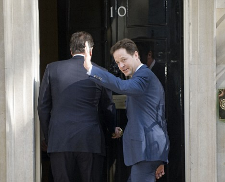 On issues of tribalism I was unhappy to receive a No2AV leaflet, with a picture similar to the one on the left. I have tried to scan the original to share with you, but my scanner isn’t good enough. Interesting that they have Cameron’s back to us. Are they hoping that Labour and other left wingers will forget that the coalition is Tory led by the simple ruse of having him turn his back on us?. (It won’t be the last time!) The leaflet is decorated with text in UKIP’s Purple and Yellow. (Did they have some ink left over from the General Election?). The text suggests that we should oppose AV because of broken promises and back room deals, and that we, the voter, should punish the dishonest. It’s merely another attempt to keep the interests of the Tory party out of the debate. How stupid do they think we are? Why should we punish only Clegg and the Lib Dems for a deal they did with the Tories! Anyway, outside London we can punish them both in the local & national elections by voting against them.
 Martin Kettle, in an article at Comment is Free, on the Guardian’s web site, called