On the autumn statement 2026

Rachel Reeves in front of No 10/1 with a red box

A quick note on the budget, remembering I wasn’t as critical of last year’s as some, at least not on macro-economic grounds. I was obviously against the failure to abolish the two child cap, but also against the failure to properly fund universities, students, and local government.

So this budget is, to me, a bit meh and I agree with Fisher, why wait for a year? Still nothing on HE or Local Government finance, and the wealth taxation is very weak and poorly focused. No capital gains tax equalisation, no financial transaction tax.

The freezing of tax free allowance amounts is probably more damaging to those on the margin of the upper rate tax band but as I read it, it’s a piece of accounting magic. There were no plans to change it for the next two tax years anyway, and they can change their minds, although some of the impact will occur after the next election.

Also the FT reports that leading business people consider it insufficiently stimulating of growth, which in their case is probably not code for, “We need to rejoin the single market and customs union.”, although there are many, including me and Liz Webster, that are saying so; our macro-economic arguments recently augmented by a report from the US non-partisan National Bureau of Economic Research and by Ryan Bourne’s recanting of his pro-Brexit position.


Image Credit: from freemalaysiatoday cc 2024 by …
On Citizens’ Assemblies

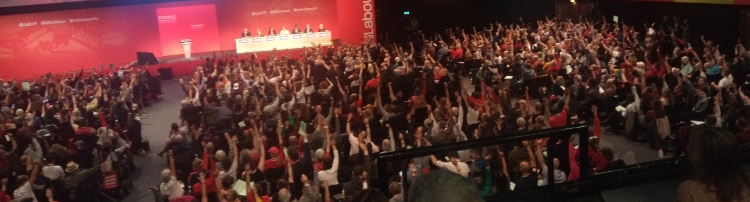
Labour Conference 2019 from the balcony

“Your Party”’s decision to make their founding conference a sortition selected meeting is causing some interest, although often from observers. The two articles to/on which I am replying and commenting are Against sortition by Michael Chessum at Prometheus and For democracy, against sortition by Will Roberts in Solidarity. In this article, I look at their arguments and their proposals for democratic engagement, and then look at how sortition selected citizen assemblies can improve decision making and democratic engagement. I feel there is a danger of losing the good in citizens’ assemblies within the polemic of democratic power.

Sortition and politics

Both articles promote classical, debate based forms of policy development, with local meetings, delegates and conferences. Within the trade union movement, an important part of the labour movement’s deliberative process, distinguishing it from Parliaments is that conferences are made-up of delegates who received mandates and so discussion occurs at both the local level on the national level. It is unfortunate that certainly within the Labour Party, too many MP’s and councillors take the Burkean view that all they owe their voters and parties is their judgement i.e. they cannot be instructed on how to vote, certainly not by local activists or even voters.

The Labour movement’s practice has grown out of the requirement of the Unions for the discipline of collective action; strikes only work if they stop work in the workplace and they need to have confidence that delegates to conference represent their members and not themselves and that all will commit to the decisions of the collective. It also has important implication for the behaviour of the losers in a strike vote.

Chessum’s article argues that much of Momentum’s democratic failure was that its Conference was abolished and the branches closed down. This was made worse by the barrier that LOTO put up to ensure that even a de-politicised Momentum did not influence LOTO, leading to the location of effective political debate becoming uniquely located amongst self-selected “senior” activists.

Will Robert’s article is more polemic, but to my mind both he and Chessum misunderstand how sortition can expose a lived experience that representatives often leave behind as they climb the ladders of representative democracy. Robert does highlight the power of leaderships in all-member ballots, citing the Momentum coup, and the 2023 UCU higher education dispute. He also values the experience of delegates which one can understand if you’ve seen the way in which Labour’s full-time staff ‘guide’ & thwart new delegates, and union bureaucracies promote the election of new delegates as a vibrancy goal.

Both authors are calling for branch and delegate structure with debate occurring and decisions made at all levels of the organisation.

I feel that much of the debate around the governance of “Your Party” and other political entities, ignores the experience of the trade union movement in resisting the Thatcherite anti-union laws, which imposed firstly individual balloting on national committees and general secretaries, then on strike ballots requiring super majorities. Individual balloting isolates people and increases the fear, it also allows the billionaire owned press to influence these ballots. The absence of debate and workplace meetings increases the isolation and fear. These rules are not neutral, they are and were designed to pacify or neutralise the unions and their membership. This is important as it has become common in progressive movements (and now the trade unions) to elect national committees by all member ballots, and to set or confirm policy using plebiscites. We also have a further example of the dissipation of radical energy by a surfeit of so-called democracy by looking at the history of Podemos, which in many ways Momentum mirrored.

For the governance and political direction of a political party, it’s crucial that political debates take place and visible democratic resolutions occur. Our two authors are concerned that decisions have the backing of the membership, because it’s movements that change society not committees, nor even parliaments. In this, I agree with them.

The decision to use Sortition on “Your Party” is almost certainly taken to ensure control by its founding leadership.

Listening harder

A huge problem in British and possibly western democratic politics is the lack of pluralism, which itself is a road to failure, and Citizens’ Assemblies are a way of introducing new ideas into a polarised debate.  In the US & UK, this is exacerbated by the winner take all nature of electoral victory and the lack of a need to continue to negotiate with your opponents.

To argue that sortition has no role in politics, is, I suggest, a mistake. Chessum, argues that there is a crisis of democracy and I would argue that sortition based citizens’ assemblies engage people who will not otherwise be engaged, as might doorstep canvassing if it was done with less cynicism.

Over the last few years, I have observed CoFoE, the EU’s ECP on virtual worlds and the Democratic Odyssey and while I can and have written essays on their weaknesses, they reach people that politics finds hard to reach and inspire them with the value of politics. They also often have different priorities to politicians. For instance, CoFoE’s citizen members having little interest in developing or even defending, the spitzenkanditaten process, or renaming the institutions and Momentum’s Council voting in favour of ‘freedom of movement’ against the wishes of its leadership.

I wouldn’t wish to argue that sortition is the best way to convene a legislature or a party’s equivalent body but I strongly believe that they help solve certain problems well. One example of its success or at least its longevity is in Ost-Belgien which has developed a standing citizens’ assembly that works with the Parliament. It only represents about 80,000 people and thus makes quota sampled citizens’ assemblies more representative and their lived experience closer to the problems they seek to solve. The Ost-Belgien government also has limited competencies. In the UK, some local authorities have experimented with citizens’ assemblies and others with neighbourhood town hall meetings to either make recommendations or even take decisions. It’s not a totally alien idea.

For more on the history and success of citizens’ assemblies, I made some notes on them at a page called “Citizens Assemblies” which captures some very heavyweight reviews including those from the OECD and the UK Parliament, together with a paper1 focusing on the UK & Ireland and performing a SWOT analysis; it also examines the resistance from the organs of representative democracy. On that page, I also link to Blokker & Gull’s paper2 on citizen’s assemblies and constitutional change.

There are known weaknesses, including the fact that members are self-selected, i.e. they need to be willing [& able] to travel and commit the time even before the statistical quota’s are applied. The selection of topics, experts and language is also a source of power and it remains very hard to isolate a citizen’s assembly from the power of lobbying either by corporations or political parties. Some of these risks can be mitigated, others remain very hard such as lobbying,

So where citizen’s assemblies are set up and given appropriate tasks, where lived experience is important and possibly the communities represented are relatively small, they enhance both democracy and the quality of decision, it shouldn’t be posed as an alternative.

People like to be listened to.


  1. POWER FROM THE PEOPLE? Citizens’ Assemblies in the United Kingdom and the Republic of Ireland by Frances Foley published by FES.
  2. Blokker, Paul and Gül, Volkan, Citizen Deliberation and Constitutional Change (February 15, 2023). M. Reuchamps and Y. Welp (Eds.), Deliberative Constitution-Making: Opportunities and Challenges, Routledge. Forthcoming, Available at SSRN: https://ssrn.com/abstract=4359555 or http://dx.doi.org/10.2139/ssrn.4359555
  3. See also Building a permanent European Citizens Assembly (ECA) together from Citizen’s Takeover Europe.

 …

Digital Justice in the EU

Image Sign in front of the CJEU's Palais de la Cour de Justice

The Commission of the European Union has issued a report proposing what they call the digitalization of justice. At the moment, this is mainly about best practise, although it seems they plan to improve digital access to the European court’s case law. A commentary has been made by the EU’s agency for fundamental rights cautiously welcoming the report but highlighting both the risks to privacy and the threat that such schemes will fail to improve justice for citizens, or worse. A further commentary can be found at the EU Observer, taking an equally cautions approach.  …

The EU Hokey Cokey

dancers in a european square

I watched the first day of the EU UK parliamentary partnership assembly. The first session was on general issues & trade and the second on defence. I made some notes which you can read overleaf. Following the agenda of the meeting, I talk of Trade and Defence in two parts. Throughout, I question the UK's half hearted commitment. Use the read more button to see the whole article. ...

Parties need pluralism

Ed Miliband at #lab14

I was writing about something else, and wrote this on party management. It’s coherent, but doesn’t belong in what I am writing, and so I thought I’d share it now,

“Your Party” is planning a Sortition based founding conference. It has probably chosen this for reasons of control but, “Your Party”’s problems occur in many parties, and I am reminded of the white paper “The (Unintended) Consequences of New Labour: Party Leadership vs Party Management in the British Labour Party…, a white paper to the PSA” by Emanuelle Averil on New Labour, which examines its managerialism and the destruction of its activist commitment and influence.

The paper was published in 2015 before the General Election. I read it in 2017 and strangely ended up sitting next to her at Conference ’19. I posted my comments in a blog, A note on Emanuelle Averil’s “the unintended consequences of New Labour” and in that article I selected some quotes. While being 20 years old, these comments seem equally relevant today, particularly about the Labour Party. I quote her on how suppressing the activist layer was mistaken and led to a failure to connect to the electorate, how factionalism suppresses plurality which made renewal impossible, how triangulation led to voter alienation and its control freakery led to a toxification of its image.

We might debate about the noughties, but it’s clearly true today. …

Immigration based on compassion and dignity

Immigration based on compassion and dignity

The Government have announced major regressive changes to the Asylum regime. These are all regressive, & vindictive. They must be opposed, and those MPs & Peers opposing these measures supported. This article looks at a couple of statements in opposition, and points at the Momentum model motion. While various press sources seem to have seen the proposals, I can't find the formal government statement. (10:57), see overleaf for more ...

About the AI Boom

an AI chip on a board

Five things

  1. There’s no positive business model, they can’t replace staff, or at least not without new supervisors.
  2. They are now borrowing to invest in each other.
  3. Hallucinations are a feature, it gets things wrong,
  4. The rule base’s ownership is obscure and Code is Law
  5. It’s [deliberately] wasteful of resources which people need to live.

It’s useless as a pillar of a growth/industrial policy. …