Innovation happens elsewhere!

Innovation happens elsewhere!

“The innovators dilemma” is a book by Clayton Christensen, first published in 1997. In it, he explores the paradox that successful companies that do everything right can still fail. The source of this failure, or that observed by the book, is new entrants to markets pushing market disrupting technologies and products, allied to a management inertia avoiding the necessary changes. This article looks at how these threats impact business strategy, its decision-making (particularly investment decisions) and political parties, specifically the Labour Party.

The innovation problem for political parties was brought to my attention in an unfinished white Paper by Emmanuelle Avril of the Université Sorbonne Nouvelle and in the text she quotes the Innovator’s Dilemma. I conclude that, Innovation happens elsewhere and is inexorable.

The complete article is available overleaf …

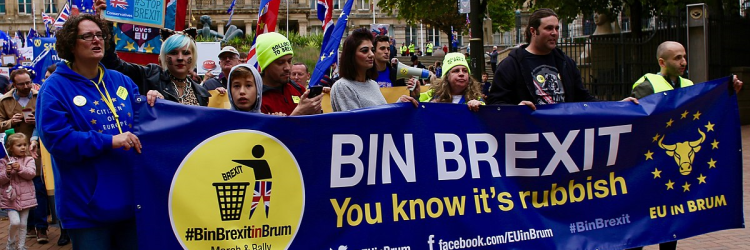
Brexit/Brejoin is on #lab23 agenda

Brexit/Brejoin is on #lab23 agenda

As a member of the AEIP National Committee, I have been campaigning to reverse Brexit. The personal politics that led me to stand for their NC is based on both an abstract commitment to what the EU could be and a detailed observation of the economic and social advantages of common citizenship, together with the economic advantages to the nation of belong to the European Union. The absence of the EU’s freedom of movement to work and the common citizenship rights do not affect the rich. Overleaf, the full article looks at the arguments to rejoin the single market, and charts the last act of Lewisham Deptford CLP in sending a motion to #lab23 calling to rejoin the single market. It also documents the speech I made.

To see the full article overleaf, use the "Read More" button. ...

More Macro

More Macro

In this article, “Britain’s tax delusion”, the ‘Statesman identifies that the UK is not overtaxed, that taxing non-doms and imposing VAT on school fees will raise trivial amounts of money and that the clawback of child benefit has a disincentive on the supply of effort. It is silent on the clawback of the personal allowance which does the same, and fails to substantiate its arguments on income and wealth equality by not quoting the gini coefficient or any altenrative statistics, or facts as I like to call them.

… creates a system that is not just dysfunctional but profoundly inequitable, in which the average effective tax rate paid by those earning more than £10m a year is lower than that of most nurses. In 1845, Benjamin Disraeli wrote of England’s division into “two nations”: the rich and the poor. Today, the gulf between Asset Britain and Austerity Britain is as wide.

Since both major parties identify growth as the answer, we need to ask how they think it’ll happen, the three sources of growth are investment (private or public), government expenditures (i.e. the deficit), or exports (and we know why they’re fucked).

The challenge for Western democracies is to provide for that spending while encouraging investment and job creation. It is a challenge that Britain is failing. Instead, the UK’s tax system is quietly managing our ­economy towards disaster.

Business taxation does not encourage investment; the UK’s investment rate is low by international comparison.

Growth strategies must only be pursued in the context of combatting climate change. So a new coal mine is not a good idea.

Modern economists argue that investment in human capital is a priority as an incubator of growth. Even those politicians who agree are silent in the face of monetarist orthodoxy which requires continued austerity. After 13 years you’d think they’d have learnt, but it seems not.

Image Credit: from asb.org.uk , cropped. Fair use as it has no economic impact on the original publisher. …

Brexit & modern supply side economics

Brexit & modern supply side economics

I have just read Jonathn Portes’ review of Peter Foster’s book “What Went Wrong With Brexit?”. Portes looks at the economic damage, the under investment in human capital and the continued timidity of our politicians. In this review, I [hope I] add to the debate by looking at long term goals and short term modern supply side programmes, most importantly in my mind, rejoining Horizon Europe.

There's a couple of things in the article which interest me. Portes in the subtitle ensures that we understand the damage that Cameron and Osborne 's austerity has done to the UK economy. A critical conclusion from this article is that the problems in the British economy are endemic, predate the Brexit vote but are made worse by the increased bureaucracy in conducting foreign trade, and the miserly modern supply side policies of this Tory government. Portes suggests that the realistic choice, because of our political leader’s timidity is between minimal change to the future trade and cooperation agreement or rejoining the single market. Portes suggests that the minimal change suggestions i.e. fixing Brexit will not be as easy to achieve as its proponents hope.

I finish my review by looking at the contradictions in Sunak's policy by continuing to exclude the UK from Horizon Europe. It is curious that Sunak permits this policy to stand, given that he is a fan of Paul Romer's work on investment & innovation. Romer argues that growth is driven by investment in Human Capital. re-joining Horizon Europe, would be a simple remediation of a number of barriers to growth.

For the full review, press the "Read More" button.

The 14th amendment and oath-breakers

The 14th amendment and oath-breakers

In the linked video, Michael Pocock, a lawyer correspondent on the Meidas Network expresses his delight at Baude and Paulsen’s white paper, “The Sweep and Force of Section 3” which argues that the 14th amendment to the Constitution prohibits Donald Trump from holding any federal office, including that of President as the clause forbids holding office by former office holders who then participate in insurrection or rebellion. Baude and Paulson are well known and respected judicial scholars and members of the Federalist Society and known supporters of the originalist doctrine of interpretation of the Constitution. The rest of this article, see overleaf, reproduces the powerful abstract and links to two further news commentaries. ...

Triangulation and abuse

Triangulation and abuse

It is clear that Labour’s leadership are executing the New Labour playbook with a touch of 20th century triangulation by pandering exclusively to communities that don’t vote for them and adding the practice of trolling those that do. On issues from foreign policy, public sector pay, fiscal policy and the EU, we can see this to be so.

In James Surowiecki’s book the Wisdom of Crowds, he examines the behavioural economics game of “Ultimatum”, which shows that you can’t take people for granted, if people don’t like the rules they won’t play the game.

In Ultimatum, players are divided into groups of two, and one is the proposer, who proposes how to split $10,000, the second player can accept or reject. If rejected, neither gets anything. Economic rationalism suggests that the second player will always accept any offer; however, reality tells a different story. The second player on the whole rejected lowball offers that they think to be unfair. Interestingly, in a second round, both players were told that the proposers had got high scores in a test, and in those circumstances the average at which proposals were rejected fell; if people thought the proposer’s deserved the privilege of proposing, then offers the accepters might once have considered unacceptable became acceptable.

In politics, as in life, you can’t take people for granted! You’d have thought that Labour had learnt this truth.  …

Science & Brexit

Science & Brexit

I wrote something more on immigration and Horizon, based on the report that the UK has had three applications for its super highly skilled visa scheme. I argue that the focus on prize winners is foolish, we need the next generation of prize winners, and that being out of Horizon Europe makes UK based innovators less attractive collaborators. I make a cheap crack about how this shows the emptiness of Sunak’s ambition to be a science super power. The article is on Linkedin and Medium, entitled, “Science, the UK and Horizon Europe, again”. It was followed up in the Independent.  …

Whose jobs are AI coming for?

Whose jobs are AI coming for?

McKinsey have produced a report on the role of generative AI on productivity and the future economy. The white paper can be found on their website. They launched the paper with a series of webinars, one of which I attended. The rest of this article describes my notes and thoughts ... I made a blog post on linkedin which I mirrored here, to see the full article, either "Read More", or click the linkedin hyperlink.