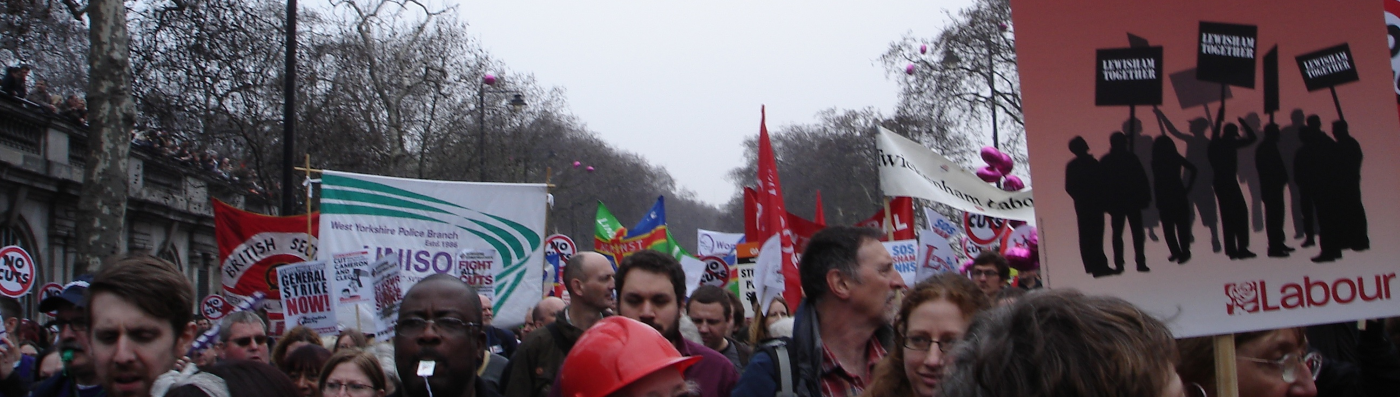
On Labour’s industrial policy

On Labour’s industrial policy

I wrote an article on Industrial Policy which was published in Chartist Magazine. In the article, I try to describe the white paper, and probably my conclusion is best summarised with this quote, which I lifted from an article in this blog,

The big unasked question is whether investment/innovation industrial policies can work. Some economists including Meadway, Graeber, Dillow and Edgerton question the effectiveness of industrial policy, especially that aimed at innovation and start-ups, not least because of the need to combat climate change. Meadway & Graeber argue that the climate crisis is or should be changing the nature of the questions of economics. Dillow argues that the multiplier effect of investment is low and that identifying the successful future is too hard. Edgerton argues that the goal of policy should be a better life, not more jobs and that investment needs to be directed at health and education, both of which can offer comparative advantage.

I also comment in my review of the Autumn statement.  …

Macro-, Welfare and Hero-voters

Macro-, Welfare and Hero-voters

Why are Labour yet again looking at the DWP budgets? The reasons are based on the wrong macro-economic theory but also on political values and electoral strategy.

There are 2½ theories on how the economy works. The first is neo-Keynesianism which understands that a national economy is unlike a household, policy focuses on expanding demand, usually by focusing on exports or investment. The second theory is quantitative monetary theory (QMT) which focuses on money supply and interest rates. Labour’s leadership have chosen the latter but the Labour government’s desire to squeeze Social Security otherwise known as welfare budgets is based on a mean puritanism and should be condemned and opposed.

The fear of inflation by both the Parties and the markets are seen as a constraint on public finances, but inflation is either demand pull or cost push. If not caused by external factors, QMT believes in increasing the interest rates to take money out of the economy and reduce demand, Keynesianism’s response is to increase taxes. Recent inflation has been caused by external shocks and as such could be ameliorated by a more interventionist energy pricing cap.

The ”Golden Fiscal Rule” of Corbyn’s leadership was designed to protect investment, not the deficit.

Progressives should be arguing that the deficit is not a constraint on government activity, not that we will fund that deficit with wealth taxes. Wealth taxes are necessary as part of “from each according to their ability” and both Income/wealth equity and the business cycle stabilisers require a guaranteed decent benefit floor. More equal societies grow better, so it is right that we implement wealth taxes and maintain benefit levels, but this is because it’s the right thing to do, not to fund the expenditure.

Another failure in the growth strategy though is that Labour are not investing in Higher Education or research nor in social/commercial structures to encourage the adoption of technology and of course, the elephant in the room for inward foreign investment and import/export is Brexity and the European Union.

On electoral strategy, in his article in the Express of all places, Andy Twelves says, “There’s a deep-rooted misconception in British politics. The belief that winning elections depends on endlessly chasing voters who are fundamentally sceptical of you.”. This would seem this is true, but in the words of Capt. Blackadder, “there’s one problem with this theory”, and it also didn’t work in 2024.  The Labour Party is continuing its so-called strategy of courting “hero voters” who are polled as not wanting to pay for those they see as feckless. Again, it is a task for progressives is to defend universal benefits, it’s the right thiong to do and a positive contribution to economic growth.


Image: from free malaysia today Licence: Attribution 4.0 International CC BY 4.0 …

Starmer’s choice

I wrote something on JD Vance’s speech to the Munich security conference. This was part of the series of policy repositioning for the trump administration. My article was published on labour hub, in it I reference Vance’s speech to the Munich Security conference, i note the oligarch’s hypocritical and fascistic agenda, the foreshadowing of the crippling of NATO, and talk of the UK’s alternatives pointing out that we seem to be re-joining the EU one agency at a time.

The plum pudding in danger via wikipedia
The return of great power politics via wikipedia

I reference reports of J D Vance’s speech to the Munich security conference, where he criticised the EU and member state governments for suppressing free speech, failing to halt illegal migration and running in fear from voters’ true beliefs. He refused to meet the German Chancellor and yet met, during an election, with the leader of the far right AfD (Alternative for Germany).

I note his arguments on free speech are partisan; US oligarchs want American rich people’s voices to be heard and amplified by privately-owned social media companies and fear Europe’s regulation of them being based on a demand for truth. We also note the hypocrisy of the US free speech advocates’ attacks on ideas, books and teachers in schools, universities and libraries in the US. His comments on not relying on foreign technology providers by which he meant China, may come to haunt him as Europe examines its defence supply chains.  

Trump’s call for European NATO to increase their defence budgets to 5% of GDP is a naked attempt to build budgets for the US arms industry, just as the UK’s requests to have a side treaty on defence and security with the EU is also at least partially based on the economic interests of BAe.

Trump’s arguments about what does his money, that is, the arms shipments to Ukraine, buy, has a moral vacancy but it is clear that the view that ‘the business of America is business’ has returned to the White House. The crudity with which Trump pursues his views of US fiscal and commercial interests is echoed by the UK Labour Government in positioning its ‘EU reset’, arguing for changes in agreements which only benefit Britian from their limited, primarily electoral, point of view. 

In the Labour Hub article I suggest, the choices facing the Starmer administration are bleak while Starmer seems to be seeking to avoid Trump’s tariff increases, on defence the choice is stark. The UK can either continue to act as a vassal state of the United States or develop more effective partnerships with the European Union. It should be noted that Vance has questioned the need for NATO joint command. Labour’s foundational commitment to NATO, is looking weaker than it once was.

Starmer’s ambition on EU cooperation is limited, I have argued that the UK should use the withdrawal agreement review clauses to re-enter the customs union and the single market. The suspicion is that for the Starmer Administration, the single market is a step too far because of its requirements for a free movement of labour and Labour’s fear of the Tories and Reform UK.

Today’s military questions and the need for ‘security of supply’ strongly imply that the UK should join the European Space Agency and possibly the European defence agency.

The proposed military and security side treaty is looking less and less attractive to both sides because in order to protect our democracy against the attacks from US social media companies and US owned AI search engines, the UK needs the umbrella of the EU’s competition & digital regulators, this needs membership of the single market. We have already rejoined Horizon (the R&D programme) and the Euro HPC joint undertaking, and Northern Ireland is still part of the single market. At what point do we say, we need our MEPs, Judges, Commissioners and Council seats back or will we just be rejoining the EU an agency at a time. …

Another Europe, Big Tech and democracy

Another Europe, Big Tech and democracy

This was a webinar called, “The big tech threats to democracy, challenging the oligarchy from Musk to meta” which was hosted by Another Europe. This article consists of the notes I took at the meeting and while I was hoping to improve my notes on the speakers contributions by reviewing the video, I am unsure if this will become available.  It also consists of the notes I used for my contribution as I was asked to speak from the floor. I made this article because I think it was the first time I argued for the need for joining the single market to participate in the EU’s democracy shield and digital market regulation regime. This article has been back dated to the day after the day of occurrence. I have tried to ensure that comments that became obvious or were impacted by events after the seminar, are presented as foot notes.For more, see below or overleaf … …

The pan-European Mediterranean convention and EU/UK relations

The pan-European Mediterranean convention and EU/UK relations

This blog article comments on the reactions to Marco Sefcovic's suggestion that the UK as part of the negotiations to improve relations between the UK and the EU should consider joining the pan European Mediterranean convention (PEM); . Sefcovic is the commissioner responsible for trade. The rest of the article looks at HMG's lukewarm response and looks to explain what the PEM is. For more, press the button ...

Munich 2025, peace in our time

Munich 2025, peace in our time

The last week has signified the death knell of NATO. The ninety minute phone call between Trump and Putin signifies the road to a 21st century Hitler Stalin pact. The Trump administration's proposals that the USA and Russia make peace in Ukraine without Ukraine being present at the table and mandating European NATO to provide peacekeeping forces are a return great power politics unrestrained by the rule of law. For more press the button ....

Accountable to whom?

Accountable to whom?

In the USA, checks and balances are written into the US constitution and are designed to ensure the power is shared and controlled by the rule of law. One weakness in the constitution and the founders’ desire to control power is the development of the executive presidency and the growth in size of the United States. In order to win a presidential election one needs to put together a very large coalition, and when one takes into account that there is only one president, and the winner takes all nature of American politics, the checks and balances seem more translucent than expected as illustrated by the behaviour of the Trump presidency. …

Win/Lose vs Win/Win & Trump

Win/Lose vs Win/Win & Trump

I was pointed at an article on Trump's negotiating style, ,and was advised, that, "Everybody I know should read this accurate and enlightening piece...". It is probably the best, most cogent and elegantly simple explanation into the inexplicably destructive negotiating processes of the President, by Prof. David Honig of Indiana University. Fore the original article, use the "Read More" button ...

An AI prosecutor?

An AI prosecutor?

I wrote a Linkedin an article called an AI prosecutor. In it I say,

The problem with modern software is much of it is inference, and completely unsuitable for “beyond reasonable doubt”. It’s also opaque and likely to fail the tests around if it returns popular vs accurate and authoritative results. It’s often wrong and arguably a bullshitter. The EU’s GDPR introduced the right to freedom from profiling, which means a freedom from being processed automatically by computers. This is an important barrier.

This is my first written declaration that that the GDPR’s “freedom from profiling” is a crucial defence of humanity against the machines.

My alarm about the consultation was probably unnecessary.  …

Regulating Social Media

Regulating Social Media

A note on the US regulation of its domestic media and internationally. I say, "Despite the US claiming the strongest free press rights in the world, rights granted in the US constitution belong to its citizens alone and are only enforceable within the United States. The US’s historic regulation of foreign media, much of which remains in place today, includes the licencing of foreign journalists and the statutory requirements the significant media organisations are owned by U.S. citizens. In fact, U.S. politics confuses the freedom of the press, with the right to platform. For more press the button ...