More on Corbyn, Starmer and Brexit

More on Corbyn, Starmer and Brexit

In my post, Is there a Starmerproject I criticised both Oliver Eagleton, its author, and Richard Seymour, its reviewer, for their takes on the role of Starmer’s Brexit positioning as part of his planned route to the leadership. I quoted Andrew Fisher on his clarification that Labour’s 2017 manifesto was to support the referendum result, only if the terms were right.

Andrew Fisher, in an article on Labour Hub, lambasts Eagleton for trying to accuse John McDonnel & Dianne Abbot of betraying a 40 year friendship and suggesting that Corbyn was too weak to get the policy he wanted. Fisher shows that Corbyn supported Labour Conference policy; it just wasn’t what Lexiters thought it was, or wanted. It’s an important contribution from someone that was there, reminding some on the Left that the CLPs, the Unions, and the majority of Labour Voters wanted to remain and wanted a second referendum. It was those who put their sterile dogma and personal careers first and voted down the meaningful votes that really killed Corbyn’s leadership. Their alternative reality doesn’t exist where a harsher Brexit line would have won the 2019 election. Corbynism was broken by then.

Fisher in his article, “I was at the heart of Corbynism. Here’s why we lost”, looks at Corbynism,  Brexit, the issue that broke it, and opportunities for progress. Fisher is clear that internal opposition and sabotage were also part of the story. He concluded that most importantly the Left needs to develop a practiced of respect for others on left; if it doesn’t it will fail. But at some time this horrendous factionalism will end as enough of Lebour’s leadership realise that “a bird needs two wings to fly”. …

Is there a Starmer Project?

Is there a Starmer Project?

Oliver Eagleton has had a book, “The Starmer Project” published by Verso. Eagleton is the assistant editor of the New Left Review and has been doing the circuits to get the book some publicity. I placed my order late last week. It has been previewed by Eagleton himself on Novara Media, and reviewed by Richard Seymour in the New Statesman (£).

Eagleton compares Starmer with Blair, and finds him wanting as, he argues, does Blair, whom he suggests is exploring a Macron like personality based centrist project. Eagleton argues that despite Blair’s essential centrism, his politics had an optimism, originality and Blair was a great orator although, on the downside, he accuses Blair of introducing a crime for each day of office and he went to war in Afghanistan and Iraq and lost 5m votes between 1997 and 2010. He argues all that’s left for Starmer is the authoritarianism and the need to expunge left social democracy as a political option for Britain. Eagleton also notes that Starmer’s cleaving to the Tory agenda is a result of Labour’s unwillingness and lack of ambition to rebuild/build a winning electoral coalition. Eagleton also did an interview with Caitlin Doherty of Jacobin which reprises these arguments and also reinforces the argument that Starmer is a bureaucrat, which is one of the reasons that Starmer’s attack lines are about managerialism and competence, and not on policy values. It’s a sad observation that the anti-corruption legal remediation comes from NGOs such as the Good Law Project.

Seymour writes a pen picture of Starmer’s route to today, his youthful leftism, his early days as a human rights lawyer, his slow route to becoming the DPP and his record in that role. Seymour summarises the position in 2015 as

By the time Starmer launched his political career in 2015 as Labour MP for Holborn and St Pancras, his radical days were behind him. He was a middle-of-the-road Atlanticist with close ties to the state. A number of “activists”, including City financier Paul Myners and Guardian journalist Polly Toynbee begged him to stand in the Labour leadership contest in 2015. He declined, backing Andy Burnham, with whom he was politically aligned, while favouring economic austerity and a tougher line on immigration. 

Seymour – New Statesman

I cannot believe the hubris of suggesting an MP with no time in the House of Commons stand for Leader; it’s on par with appointing people with no election campaigning experience to senior roles in the Labour Party’s organisation and field operations teams.

Seymour looks at Starmer’s role in Corbyn’s cabinet as the shadow spokesperson on Brexit. This is where I part company with Seymour. Labour’s slow move from a worker’s Brexit to a second referendum was driven by three things. The first, the unacceptability of the Tories terms, whether May’s or Johnson’s. Neither Labour Conference nor the 2017 manifesto agreed to “Brexit under any terms”; Fisher, its author, always reminds people, that Labour supported the results of the referendum, provided the terms were acceptable. Secondly, the majority of Labour’s members and voters wanted a second referendum and wanted to remain, much of Labour’s astonishing performance in 2017 was due to remainers having nowhere else to go with only Labour offering any hope of either better terms or remaining. This support within the Party for the EU and the obvious economic damage is what led Corbyn’s closest and longest term allies to come to the conclusion that the Tory Brexit had to be stopped. They became more public after #lab18 and Starmer’s speech. The third factor is that an influential faction within the Labour Party wanted Brexit on any terms; it proved impossible to persuade them to co-operate with the Party and its whip and their parliamentary allies were encouraged by senior members of Corbyn’s office. The reality was that there was no path to Lexit and while Seymour presents Corbyn as seeking to find one, it was never on the table and I question Corbyn’s commitment to it; LOTO were freelancing. May would not or could not compromise enough to get Labour on board and Seymour is silent on the role of Labour’s so-called Lexit MP votes in the meaningful votes (or on medium) in the Spring of 2019 which in retrospect can be seen to have sunk any chance of remaining and although not known at the time sank Corbyn’s leadership. If anything, Starmer’s ’18 speech prolonged Corbyn’s leadership; his interventions on immigration were unhelpful to the Remainer’s cause and to Corbyn.

I have no doubt that many of those inside the Labour Party campaigning for a second referendum did so in bad faith and in the hope of bringing Corbyn down, but not all and the so-called praetorian loyalists who wanted Brexit played into their hands and eventually legitimised the votes of those who voted for Johnson’s Tories for the first time because they too wanted Brexit.

Starmer in his election run for leader did not mention Brexit or the EU and neither did his 10 pledges. This was an obvious clue for those for whom Brexit was the critical issue. Throughout the Corbyn leadership, Starmer has been poor on immigration for instance insisting on toughening up the words in the ‘17 manifesto, other events are listed in Seymour’s review. He was not a serious remainer. Many Labour remainers will have voted for Starmer, but must be disappointed although the clues were there. Some of them have left.

I sort of wonder, why did he lie in his 10 pledges. Has he been captured by the progenitors of New Labour? Or as Seymour says, is triangulating with the Tories where he always wanted to go. Seymour also suggests that oddly like Johnson, the ambition to get the job, is more than the ambition to do something good. There is no doubt he has powerful friends and allies who sustain him in his uber-factional, yet politically empty project.

To get more of the story, we’ll have to wait for Michael Chessum’s book, “This Is Only the Beginning: The Making of a New Left which is not yet available; I am also hoping that Michael looks at the efforts of Labour RemaIN as Labour’s self-destruction over Brexit probably started within that campaign, or even in the seventies when Wilson allowed the Cabinet to do what they liked. This established the precedent that unlike elections, Labour members could campaign against the Party. …
Is exit from the single market dead?

Is exit from the single market dead?

This needs to reported; the UK Government, is postponing the introduction on import checks on goods arriving from the EU. The announcement was made by the Minister for Brexit Opportunities Rees-Mogg. It is reported in the Guardian with the following comment,

You read that right. Jacob Rees-Mogg, arch-leaver and longtime loather of the EU, is now parroting lines from the remain campaign. He is admitting that implementing Brexit in full, honouring the 2016 promise to take back control of Britain’s borders, would be “an act of self-harm”. There’s plenty to attack here, starting with the nerve of hailing this move as “saving” Britons £1bn, when this was £1bn that Britons would never have had to spend at all if it hadn’t been for Brexit. Or you could share the outrage of British farmers, appalled that, thanks to Brexit, they have been left at a serious competitive disadvantage: they now face onerous and costly checks when they ship their goods across the Channel, while French, Italian or Spanish farmers face no such hassle moving their products in the other direction. Or you could worry along with the British Veterinary Association, which warns that not checking food imports leaves Britain exposed to “catastrophic” animal diseases such as African swine fever – a risk that was reduced when Britain was part of “the EU’s integrated and highly responsive surveillance systems”. Or you could join the lament of the UK Major Ports Group, whose members have spent hundreds of millions of pounds building checking facilities, which now stand unused as “bespoke white elephants”.

Jonathan Frredland – TheGuardian

The BBC also report with a comment from Faisal Islam, their economics editor, although they find a quote to illustrate the benefits, or at least the avoidance of further harm. This is the fourth postponement. The critical politics is that this Government, things that the customs checks are a harm.

Luke Cooper of Another Europe, in an article on Brexit Spotlight also highlights the announcement and concludes with,

This is why the Rees-Mogg announcement shows that the game is up for the British exit from the single market. … This [the asymmetric checking system] is self-evidently unsustainable. If the most nationalistic government in recent British history is not able to fully extricate the country from the European market, then it simply isn’t possible. The question now is when – not if – Britain re-joins the single market.

Luke Cooper – Another Europe

At the beginning of the year, I thought that the critical failure of exit from the single market would be in Northern Ireland but maybe not; the new lorry park in Kent is another pressure point and a number of EU exporters were just giving up on the UK as a market. …

Sophie’s choice

I had the pleasure of meeting Rachel Reeves (MP Leeds West) last weekend; she was guest speaker at a Lewisham Labour fund raiser and I was fortunate enough to be able to ask her a question as she was leaving with her sister, Ellie (MP Lewisham West & Penge). I asked where she got her mandate to say we are not going to rejoin the EU in 50 years. She said that it came from Keir and when I said that I’d ask him the same question, she said that we have to win back the Red Wall seats and that even hers remained in jeopardy unless we had a firm position. I did say that “not in 50 years” will lose votes in London, wish I’d made it clear that the “policy” may be posing a choice between the two sisters’ seats.

There’s an interesting asymmetry in the estimated Brexit votes between the two seats, Leeds West 53% leave, Lewisham West and Penge 35% leave. …

Ukraine, war & Britain

Ukraine, war & Britain

I wrote a piece two days ago, focusing on what UK  citizens and residents of good will should do about the war in Ukraine but feel I need to clarify.

I congratulate the Ukrainian people and their armed forces for the defence they have put up. It proves to me that the UK, because that is what I know , was fooled by the hybrid war conducted by Russia who weakened the UK’s will to resist its imperial adventures and defend its own democracy. Russia funded the Brexit campaign and much of the Tory Party; Brexit is a massive weakening of the European self defence capability as we can see by the EU’s speed in responding to the Russian invasion compared with the UK’s pedestrian pace. Russia’s propaganda presented us with a view as to the invincibility and overwhelming numeric superiority of the Russian Army.  This imbued in some British people, including me, a moral cowardice. This cowardice, equivalent to appeasement in the 30’s will have been reinforced by the moral subversion of NATO due to its US led adventurism in the Middle East.

NATO is the only alliance that can act but to call it a great achievement is hubristic and sectarian overstatement. Today’s NATO is not the same organisation as it was thirty years ago. The need for NATO will be proven if Sweden and Finland seek to join but all its fans need to recognise that the US is not the reliable and generous ally it once was. Trump explicitly questioned the US commitment to Article 5 and Biden’s withdrawal from Afghanistan was not agreed by NATO.

The Ukrainian state is not pretty, it has the 3rd worst record in front of the European Court of Human Rights, and is judged by the EIU democracy index as a Hybrid State. In terms of both metrics the Russian record is worse. NATO member Turkey is the second most frequent breacher of the ECHR. But the Russian invasion is a war crime which it seems will now be investigated by the ICC. Good!

Throughout this we must not forget the brave Russians who are expressing their opposition to the war.

At home, a government that speaks for me must

  • Implement effective sanctions
  • Set up effective and generous refugee acceptance programmes
  • Purge itself of Russian funded corruption
  • Develop a defence policy that defends us against real threats not fake ones.

I would add that we should rejoin the EU but that will not happen until it ceases to be a partisan issue, however this will take much less than 50 years. …

Not for 50 years

Sir Keir Starmer at the Rivoli

Starmer gave a speech in Newcastle in which he says there is no case for rejoining the EU for 50 years.

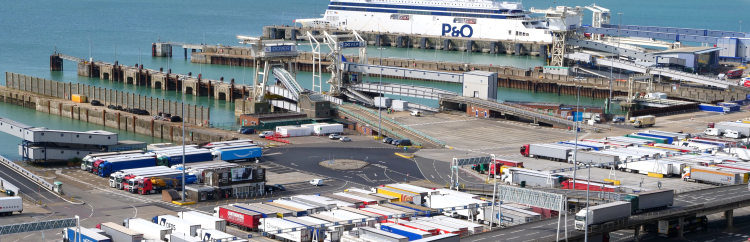
This is nonsense, if we want the UK to be more than an offshore money laundering factory, then re-joining the EU is inevitable.  It will only happen when membership becomes a non-partisan issue, or its partisan opponents are once again an irrelevance. The queues and delays at Dover, the developing maritime routes between Eire and continental Europe, and the declining trade balances as our export trade with the EU dies, all require remediation. To these problems we can add the labour shortage-based inflation as the plutocrats’ essential services, i.e. sandwich & fast food shops and restaurants can’t find staff and the people’s essential services are under funded and failing.

The short to medium term task for those who want to rejoin is to show & highlight Brexit’s failings, show how these failings are as a result of the Tories’ deal and that a better deal is possible. I outline my first five steps (my blog, Labour’s policy forum, medium). Other’s have points to add, but by offering a better future, we will win people to the position that we can do better than what we have. We need a better deal and we need to build a stable majority for a better relationship with the EU and see where it goes. Other’s have pointed me at this which is a better way of dealing with the policy issue.

Some argue that the EU’s own developments will strengthen opposition to the EU in this country but more importantly it’s possible that we will have problems meeting the EU’s requirement to have  “stable institutions guaranteeing democracy, the rule of law, human rights and respect for and protection of minorities;”; the House of Lords (and maybe Parliamentary Sovereignty & FPTP) and the “Hostile Environment” are all problems. The most rapid short-term changes in the EU today are its adoption of the Budget Conditionality Regulation, designed to sanction Hungary and Poland; this is because of their attacks on the independence of the judiciary, behaviour being repeated by our Tory government. Progressives should welcome this chance to examine and improve our democracy.

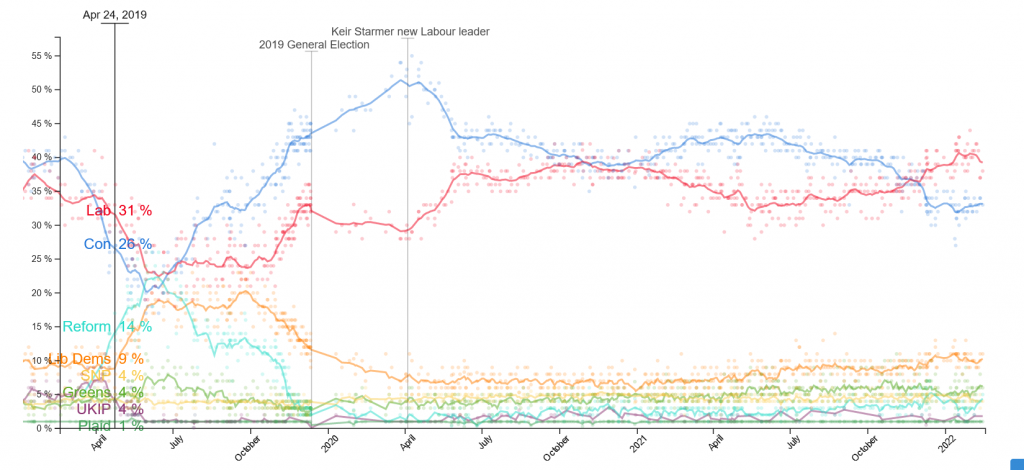
The problem with Labour under new management ‘s slogans, Fix Brexit and “Not in 50 years”, the latter a slogan used by both Starmer and Rachel Reeves is they do not allow Labour to criticise the current deal, and it looks like it’s designed not to. It also inhibits arguments for reform of the Brexit deal; this also looks to be by design. It denies Labour a role in scrutiny in Parliament or in the deal’s scrutiny structures. It’s also is trolling the membership and the majority of Labour’s voters. Their loyalty is not as strong as that of the old trade unionised workers, and New Labour lost 5m of them between 1997 and 2010. It adds to the evidence that they want to disassemble the new class coalition that voted for and is voting Labour. A quick look at politico.eu’s, poll tracker shows what happens when Labour loses the support of its remainer core vote as it did in the summer of 2019.

 That Starmer’s 10 pledges have been broken is probably priced in but interestingly he was silent on the EU and Brexit, and his Labour under new management is a policy vacuum, merely following the Tories on COVID, much of its authoritarianism and now on Brexit. Someone should explain that triangulation involves minimising the differences not eliminating them because people can tell the difference between the echo and the shout, They’ll trust the Tories to do Tory things before they trust Labour. Triangulation legitimises your opponents politics and policies. It’s not a strategy for principled people.

This comes from a mindset where focus group driven triangulation  remains cute, it is an electoral strategy based on letting down and ignoring those who vote for us. Last time we did that, we lost 5m votes and laid the ground for 2019 when the old steel and pit towns finally voted Tory. …

Steps towards a closer relationship with the EU.

I have just viewed the video, pointed at by this post on Brexit Watch.

He talks about the obvious, and the splits in Labour’s current leadership. He talks about the hardening of Labour’s views on a US vs EU trade deal, the transition from Thornbury to Symons-Thomas. He mentions the poll lead and its historic size although notes we lost in 2015, partly because the neo-liberals in the party sabotaged Miliband’s attempts to differentiate ourselves. In response to the question what do we do short of a single market, he states we need to be in it, even if we disguise the fact. Lots of facts on how trade is down the toilet and that the best levelling up policy would be to regain, non-tariff barrier free access to the single market. This would help manufacturing which remains the single largest source of R&D expense and permit a levelling up agenda, and an anti-climate change investment. He mentions that rejoining the single market would massively ease the problems of the Northern Ireland Protocol.

Luke calls for Labour, presumably after it comes to Government, to renegotiate the TCA to synchronise regulation and citizenship, and make revised settlement on security & crime. The TCA has strict level playing field clauses and so there is little benefit to the ‘sovereignty’ of Brexit; he alleges that Labour’s leadership will not accept anything called free movement, despite the fact that we have a common travel area with Eire; and so he proposes to negotiate a liberal visa scheme, revising the income qualification and removing employer sponsorship; we need an immigration policy that recognises we need young workers as well as bring some skills to come here. . I am not sure that Starmer will go that far or that fast, with Reeves and Nandy in key roles in the Cabinet, although Lammy holds the Foreign Office, it seems we are back not so much to constructive ambiguity, more an attempt to constructive silence.

These are my version of today’s demands on the Labour Leadership although I believe that we will have to rejoin the single market to solve the Northern Ireland problem, but neither Labour nor the country are quite ready for that. It’s our task to change that.  …

Small steps to a better relationship with the EU & its citizens.

Small steps to a better relationship with the EU & its citizens.

Labour’s leadership has a slogan not a policy, something about fixing Brexit but Brexit cannot work!

These five reforms are both small steps and address real issues; work, higher education, investment, voting and trade with Ireland. It allows us to talk about some of Brexit’s failures.

i think trade barriers will become more significant, and this manifesto does not address trade except within the context of the Northern Ireland Protocol although this may become more significant over the next few months pushed along by the extraordinary Lorry queues in Dover which will get worse.

I am taking this GMB Congress and have put it on Labours National Policy Forum site where it will be ignored but it would be good if you agreed you could ‘vote it up’ there .


the featured image is taken from the Guardian, https://is.gd/OKqrmV, this has been cropped and is stored to allow WordPress to address it, and for reasons for longevity.  …

Don’t start from here

Don’t start from here

Paul Mason comments on the crisis in the Ukraine and outlines Russia’s goals and some counter strategies. He argues that one of Putin’s Russia’s goals is to diminish the EU as a world class power. This will be why he is demanding that NATO withdraw troops from the ex-Warsaw pact countries and that the EU non-member states are prohibited from joining NATO. This would include Sweden , Finland together with the Baltic states and Romania & Bulgaria.

It’s a strange serendipity that the Queen Elizabeth has returned from the far east today as it symbolises everything wrong with the UK’s defence strategy (Medium | my blog) where we have an ill equipped and tiny Army. It’s unlikely that aircraft carrier could survive in the Baltic or Black Sea. It’s a weapon of prestige and can do little to help during an escalating crisis on the EU/Russian border. Our defence strategy is based on a flawed threat analysis. A post Brexit global Britain is weak and has little influence; before Brexit the UK military could only operate in alliance and now it’s just turned away from the EU and  both Trump and even Biden are undermining NATO as an effective defensive alliance for Europe.

Furthermore, the UK is a victim of Russia’s “Hybrid Warfare”. Its funding and cyber support of the Brexit Campaign and latterly the Tories not to mention Boris Johnson’s receipt of oligarch’s bunga bunga hospitality.  The closest the Govt has come to considering this threat is the delayed and unfinished Russia report from Parliament’s Intelligence Services Committee. The Tory Govt has refused to follow up.

We shouldn’t have stepped away from Europe because NATO maybe past its sell-by date; the obvious desire to avoid sanctions against Russian UK based assets leads the Govt. to unbelievable sabre rattling. It will make us look very stupid.


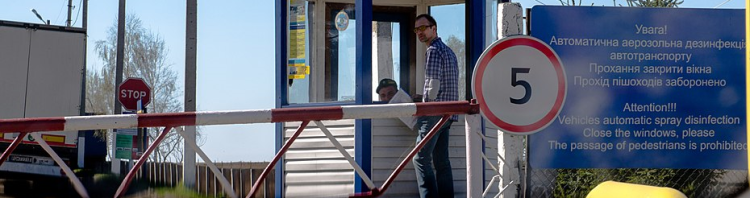
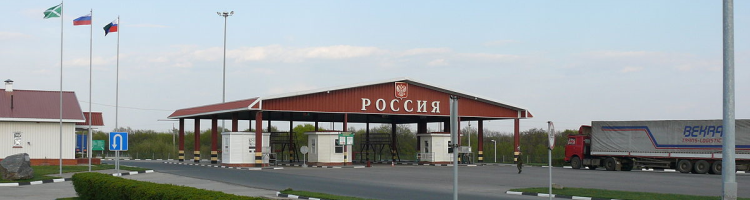
The featured images is, Nekhoteevka customs on Russia-Ukraine border. by Дар Ветер from wikimedia, CC 2020 BY-SA v3. …

A Frost free xmas

A Frost free xmas

Lord Frost, the Brexit Minister has resigned from Govt. He couldn’t square the circle of cakeism! Boris was walking away from a Northern Ireland & CJEU showdown with the EU and further compromises were/are needed; Johnson needs all his political capital to be half sensible on Covid 19. Frost took the opportunity to argue its about macroeconomics and vision, but we all know he’d made the job impossible and like his brexitloon predecessors he was costing the Govt more than he was bring to it on the one metric that counts, Popularity. He’ll lose about £31,000 in pay, but keep the right to claim about £67,000 as a member of the House of Lords as an attendance allowance.

Have I got news for you comments,

 …