A quick note on the budget, remembering I wasn’t as critical of last year’s as some, at least not on macro-economic grounds. I was obviously against the failure to abolish the two child cap, but also against the failure to properly fund universities, students, and local government.
So this budget is, to me, a bit meh and I agree with Fisher, why wait for a year? Still nothing on HE or Local Government finance, and the wealth taxation is very weak and poorly focused. No capital gains tax equalisation, no financial transaction tax.
The freezing of tax free allowance amounts is probably more damaging to those on the margin of the upper rate tax band but as I read it, it’s a piece of accounting magic. There were no plans to change it for the next two tax years anyway, and they can change their minds, although some of the impact will occur after the next election.
In its autumn statement, not exactly hidden, the government have announced their plans to extend sanctions against benefit recipients, included the mentally ill and the disabled, if they fail to look for work. The sanctions scandalously include the levying of prescription charges and prohibition on receipt of legal aid. Labour’s leadership is sadly relatively silent on these proposals. I remind myself that access to healthcare is a human right, as should be access to justice.
Here are some links I have discovered, they include the government’s boastful announcement, where they focus on the increase in expenditure from the low levels that previous statements have created. Rachel Reeves in her reply notes that the overall taxation level is as high as it’s ever been due to changes made in previous years, but her reply does not deal with the issue of sanctions; Liz Kendall’s words are deeply unassuring [and also here last month] for those who consider these sanctions to be a step too far. In the abstract it’s possible to argue that people who can work should work, but it is impossible to build the means by which this can be implemented without simulating the worst of labour conscription programmes from historic totalitarian regimes.
Not only are these rights, I remind myself that once upon a time many of these benefits were funded through National Insurance, and seen and conceived as an insurance based benefit. People or their families have paid for these benefits and even if an individual’s work record and contributions are low, they will have been paying VAT and various other taxes.
All the human rights charters including those that we are still members of require that legal support is provided where it cannot be afforded. Admittedly, this is usually when being prosecuted by the State but then human rights law primarily addresses abuse by the State against its citizens and denying benefit claimants access to legal aid so they can’t sue the government when the break the law is a policy goal of the government.
The UN Declaration of Human Rights & the EU’s Charter of Fundamental Rights express a right to healthcare. The European Convention does not although, they say, case law requires states to safeguard people’s mental and physical well-being in many different circumstances and ensure that people can access the healthcare they need, they have a say in the treatment they receive and they can get justice when mistakes are made.
The government and the Tory Party’s contempt for universal rights is one reason why the UN has issued so many adverse reports against the UK and its government. …
It is little wonder then that the Conservatives are under acute pressure to revise their trading arrangements with the EU in order to re-open access the European single market. But it seems likely that – at least for the time being – Brexit ideology will not allow any serious recognition of the economic reality. …
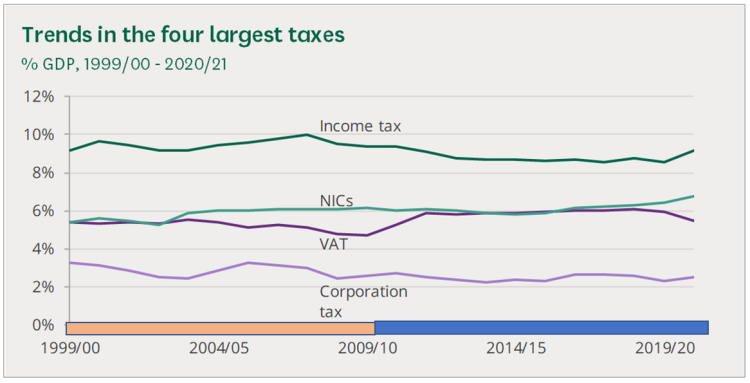
I wrote a short piece on the potential need for the EU to acquire direct taxation powers which led to me checking how much the UK government raised from income based taxes vs. VAT. The article reproduced some charts from Parliament but I was surprised to discover how low a share of government revenue it now represented. The article was written after the budget, which had not really made an impact in my consciousness; it just seemed ‘meh’ to me. It is however yet another turning of the screw in a largely successful attempt to make the working classes pay for the crisis in national income and wealth facing this country.
[He can ] deliver a spring statement – AKA a seismic budget in any other year – that offers nothing to the poorest and most vulnerable members of society while sobbing on their behalf. Who can tell the chamber with a straight face that he is committed to cutting taxes even when the Office of Budget Responsibility is saying that the tax burden is set to go up to 36.3% by 2026: the highest level since the 1940s.
Critics of UK chancellor’s spring statement say it prioritises debt reduction and fails to provide support to lower-income households
Philip Inman
This despite the sub-headline concentrates on the macro-economics, reflecting the argument that since the Govt has borrowed on variable interest rate bonds, as inflation kicks in, they argue they need more money to service the debt. The article concludes by observing that inflation may fall, that soaring energy costs are a drag on prosperity, and that the real reason for increasing tax revenues is to be able to give it back in the run-up to an election.
Despite being under pressure to minimise the effects of the cost of living crisis, driven by Brexit and energy cost inflation and help households across the country who are being forced into poverty, all the budget did was announce a cut on fuel duty, Labour are asking for a VAT cut on energy bills, although instructing Ofgem to implement a price cap would be more effective. He also raised the threshold at which people start to pay National Insurance, which is a means of alleviating the fiscal drag created by freezing the tax free allowance.
From Inman’s article, I also note that Sunak has frozen the income tax free relief for the next four years, together with the IHT limits. The effect of this is that before, people could expect the tax free allowance to rise in accordance with inflation, giving them small amounts of extra disposable income, even if they did not get a pay rise. This has now gone. It will also have the effect of raising the share of income tax paid by the low paid.
He also, in contradiction, to the Tories election promise suspended the pension link with earnings for 2022/23 although he claims to be willing to reintroduce it next year. He has also cut the amount the poorest in our society get by clawing back the uplift paid in 2019-2021.
My segue into this piece was the low proportion of government income attributed to Income Tax vs VAT. The House of Commons Library produced a report called, Tax Statistics: an overview, and my previous article reproduces some charts from it while making the point that treating NI as separate category minimises the impact of employee contributions, which are levied at 12% until one begins to pay higher rate tax and allows Income Tax to be described as more progressive than it is. NIC’s also are paid by employer’s and so clarity on corporate contribution to the exchequer is also reduced.
from the HoC Library Report : Open Parliament Licence v3.0.
VAT is 20%, for the less well paid more than they pay from Income Tax. This needs to be rebalanced.
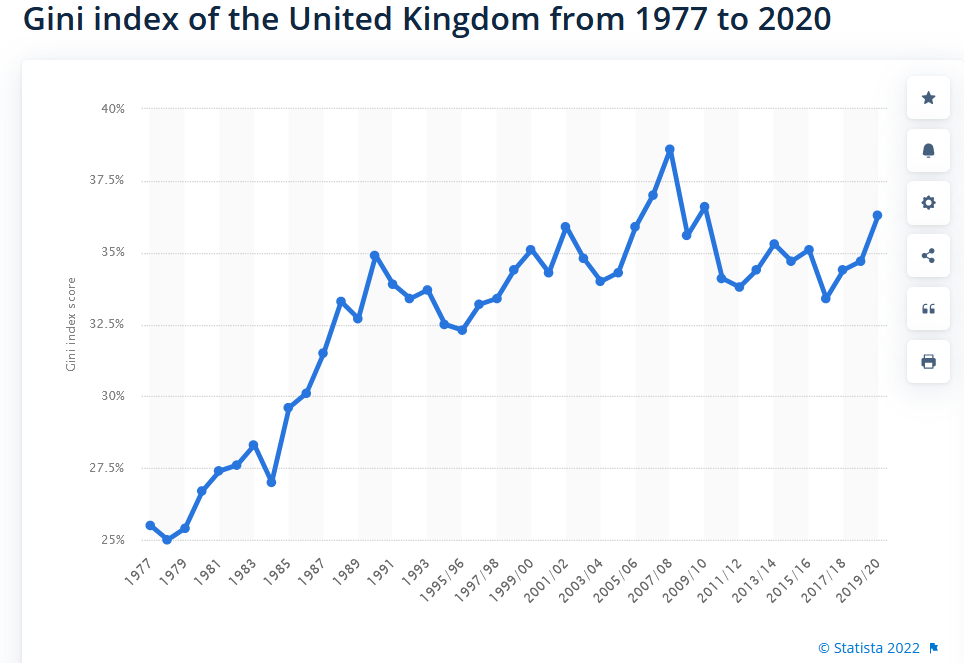
I finish with Statista’s charting of the Gini Coefficient over time., which measures the level of income inequality in our society,
Statista UK Gini Coefficient over time , used under Statista Terms of Use
We have the lowest social security net in Europe, the lowest pensions and amongst the most strongly regulated Unions. Something’s got to give. …
Simon Wren Lewis tweets on the Budget, the full thread talks of macro-economic illiteracy, the need to stimulate demand and the fact that this is a budget for austerity. He writes more on his blog, mainly macro where he talks about the need to spend more on those with less savings i.e. the poorer 20% of our society because their multiplier is higher as is their need. He also repeats the Economics 101, that fiscal policy is about growth and monetary policy about inflation. I also link to Paul Mason's comment which reinforces the need to concentrate on demand.
In this article in the Guardian, Richard Norton Taylor looks at the UK defence budget, quotes its critical parliamentary scrutiny, the NAO and defence select committee through the prism of an examination of value for money; It costs too much, the nuclear subs and aircraft carriers are of questionable value and as suggested by Conan’s “Riddle of Steel”, weapons need to be wielded by people, we don’t have enough and they are not well enough educated.
It’s almost as if the ruling class and their educational policy makers have forgotten that the greatest educational reform acts were passed in response to the challenge to the nation of then recent wars. …
Yesterday, Lewisham Council at its Budget Setting meeting, agreed a legal budget. While this involves reducing expenditure in some areas because of Tory central government grant cuts, the Labour Council kept its key manifesto promises, to freeze the Council Tax, sustain the living wage & build new houses. I made a storify from tweets and blogs from the Mayor and councillors. which tells part of the story. John Coughlin, the sole Green Councillor allowed himself the luxury of voting …
It may be that my first take on the budget significantly under estimates the impact of the changes around the use of pension savings. I was looking to make the point that you’d need to be rich, or to have been rich for this to make a difference but it’s possible they will have a wider effect than I expected. The stock market reaction and political comment certainly suggests that this is the case. …
I have just posted my comments on the 2013 budget, I have back dated the post to budget day, to try and keep the blog closer to diary form, some notes were made over the next couple of hours, but the article was finished today. …
This website uses cookies to improve your experience. We'll assume you're ok with this, but you can opt-out if you wish.AcceptRead More
Privacy & Cookies Policy
Privacy Overview
This website uses cookies to improve your experience while you navigate through the website. Out of these, the cookies that are categorized as necessary are stored on your browser as they are essential for the working of basic functionalities of the website. We also use third-party cookies that help us analyze and understand how you use this website. These cookies will be stored in your browser only with your consent. You also have the option to opt-out of these cookies. But opting out of some of these cookies may affect your browsing experience.
Necessary cookies are absolutely essential for the website to function properly. This category only includes cookies that ensures basic functionalities and security features of the website. These cookies do not store any personal information.
Any cookies that may not be particularly necessary for the website to function and is used specifically to collect user personal data via analytics, ads, other embedded contents are termed as non-necessary cookies. It is mandatory to procure user consent prior to running these cookies on your website.