At the Tory Party conference, the Chancellor, George Osborne proposes legislation that will allow employers to “buy” employment protection rights in exchange for shares. Better read and experienced economists than I are writing about how the threat of dismissal will lead to talent leaving; it's always the confident and good that go first. The Trade Unions are also quick to comment. I just want to mention four points which might otherwise be missed. ...
#lab12 conference diary
#lab12 Despite being a member of the Labour Party for 38 years, I have never been to conference before; I have just returned from Manchester, where I attended for 2½ days. It was rather fun, jolly useful and thanks to some of the people I met, inspiring.
I got there late-ish on Sunday and met up with my comrades from Lewisham Deptford CLP, including @vickyfoxcroft, @joe_dromey, @joeperryuk, @mjrharris and @Len_Duvall in a bar near the conference centre. I had been disappointed that the conference and fringe running order had not been sent to me until after I bought my train ticket. This meant I missed part one of the shenanigans and the debate on “Refounding Labour” which I had wanted to attend. After the Lewisham meetup, I moved on to the New Statesman party. I think as a subscriber, I should have had an invite, I didn’t, but anyway, I got in OK. I met up with one of their staff, and expressed my views that I didn’t want to pay to read Dan Hodges and could they stop publishing his stuff. I was advised to write to the Editor, Jason Cowley, with that view, but I can’t find his email or twitter handle! Poor show! …
Influences on my economics
There are three books which have changed my thinking about economics over the last few years. I originally questioned whether these books are revolutionary but they have added to my thinking in very basic ways. These books all look to address the economics of information, or the wealth unleashed by I.T. and the internet. My thinking about this started in the early 1990’s, Dan Remenyi at Henley Management School introduced me to the ideas that Information was the 4th Factor of Production, that Industrial Age economics was insufficient as it was unable to explain why companies that invested in negative or zero profit IT projects, as measured by ROI, outperformed those that didn’t, and that an industrial age balance sheet was incapable of evaluating an information system asset.
The three books all relate to the evolution of society and its economics, the empowering of knowledge workers and their relationships with Capital, and hence capitalists. …
Let’s take back the Internet
Rebecca Mackinnon previews the arguments for digital liberty, exploring the contention points between people and power. I suspect it needs to be informed by Kondratiev cycles, , she takes her start point as the historical achievement of political liberty but we shouldn’t be looking back 300 years.
The steel, oil, & silicon technology revolutions have spawned social democracy, enviromentalism and the digital liberty movement respectively. Each of these reactions have spawned political movements to achieve their goals. …
New-ish corporate stakeholders
Peter Drucker & Will Hutton developed and articulated theories of stakeholder constraints on corporate behaviour. Of course, as far as Marx was concerned the only moderator of corporate behaviour was the proletariat, the organised working class; but these later theorists argue that suppliers, consumers and neighbours/regulators are also now inhibiting factors on the company with in my version of the model, neighbours and their law enforcement entities should be having a final word. Law enforcement should be interpreted broadly to include the HSE, HMRC (for low wages and tax compliance), the Equal Opportunities Commission and now the Information Commissioner’s Office. Much of consumer and environmental protection is enforced by local authorities.

The development of feminism, and latterly green (consumerist) responses to companies, including now, campaigns against climate change are new factors in the neighbourly and employee stakeholder constraints upon the company.
Hutton has expressed his views more recently in Hutton 1999,The Stakeholding Society: Writings on Politics and Economics, ISBN: 978-0-745-62078-7 January 1999 Polity.
Drucker’s most famous work might be, Drucker, P.F. (1955) The Practice of Management. Heinemann, London.
Vote for me! I am standing for the ORG board.
I am standing for election to the Open Rights Group (ORG) Board. I hope to offer experience, knowledge and commitment.

I work in the information technology business and came to ORG via the Open Source and Software Freedom campaigns. I submitted personal evidence to the Government consultation on peer to peer file sharing in 2009, started following the ORG shortly after. …
Only a musician sees the future
The queue to get into Parliament last week was a bit long, so long I missed the first presentation at Pictfor’s Consumer’s and Creators in the 21st Century Copyright World, although I did take some good pictures. Saskia Wetzel was the first person on, and it’s a shame I missed it; she was the only speaker designated as a consumer representative. … …
The internet is a UK success
I was going to polish my notes from the #Pictor meeting last week, which has published its own precis of events, but the Wall Street Journal and the BBC are both carrying a story sourced from Boston Consulting that the UK’s internet industry is now over 8% of GDP, and grew at over 10% during the period of the study. This is while the UK GDP grew by 0.7% over the last year and there remain fears of a return to recession.
James Firth, at his blog, “Slightly Right of Centre”, tries to evaluate the contribution of the Internet industry vs. the “creative” industry and makes the point that the Digital Economy Act was passed to help and support a very important wealth creator in our economy. It’s a shame, well, more truthfully a point of design, that it almost certainly discriminates against an even more important one. The figure bandied about by BIS at the time the time the act was passed was that creative industries were about 7% of GDP; the internet has overtaken it.
No matter how one does the sums, maybe its time to back a winner! …
A look at the sources of Government Income
The budget was presented last week and I decided to look at where the money comes from.
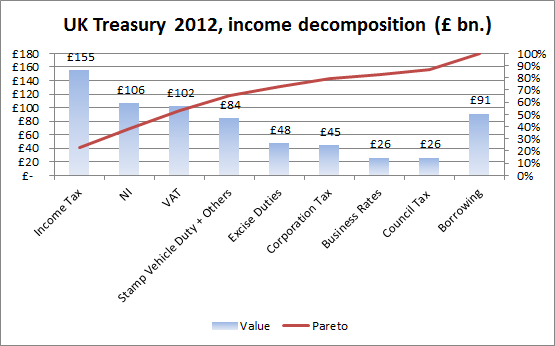
Interesting how much comes from personal taxation; NI is a payroll tax, much of it paid by business. 13% of the total income is new borrowing. I suppose I am most shocked by how little is collected through the ‘progressive’ income tax ( 23%). …
Neither the UK, nor the EU should sign ACTA
Red Sin Censura, published an Internet in Danger page the other day, which pointed me at Le Monde’s “What’s wrong with ACTA”. This has been worrying me, since much of the opposition has been based solely on secrecy, although this bleeds into democratic oversight. Since the treaty has been negotiated primarily between democracies and their politicians and public servants, to me secrecy alone is not sufficient to win broad support to opposition to the proposed treaty; there’s a lot of people that trust their politicians. …