
On the economics, about micro-, macro- and the economics of ideas.


Supporting Nominations
Over the last week, we see that a number of Labour CLPs, including mine, reported here by Jacquie Walker have been deciding not to hold meetings to make “supporting nominations” in Labour’s Leadership election. It would seem that this is a tactic to suppress support for Corbyn, to exclude the membership from talking about it with each other, particularly in constituencies where the MP is supporting Smith. In our case, our elected executive committee, a group of 13 have decided that over 2100 won’t meet, debate and collectively influence the result. This blog looks at the legalities, implications and practical consequences of the NEC rules for the Leadership election, I conclude that the bias and factional one-sidedness of the bureaucracy, in this case validated by an NEC majority is deliberate and sustained; the only way to rectify the democratic deficit in the Labour Party is to vote for and elect the Centre Left Grassroots Alliance slate.
The NEC, having decided to impose a freeze date, have also borrowed a number of other rules from the chapters on selection: the prohibition of visitors, i.e. members without a vote at all members’ meetings, the repeated advice from last year that CLPs may choose to use a General Committee[1] or an all members meeting, they have also limited the amount of debate to 30 mins (irrespective of attendance) and I believe instructed that the doors are to be ‘locked’[2] at the commencement of the meeting. (This is to stop people hiding in the toilet to confuse factional whips).
There are genuine practical difficulties in organising these meetings since even some General Committees are pretty big, the one I attend has over 60 members; it’ll be considerably larger next year when those who joined in 2015 are represented on the General Committee. The large numbers of some Parties make room booking a problem, due to both expense or notice requirements for booking. Such practical difficulties are exacerbated where all members in good standing[3] are invited to observe (& speak at) the General Committee as is the standard custom and practice at Lewisham Deptford. This is not, as far as I understand permitted for this meeting under the NEC advice.
There is of course the question of will, the fact that a number of CLPs, especially in London have been choosing not to have supporting nomination meetings shows that many local leaderships don’t want to hear what the membership have to say. I expect I’ll find out more when we finally do meet.
I felt last year that instructing London Parties they must have all members’ meetings to make nominations for the London Mayor but could choose to make nominations to the Leadership elections from GC if they chose, was an act of cowardice[4] by the NEC. We must begin to ask, if we haven’t already, just what value the PLP and their allies on the NEC place on discussion, debate and the collective voice of the ordinary membership. I think we know the answer.
It would seem to be a compelling conclusion that the bureaucracy has been using their monopoly powers of rule interpretation to delay and minimise the impact of the new joiners and the registered supporters since May 2015. From the decision in 2015 to mandate that the branch delegations should be based on membership as at 31st Dec 2014, (which had the effect of delaying new member’s entry to General & Executive committees), the banning of registered supporters from attending meetings, the attempted rigging of the current Leadership elections, the bogus administrative expulsion or suspension of socialists and activists (even when they are readmitted and despite the Chakrabarti Inquiry’s findings and recommendations) and the aggressive interpretation of the various probationary membership rules. This record of partisan activity strongly implies that the General Secretary, the Compliance Unit and its staff, backed by an NEC majority can no longer be considered neutral servants[5] of the party and its membership and have become an asset in Labour’s factional strife.
Some argue they are minimising divisiveness, but it’s debate and votes that heal, at least they do if both sides believe in Clause IV’s common endeavour,
…a democratic socialist Party. It believes that by the strength of our common endeavour we achieve more than we achieve alone,
It means you need to take advice from other party members and lose gracefully when in a minority, not rummage around in the rules cupboard looking for something that might be what you need or to misuse legacy power to stop the membership having their say.
The problem is the NEC. Frankly it has been for years, it’s their job to run the Party on behalf of the members and to control the bureaucracy, and hold the PLP accountable.
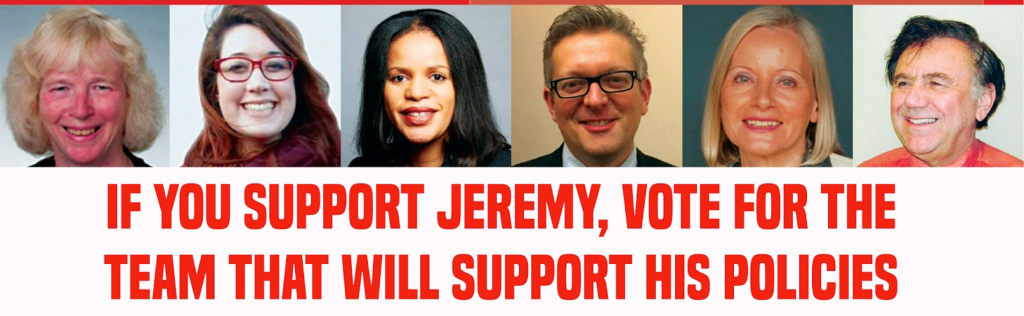
The first step in ensuring that the members’ voices are heard and become the last word is to vote for the Centre Left Grass Roots Alliance candidates for the NEC, Black, Woolfson, Webbe, Williams, Shawcroft & Willsman and those of us who are Union activists or members[6] need to examine the accountability of our representatives on the NEC.
ooOOOoo
Footnotes
[1] A General Committee is a delegate body based on one delegate/25 members plus Union delegates, with the membership snapshot date of the 31st Dec of the year previous to the AGM. For those CLPs who keep to the rule to have the AGM in the 2nd half of the year, we have GC’s based on the size the Party as at 31st Dec 2014, before the first surge in membership.
[2] Late arrivals may not participate in the meeting.
[3] Not in arrears, not under probation, not subject to freeze date exclusion or otherwise ineligible to attend.
[4] Maybe of foresight
[5] This is despite the help I was given in reversing membership rejections in 2015 by one member of the Compliance Unit.
[6] Chapter 2 Clause I 6 B states that members of the Labour Party must be members of a Union (if applicable) and must pay into the political fund of their Union, presumably if their Union has one.
See Also
- https://www.facebook.com/jacqueline.walker.3990/posts/10153885216584912
- https://davelevy.info/the-team-we-need/
- https://www.flickr.com/photos/anthonymck/15359452685