The right to strike

The right to strike

Last November, my Union branch invited Gemma Short of the Right to Strike campaign to talk about the need to change the Trade Union Laws. I have reported the speech and discussion on the branch’s web site, and shall précis it here.

The Thatcher Government’s changed the law significantly and non of the Government’s since have repealed those changes. The key changes have been the mandatory need for individual balloting for strike decisions and the prohibition of solidarity action. The full details have been documented in a House of Commons Research Paper,

Labour’s 2017 Manifesto promised to repeal the 2016 Trade Union act, which further limited picketing, introduced turnout thresholds for ballots, gave employers the right to refuse to deduct union fees from the payroll and that,

A Labour government will ensure Britain abides by the global Labour standards of the ILO conventions.

This is more radical than it sounds since most of Thatcher’s laws are in breach of the ILO standards.

We concluded that the effective right to organise is the workers defence against discrimination and exploitation and today’s Laws have a chilling effect on that right to organise and to take effective action. …

Block Votes

On my way to the pub, after the local labour party General Committee, someone described weighted voting as “block votes”. In truth that’s all it is and was; a delegate or representative has a vote in proportion to their mandate.

I think we were talking about the Local Campaign Forum, where it seems that Deptford has more members than the other two participating CLPs combined. Perhaps we should have more delegates. …

Labour’s Socialist Societies

I decided to have another go at a Socialist Societies submission to the Democracy Review

I wrote about the socialist societies and have been researching how they work and would like to add some supplementary evidence.

I believe that real and effective special interest groups will add to the Labour Party’s policy making and campaigning capability. They are also a recognition of Labour’s federal history. I believe they should be retained.

They are also subject to abuse as the stories about the Labour Party Irish society show.

I recommend that,

  1. There needs to be a minimum level of activity and democracy in a socialist society before it is allowed to affiliate to the Labour Party and its CLPs. This minimum activity to include an AGM, the election of a secretary & committee, the possession of a bank account from which affiliation payments can be made and in the case of affiliation to CLP, the branch affiliating must be greater than 10 members and should be ‘locally’ defined, i.e. the SocSoc’s regional structures are not to be permitted to affiliate to CLPs.
  2. two tier affiliations should be permitted, possibly based on size with the lower tier excluded from CLP affiliation, but permitted national & regional conference representation.
  3. That CLP affiliations should be only made by local branches and that the allocation of delegates be based upon one per 25 members resident in the CLP. (Possibly plus the secretary, if a member of the CLP.)
  4. That those socialist societies, mirroring Labour’s ‘forum’ structures be disaffiliated.
  5. Phantom affiliations, i.e. those without delegates should not be permitted.

  …

Brexit’s Red Lines

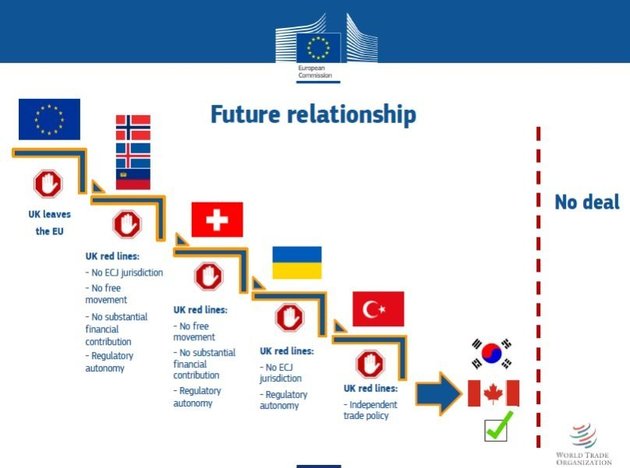
Last month, was it really under 30 days ago, Michael Barnier produced a slide, showing the impact of the British Government’s self-imposed Red lines on the likely end-state of the UK’s relationship with the EU.

It shows that the only option is a bespoke trade deal on the lines of the Canadian/EU one, which famously took 7 years to negotiate.  It also shows that the only other option is a No Deal Brexit. …

Investigatory Powers revisited

Investigatory Powers revisited

In December, the CJEU stated that the British and Swedish investigatory powers laws were in contravention to the EU’s Charter of Fundamental Rights. This was in the case of the UK partly based on the litigation started by Tom Watson MP, initially with David Davies MP. This was reported in the Register, here, and the Guardian here.  The Open Rights Group have asked for people to engage in the Home Office consultation; they propose to put a judicial warrant requirement on investigation requests for suspect internet data. This blog discusses my contribution. If you want to follow me, you’ll have to be quick the consultation closes tomorrow. …

On Plebiscites

On Plebiscites

I have been looking to see what there is to be said about Referendums and their role in democracies. Much has been said that Referendums or more accurately Plebiscites are the tools of dictators, but I have yet to see a compelling argument as to why! As I explored the issues, it became clear to me that I was pretty ignorant about the development of political theory and its application to the politics of government. I would be happy for any guidance from people more expert to me. …

Oops

Jeremy Cliffe, Berlin Desk Chief of “The Economist” reports on the state of “negotiations” between the UK and the EU27, the remainder of the EU. It’s not pretty.

 …

Racism in culture & politics

Racism in culture & politics

Two stories, one personal and one public showing the endemic racism in the UK in Thatcher’s ’80s and wondering how much things have changed. Originally posted as a storify, rescued and back dated to the original date.

The personal story related to watching an episode of Minder, “Poetic Justice, Innit!” and the endemic, unnecessary casual racism within it. This was cross referenced with yet another shock story of racists in the Tory cabinet.

The Minder episode was published a year after the Brixton riots, and the video copy on youtube, pointed to in the story is no longer available there. The story was made in 2017, posted here in 2020 and backdated to the date of its first publication.  …

A coach and horses through privacy rights

A coach and horses through privacy rights

I have just been approached by a Trade Union member who wanted to know how to complain about his employer’s record keeping. The short answer is to complain to the Information Commissioner’s Office. It reminded me that the ORG are campaigning to change the current Data Protection Bill to allow non-profits to represent complainants; this reminds me that Trade Unions might also want to benefit from this legislative protection, but I was horrified by the Government’s proposed exemption of immigration data from the remit of the Data Protection law and thus the GDPR.  …