What the CoFoE thinks about citizen privacy

What the CoFoE thinks about citizen privacy

The Conference on the Future of Europe, Democracy and Rule of Law panel has generated 39 recommendations to improve the EU’s Democracy and compliance with the Rule of Law. Three of these related to Privacy and one to Cybersecurity. I have drafted a response for CTOE, which I hope will become part of their response but did not form part of their first response, which is fortunate since I changed my mind slightly. The article, overleaf, covers regulations and sanctions, equality of arms, and enforcement and political will. ...

Steps towards a closer relationship with the EU.

I have just viewed the video, pointed at by this post on Brexit Watch.

He talks about the obvious, and the splits in Labour’s current leadership. He talks about the hardening of Labour’s views on a US vs EU trade deal, the transition from Thornbury to Symons-Thomas. He mentions the poll lead and its historic size although notes we lost in 2015, partly because the neo-liberals in the party sabotaged Miliband’s attempts to differentiate ourselves. In response to the question what do we do short of a single market, he states we need to be in it, even if we disguise the fact. Lots of facts on how trade is down the toilet and that the best levelling up policy would be to regain, non-tariff barrier free access to the single market. This would help manufacturing which remains the single largest source of R&D expense and permit a levelling up agenda, and an anti-climate change investment. He mentions that rejoining the single market would massively ease the problems of the Northern Ireland Protocol.

Luke calls for Labour, presumably after it comes to Government, to renegotiate the TCA to synchronise regulation and citizenship, and make revised settlement on security & crime. The TCA has strict level playing field clauses and so there is little benefit to the ‘sovereignty’ of Brexit; he alleges that Labour’s leadership will not accept anything called free movement, despite the fact that we have a common travel area with Eire; and so he proposes to negotiate a liberal visa scheme, revising the income qualification and removing employer sponsorship; we need an immigration policy that recognises we need young workers as well as bring some skills to come here. . I am not sure that Starmer will go that far or that fast, with Reeves and Nandy in key roles in the Cabinet, although Lammy holds the Foreign Office, it seems we are back not so much to constructive ambiguity, more an attempt to constructive silence.

These are my version of today’s demands on the Labour Leadership although I believe that we will have to rejoin the single market to solve the Northern Ireland problem, but neither Labour nor the country are quite ready for that. It’s our task to change that.  …

Small steps to a better relationship with the EU & its citizens.

Small steps to a better relationship with the EU & its citizens.

Labour’s leadership has a slogan not a policy, something about fixing Brexit but Brexit cannot work!

These five reforms are both small steps and address real issues; work, higher education, investment, voting and trade with Ireland. It allows us to talk about some of Brexit’s failures.

i think trade barriers will become more significant, and this manifesto does not address trade except within the context of the Northern Ireland Protocol although this may become more significant over the next few months pushed along by the extraordinary Lorry queues in Dover which will get worse.

I am taking this GMB Congress and have put it on Labours National Policy Forum site where it will be ignored but it would be good if you agreed you could ‘vote it up’ there .


the featured image is taken from the Guardian, https://is.gd/OKqrmV, this has been cropped and is stored to allow WordPress to address it, and for reasons for longevity.  …

A short history of the British constitution

housesofparliament

How have the British ‘improved’ their constitution over the last 100 years. I have a look but conclude with how the Government is riding roughshod over what puny safeguards exist. I look at parliamentary sovereignty, suffrage, the parliament acts, the impact of the EU on the constitution, human rights act, the House of Lords and supreme court, and finally the Prime Minister. I conclude with a sad cry to do better.

Impunity and contempt in Government.

Impunity and contempt in Government.

Is it worse under Johnson? The short answer would seem to be “Yes”. None of the controls on Governments are law, they are all based on conventions and Parliamentary Sovereignty means that they are not permanent. (The recent habit of previously prohibited retrospective legislation and emergency parliamentary/legislative schedules also strengthens a Govt. and thus a Prime Minister’s hand.) But, it’s the shamelessness of Johnson and his Government which is the danger to democracy.

Respect for Parliament and politicians had been damaged by the expenses’ crisis but the Brexit referendum and its aftermath further damaged Parliament’s political legitimacy often at the hands of MPs who showed extreme cowardice in the face of the tumbrils pulled by UKIP’s donkeys.

The British people were fortunate that the decision to order the longest prorogue in modern times was able to be overturned by the courts even though the government argued that they didn’t have the power. Parliament also ripped up a further control when the SNP1 voted in 2019, to agree an election for reasons of sectarian advantage and fatally undermined the fixed term parliament act.

Since the election, there have been number of breaches of the ministerial code, involving money, influence or vote buying. This article from Yorkshire Bylines, dated March 20, details breaches by 11 cabinet members. There have also been an egregious corruption of the procurement process where they are now being pursued by the good law project, with the crowning glory the pursuit of the £37bn spent on a track and trace system that has never worked. The ‘levelling up’ initiative, once called Regional Policy is also the subject of both controversy and legal review being characterised as pork barrel politics.

 The current troubles aka partygate were started by Johnson and the Tory Whips’ attempts to rewrite what limited controls remained to save Owen Paterson, once the MP for Shropshire North from sanction for lobbying. The list of breaches is so long that Transparency International are calling for the Ministerial Code to be made law. This government has also has a series of breaches by most publicly Cummings and Hancock, of covid safety regulations culminating in today’s heavily redacted Grey Report, cataloguing 20 inappropriate events while the public could not visit relatives in care.

This impunity is reflected in policy making by Priti Patel as Home Secretary, not only did May kick her out for off-piste foreign policy and breaches of the ministerial code, she was taken to tribunals for bullying and the Home Office is being sued by its own watchdog for breaching the withdrawal agreement as it applied to EU citizens in the UK. This impunity was also shown in the trade negotiations led by Lord Frost with the threats to break the agreement in contradiction to international law and the threats to void the Northern Ireland Protocol.

There is a culture of impunity running through this government, underpinned by Parliamentary Sovereignty, a fake definition of national sovereignty and a party majority in the Commons reinforced by what would seem an unwillingness of the police or other regulators to investigate crimes committed by govt. ministers.

We have no basic law nor it would seem today a police force willing to pursue wrong doing in Whitehall.

ooOOOoo

This was originally written as part of a longer article, but I have decided it doesn’t fit in that article and so here we are.


[1] The SNP gave Johnson a 50% majority in the House, and were quickly followed by the LibDems and then Labour split with many of them voting for the election. There is an alternative view that the FTPA transferred the power to call an election from the PM to parliament and parliament just decided not to go through the vote of confidence, the requirement for a supermajority and a waiting period. …
A note on Emanuelle Averil’s “The (Unintended) Consequences of New Labour …”

A note on Emanuelle Averil’s “The (Unintended) Consequences of New Labour …”

I have been influenced by the white paper “The (Unintended) Consequences of New Labour: Party Leadership vs Party Management in the British Labour Party..., a white paper to the PSA” by Emanuelle Averil on New Labour, its managerialism and the destruction of its activist commitment and influence. It was published in 2015 before the General Election. I read it in 2017 and strangely ended up sitting next to her at Conference ’19. What she said in 2015 is increasingly relevant in 2021 as Starmer tries to reimpose the controls established by New Labour. Use the "Read More ..." button for a series of quotes from the paper, which I originally posted on diigo and remember that New Labour lost the 2010 election partly because it was unable to renew itself. ...

Again I want your support.

Again I want your support.

AEIP is running its election for its national committee. I am standing again, I hope to continue the work I have been doing in ensuring that the truth about Brexit is known. This is what I said on their candidate statement pamphlet. What i said last year is still relevant. Please vote for me if a member, the ballot links are in your mailbox.

I got on ... thank you

My short statement is overleaf ...

A note on Data Protection Officers

A note on Data Protection Officers

Data Protection Officers roles were revised by GDPR and the member state implementations. Here is a reminder for those that need it.

Article 37 states that a processor or controller requires a DPO if it is a public authority, if it requires regular sys systematic monitoring of data subjects on a large scale or if it processes special data.

A DPO may work for multiple companies, but Article 38 requires the DPO to be adequately resourced and supported.

The DPO must be appointed on the basis of professional qualities and, in particular, expert knowledge of data protection law and practices and the ability to fulfil the tasks specified in the GDPR Article 39.

Article 38 states that the DPO must be involved in in all issues which relate to the protection of personal data, be properly resourced to perform their duties and to maintain their professional expertise, not receive instructions on the conduct of their duties, not be dismissed for doing their job, and report to the highest levels of management.

The tasks of the role are defined in Article 39, the job is to advise the highest levels of management on their obligations, to monitor compliance including the assignment of responsibilities,  training and operations’ audits, to assist and monitor the data privacy impact assessments, to cooperate and act as a contact point for the supervisory body, in the UK, the ICO.

I have used the EU text as the source of my summary and is reproduced overleaf/below ...

This post was originally posted at linkedin.

Don’t start from here

Don’t start from here

Paul Mason comments on the crisis in the Ukraine and outlines Russia’s goals and some counter strategies. He argues that one of Putin’s Russia’s goals is to diminish the EU as a world class power. This will be why he is demanding that NATO withdraw troops from the ex-Warsaw pact countries and that the EU non-member states are prohibited from joining NATO. This would include Sweden , Finland together with the Baltic states and Romania & Bulgaria.

It’s a strange serendipity that the Queen Elizabeth has returned from the far east today as it symbolises everything wrong with the UK’s defence strategy (Medium | my blog) where we have an ill equipped and tiny Army. It’s unlikely that aircraft carrier could survive in the Baltic or Black Sea. It’s a weapon of prestige and can do little to help during an escalating crisis on the EU/Russian border. Our defence strategy is based on a flawed threat analysis. A post Brexit global Britain is weak and has little influence; before Brexit the UK military could only operate in alliance and now it’s just turned away from the EU and  both Trump and even Biden are undermining NATO as an effective defensive alliance for Europe.

Furthermore, the UK is a victim of Russia’s “Hybrid Warfare”. Its funding and cyber support of the Brexit Campaign and latterly the Tories not to mention Boris Johnson’s receipt of oligarch’s bunga bunga hospitality.  The closest the Govt has come to considering this threat is the delayed and unfinished Russia report from Parliament’s Intelligence Services Committee. The Tory Govt has refused to follow up.

We shouldn’t have stepped away from Europe because NATO maybe past its sell-by date; the obvious desire to avoid sanctions against Russian UK based assets leads the Govt. to unbelievable sabre rattling. It will make us look very stupid.


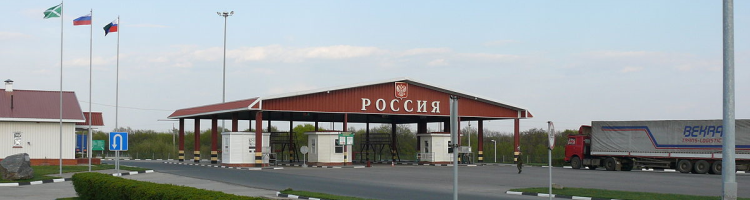
The featured images is, Nekhoteevka customs on Russia-Ukraine border. by Дар Ветер from wikimedia, CC 2020 BY-SA v3. …